Showing posts with label David Lynch. Show all posts

Saturday, January 18, 2025

A Film Babble Blog Retrospective: David Lynch In Three Films

The passing of one of my all-time favorite filmmakers, David Lynch (January 20, 1946-January 15, 2025), made me go back to the reviews I’ve written of his work over the years for Film Babble. In the almost 21 years that I’ve had this blog, I posted about three of the ten theatrical releases he made from 1977-2006: ERASERHEAD, MULHOLLAND DRIVE, and INLAND EMPIRE. These were interesting for me to revisit, as I had forgotten some details like I wrote that I had a “love/WTF? relationship with the films of Lynch,” and that one of my first dates with my ex-wife was a midnight show of ERASERHEAD, so I thought I’d gather the reviews for this tribute post.


My first review is from that midnight movie screening that was at the Colony Theater (sadly closed in 2015) in Raleigh, North Carolina as part of their Cool Classics series in the summer of 2008. 


I was mounting a series that didn’t go on very long called “Hey, I finally saw…” where I blogged about seeing a classic film for the first time, and before that night, I’d never seen Lynch’s mesmerizing debut ERASERHEAD in full (I think I saw parts of it in the ‘80s on cable, but I’m not sure). Here’s how it went down (click on the title to read the post):


Hey, I Finally Saw ERASERHEAD (August 8, 2008)


Later that year, the North Carolina Museum of Art presented a screening of Lynch’s ninth film, 2001’s MULHOLLAND DRIVE, which my then girlfriend, and I attended. I had seen the movie before, but only when it was released on DVD in 2002, so it was great to see it on the big screen in the museum’s auditorium. 


The film was introduced by a great local film critic, INDY Week writer/editor David Fellerath, who I quote the in the piece, which amuses me because like with ERASERHEAD, I was trying to figure it out. I also am amused by something I had forgotten, the confused reaction of one of the attendees at the end of the movie. I believe it’s worth the read:

Seven Years Later, Does MULHOLLAND DRIVE Make Any More Sense? (October 28, 2008)

Lastly, I go back further in time (just a  year earlier) to my first review of a Lynch film, his last feature-length production, INLAND EMPIRE, which came out in late 2006. 


I viewed, and reviewed the DVD when it was released in 2007, and I enjoyed re-reading, and re-living my thoughts on the bizarre film (I know, they’re all bizarre). I had forgotten the line “One can not casually watch INLAND EMPIRE - that would be like casually visiting somebody in prison.” Read the rest:

INLAND EMPIRE Burlesque (September 4, 2007)


So that’s what I had to say in the past (the 2000s) about three of Lynch’s films. I’m definitely going to revisit his work in the weeks to come, and may post some new re-evaluations here. As for the rest of the master’s movies, I saw THE ELEPHANT MAN and DUNE on cable, but was too young to appreciate them as Lynch works. It was BLUE VELVET (1986) on VHS in the late ‘80s that blew me away, and made me a fan. The others that followed, I saw mostly on home video, but did see a Cool Classics showing of WILD AT HEART at the Colony in 2012.

The Carolina Theatre in Durham, NC, is hosting a free screening of BLUE VELVET as part of their Retro Film Series next Tuesday, January 21, at 7pm, which I might attend, and I’m sure there’ll be a number of other showings of Lynch films in the area in the months, and years to come.


In the mean-time, I posted this handy guide on Facebook, and  it’s worth re-posting:


R.I.P. David Lynch


More later…

Thursday, November 28, 2024

The Beatles Invade America All Over Again In New Disney+ Doc

BEATLES ’64 (Dir. David Tedeschi, 2024)

There was a sketch on the IFC show Portlandia in which comedian Fred Armisen decides he wants to make a documentary about the Beatles. Despite his friend/comedy partner Carrie Brownstein skeptically replying “seems like there are so many,” Fred isn’t dissuaded, and declares that he will bring a new spin to the oft told tale, saying it’ll be about “Four mop-topped lads from Liverpool who changed the world…forever!” 


The rest of the sketch has Fred telling anyone who’ll listen what he’ll have in his film - the Beatles arrival at JFK, their Ed Sullivan Show appearance, their psychedelic experimentation, etc. – obviously all the expected historical highlights of the band’s career that have been done to death. The joke that Armisen had no new angle, spin, or take on the Fab Four for yet another doc came to my mind when I first heard about BEATLES ’64, which premieres on Disney+ this Friday, November 29.


Now, this Portlandia bit was from ten years ago, and there have been lots of Beatles docs since then - even one funnily enough about the band’s 1965 visit to Portland – but I had to wonder what new could be brought to the table about a period that was pretty well covered by Albert and David Maysles’ THE BEATLES: THE FIRST U.S. VISIT or THE BEATLES ANTHOLOGY or HOW THE BEATLES CHANGED THE WORLD or…well, you get the idea.


So the big selling point of David Tedeschi’s BEATLES ’64 (produced by Martin Scorsese) is that it features 17 minutes of never-before-seen footage that comes from the 11 hours of film the Maysles brothers shot for a program entitled What’s Happening! The Beatles in the U.S.A., which was aired on CBS in late 1964 as a special episode of the TV show, The Entertainers.


That show was later re-edited for the 1991 home video release, THE FIRST U.S. VISIT. Now, it’s been a long time since I’ve seen that on VHS in the ‘90s, so I can’t say how much overlap there is here, but as a big fan of John, Paul, George, and Ringo, I am delighted to report that this third take on the material delivers a fresh, insightful exploration of that crazy time when the Beatlemania epidemic swept the country.


BEATLES '64 gives viewers quality time with their prized Pepsi vending machine replica transistor radio.


Tedeschi deftly packages the narrative of the Beatles arrival in America, and the days leading to their legendary appearance on The Ed Sullivan Show, with present day commentary from Paul McCartney, and Ringo Starr, who we see showing his collection of clothes and gear to Scorsese (so makes me want a mini-series of Marty and Ringo just hanging out). 


There are also fascinating and funny interviews with Ronnie Spector, Smokey Robinson, and most touching, David Lynch, who saw the Beatles in Washington D.C. a few days after their stateside debut on Sullivan. There’s also a sideline story that producer Jack Douglas tells about travelling to Liverpool to tap into that Merseybeat magic, but not being able to perform without a visa and work permits might perplex at first, but pays off amusingly.


Another selling point is that the black and white footage pops with sharp crispness, which isn’t surprising as it was restored in 4K by Beatlemaniac Peter Jackson. And, of course, the music all sounds terrific, not just the Beatles, but of their contemporaries like Robinson, the Supremes, and Little Richard. 


In moments that play like a real-life A HARD DAY’S NIGHT, we see the guys clowning around in their Plaza Hotel room with highlights being when a cheeky McCartney tells the cameraman to “defy convention!” and shoot them from a lower angle so the mike can be seen, which he does to clapping from the group and entourage, and when Lennon calls a reporter a “wanker.” Meanwhile, the hubbub happening outside the Beatles’ bubble plays like a real-life I WANT TO HOLD YOUR HAND (Robert Zemeckis’ 1978 comedy about fans trying to get close to the band at the hotel) with groupies praising their beloved in street interviews, and being caught in the hallways by cops and hotel security.


All of this comes together now as a highly worthwhile watch even if you feel like you’ve seen and heard it all before. It’s especially recommended if the Beatles are new to you, and you don’t know how it went down, but I doubt many of those people would’ve read this far. Three years ago this week, Jackson’s monumental, and wonderful three part/eight hour GET BACK project was released, so if BEATLES ’64 is supposed to continue the trend for future Thanksgiving weekends, I’ll say what Paul’s father suggested should be the repeated refrain in “She Loves You,” - “yes, yes, yes.”


More later...

Monday, May 31, 2010

R.I.P. Dennis Hopper (1936-2010)


"Somewhere in my strange career, someone has liked something." - Dennis Hopper 


Sadly, iconic actor/director Dennis Hopper lost his battle with prostate cancer Saturday morning. Every obituary will understandably point to his breakthrough milestone EASY RIDER (1969), but I'm sure most people who would read this blog know he had a ginormous crazy career spanning almost 6 decades. 


 Impressively IMDb lists over 200 film and television appearances in nearly every genre. In 1986 alone he appeared in HOOSIERS, BLUE VELVET, RIVER'S EDGE, and THE TEXAS CHAINSAW MASSACRE 2, and from the looks of it that was a typical year for the man as he worked constantly until his illness got the best of him - 6 movies in 2008, 26 episodes of Crash 2008-09, and a couple of upcoming projects (THE LAST FILM FESTIVAL, ALPHA AND OMEGA) set for later this year. A career so vast is difficult to cherry pick from, especially since he had so many bit parts in major movies - his roles in friend James Dean's movies REBEL WITHOUT A CAUSE (1955) and GIANT (1956) for example - and also because a few films he directed are unavailable on DVD these days - THE LAST MOVIE (1971) and OUT OF THE BLUE (1980). That said these are my picks for:


10 Essential (And Available) Dennis Hopper Performances


1. EASY RIDER (Dir. Dennis Hopper, 1969)


When I said every obit would highlight this as Hopper's most acclaimed achievement I wasn't saying I wouldn't also. It's inescapable as a classic counterculture event of a movie that helped kick off the "New Hollywood" movement of the late '60s/early '70s. It also solidified the long-haired mustached hippie wiseacre persona that Hopper would return to a number of times throughout his acting career. 


 Concerning a couple of drug dealers (Hopper and Peter Fonda) who make a huge score and set out on their motorcycles to go, in the words of the film's tagline, "looking for America", EASY RIDER is very dated with clumsy artistic cuts, redneck stereotypes, and a cringe-inducing psychedelic trip sequence, but Hopper's glee while riding through Monument Valley out over the sunset on his chopper is infectious. In those moments, which were innovative in their use of rock song scoring, the film's theme of freedom lets its freak flag fly the highest. 


2. BLUE VELVET (Dir. David Lynch, 1986)


Frank Booth, a Nitrous Oxide inhaling sexual deviant, was considered a comeback role for Hopper who had gone through more than one wilderness period in the years since EASY RIDER and the failure of its follow-up THE LAST MOVIE. Booth was scary and a bit funny at the same time; the manner in which he menaces nice boy Kyle MacLachlan being a twisted yet beautiful example: "Heineken? Fuck that shit! Pabst Blue Ribbon!" The part won Hopper a few Critics' Association awards and in 2008 was voted #54 in Premiere Magazine's list of "The 100 Greatest Movie Characters of All Time."


3. APOCALYPSE NOW (Dir. Francis Ford Coppola, 1979) Credited as "Photojournalist" and only given a small amount of screen-time in the final reel, Hopper is one of the most memorable elements of Coppola's seminal sprawling Vietnam epic. His cryptic speeches like this one still resonate 30 years later: "This is dialectics. It's very simple dialectics. One through nine, no maybes, no supposes, no fractions. You can't travel in space, you can't go out in space without, like, you know, with fractions - what are you gonna land on, one quarter, three eighths - what are you gonna do when you go from here to Venus or something? That's dialectic physics, okay? Dialectic logic is there's only love or hate, you either love somebody or you hate them." Marlon Brando as Colonel Kurtz then angrily hurls a book at Hopper in a moment that doesn't feel scripted.


4. HOOSIERS (Dir. David Anspaugh, 1986) As I mentioned earlier, 1986 was a banner year for Hopper. His roles in BLUE VELVET, RIVER'S EDGE, and this Oscar nominated turn as the basketball supporting town drunk had him unstoppably on the comeback trail. It's a folksy formulaic sports film about underdogs triumphing against all odds, but Hopper's gutsy edge is no small part of the film's abundant charms.

Saturday, October 10, 2009

Without A Hitch - 10 Definitive Directors' Cameos In Their Own Movies


As film geeks throughout the blogosphere well know, an appearance by a director in their own film is a tradition established by Alfred Hitchcock. Hitch (or “Cock” as Teri Garr once claimed she called him to Francois Truffaut) had brief but notable appearances in 37 of his 52 films. 

Obviously excluding those who act in sizable roles in their own films (Woody Allen, Sylvester Stallone, Orson Welles, etc.) these are my favorites of the film maker folks that followed in Hitch's footsteps:

1. Martin Scorsese in TAXI DRIVER (1976)


Scorsese has had brief bit cameos in a lot of his movies but it's this appearance credited as "Passenger watching silhouette" that makes the biggest impression. 

As a nervous gun totting cuckolded husband, Scorsese tells his cabbie Travis Bickle (Robert De Niro) to pull over and stay parked with the meter running outside the building where his wife is with another man. He talks about his revenge fantasy involving his 44 Magnum in the only scene in the movie in which we are creeped out by somebody other than the title character. 

What puts this at the top of the list is that Scorsese actually shows some acting chops and a persuasive presence. His later performances in other's movies, particularly Akira Kurosawa's DREAMS and Robert Redford's QUIZ SHOW, confirm TAXI DRIVER's hinted at prowess. Incidentally Scorsese can also be seen in a daylight street scene shot earlier in the film.

2. John Huston in THE TREASURE OF SIERRE MADRE (1948) Another American master who appeared in many movies, his own and others', Huston stole a short but sweet scene from star Humphrey Bogart in this undeniable classic. Bogart's down on his luck character Fred C. Dobbs makes the mistake of trying to bum money 3 times from Huston as an "American in Tampico in white suit."

Huston reluctantly complies but warns: "But from now on, you have to make your way through life without my assistance."

Luckily this was nothing but a movie line - Bogart and Huston assisted each other on a couple more classics afterwards (KEY LARGO and THE AFRICAN QUEEN).

3. Roman Polanski in CHINATOWN (1974) Perhaps it's been all the op ed pieces on Polanski lately (Sometimes that have the same screen capture I have here) that helped to inspire this list but whatever the case this is a colossally classic cameo. In less than a minute of screen time, as a thug that Jack Nicholson's Jake Gittes dismisses as a "midget", Polanski convinces us that he actually slices Nicholson's nose with a switchblade. It's a moment that's impossible to forget:


4. George Lucas in STAR WARS: EPISODE III - REVENGE OF THE SITH (2005) This is movie director as extra. For a member of a crowd scene in the last STAR WARS series entry (or the third if you're into the revisionist re-jiggling thing), Lucas got himself decked out in alien garb and gave himself a name: Baron Papanoida. There's an oddly lengthy bio at IMDb. And yes, there's an action figure too.

5. Richard Linklater in SLACKER (1994) Linklater's role as "Should Have Stayed at Bus Station" sets into motion the stream of self consciousness exercise that he geared the movie to be:


It's quite a loose likable persona that Linklater affects - one that kicks off his film career and also appears in animated form in WAKING LIFE (2001) - a sort of sequel (or at least spiritual follow-up) to SLACKER.

6. Hal Ashby in HAROLD AND MAUDE (1971)


Film babble blog favorite Ashby also does the "movie director as extra" thing as a hippy freak at a carnival in his counter culture cult classic. Of course, he was just dressed as usual and it's not really a cameo; more of a brief shot that captures the director as a random passerby watching a mechanical toy train with Harold (Bud Cort) and Maude (Ruth Gordon).

Ashby also shows up doing the extra thing again in a newsroom in BEING THERE (1980) - something I noticed just recently after missing it for years on many repeated viewings.


7. Francis Ford Coppola in APOCALYPSE NOW (1979) So he's the "Director of TV Crew" who barks orders at the soldiers as they run through his shot - is it an exaggeration of Coppola's ego or the real thing? You decide:


8. David Lynch in TWIN PEAKS: FIRE WALK WITH ME (1992) Lynch has done a number of walk on parts in his films but here he gives himself an actual character: FBI Regional Bureau Chief Gordon Cole who Special Agent Dale Cooper (Kyle Machlachlan) reports to. Lynch's Gordon appeared on the TV series a few blink and miss them times and his bit for the prequel/origin story/whatever movie is pretty meager. So what gets him on this list? I guess it's that a normal office scenario is skewed by the likes of David Bowie and flashes of a white faced pointy nosed circus wack job or whatever dancing around and this time Lynch himself is in the midst of it. Welcome to my nightmare, indeed:


9. Oliver Stone in WALL STREET (1987)


Yet another director that has taken bit or extra roles in multiple movies, Stone does a split screen sound bite appearance as a broker on the phone in one of the film's many frenetic montages. No word whether he'll reprise the role for the sequel.

10. Sam Raimi in THE EVIL DEAD TRILOGY (1981-1992) As documented by AMC Filmsite, Sam Raimi appeared: 1981: as a Hitchhiking Fisherman and the Voice of the Evil Force 1987: as a Medieval Soldier; and 1993: as a Knight in Sweatshirt and Sneakers, who assured Ash (Bruce Campbell): "You can count on my steel."

Peter Jackson pulled the same stunt by appearing in all 3 LORD OF THE RINGS movies.

More later...

Tuesday, October 28, 2008

Seven Years Later, Does MULHOLLAND DRIVE Make Any More Sense?


Short answer: Maybe a little.

Long Answer: Last Friday night as part of a series on film noir, the North Carolina Museum of Art in Raleigh had a screening of David Lynch’s twisted surreal drama MULHOLLAND DRIVE. The film was introduced by Independent Weekly Arts Editor David Fellerath who considers the film a masterpiece and one of the greatest of the last 10 years. 

Fellerath asked how many folks were seeing the film for the first time and a surprisingly huge amount of hands were raised. After some background and an attempt at plot summary, he assured the almost full room that 95% of the film holds up to “logical scrutiny.” I’m not so sure about that, but the film did seem to gain levels of coherence that it lacked for me back in 2001. Fellerath had also stated that if anybody still had problems with the film’s meaning afterwards - “there’s lots on the internet.”

There sure is lots on the internet, starting with one of the lengthiest Wikipedia entries for a film that I’ve ever seen with content headings like "Interpretations and Allusions," detailed character breakdowns, and long intricate paragraphs on the style and critical reception. 

The references for the entry site 82 articles with such titles as “Nice Film If You Can Get It: Understanding Mulholland Drive (The Guardian) and Salon.com’s “Everything You Were Afraid To Ask About Mulholland Drive” (which Roger Ebert considers “the best explanation”). 

Another worthwhile read is Anthony Kusich’s “Mulholland Drive…Explained” which deals which the 10 clues that Lynch included in the notes for the original DVD release. The existence of the clues is curious because Lynch was quoted in the New York Times a few years later as saying that DVD extras can “demystify” a film. 

Perhaps what Lynch and many critics have proposed is the most sensible way to take MULHOLLAND DRIVE – not to try and make sense of it. Just absorb the mood and visual tones winding through the various narrative strands. Naomi Watts and Laura Elena Harring are either friends turned lovers named Betty and Rita in a dream or the former lovers now estranged Diane and Camilla in reality or vice versa. 

It appears that Justin Theroux is one of the only constant characters – an arrogant film director who is pressured by Mafioso types, to cast Camilla in his newest film. In one of the most memorably amusing scenes has Theroux meet a cryptic character called “The Cowboy” (Lafayette Montgomery) who tells him: “A man’s attitude goes some ways. The way his life will be.” 

When The Cowboy can be seen passing through the background of a party scene later on it is impossible not to take as intensely comical.

A turning point comes when Betty and Rita doing some detective work because Rita has lost her memory (she took her name from a Rita Hayworth movie poster) locate a woman’s dead body.

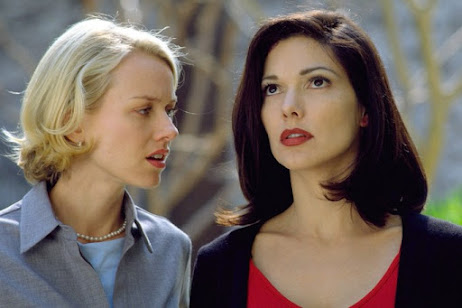
Identities then blend (the Igmar Bergman-esque screen capture above says a lot about the merging of identities I believe) with Rita donning a blonde wig and then they shatter completely with the aid of a shiny blue box (that of course appears with no explanation) and then reassemble or emerge from a dream - as when The Cowboy says: “Hey, pretty girl, time to wake up.”

Many elements familiar to fans of Lynch fill the frames throughout - among them the darkened old fashioned back room of the mysterious movie studio string puller Mr. Rogue (Michael J. Anderson) wouldn’t have been out of place in the dreams of Special Agent Dale Cooper (Kyle MacLachlan) on Twin Peaks and the creepy Club Silencio that Betty and Rita attend one fateful night is somewhere you would expect to see Frank Booth (Dennis Hopper) from BLUE VELVET lounging around in.

Writting before about the “love/WTF?” relationship I’ve had with the films of David Lynch (“Inland Empire Burlesque” and “Hey, I Finally Saw...ERASERHEAD”) I had decided to let go of the idea of determining definitive meanings and just go with the freaky flow. 

Wading through the various analyzing articles previously mentioned of this particular film though is still extremely fascinating because many interpretations can exist side by side, none more valid or more convincing than the other. 

Maybe MULHOLLAND DRIVE doesn’t make any more sense now than it ever did but its captivating spell has indeed grown and its perverse passion is definitely more powerful than when it was first shown in the heady distracting days shortly after 9/11. 

For those who haven't seen it before and lived with it for a while, I have to relate this - while the end credits were rolling at the Art Museum last Friday, a irrate woman who was obviously one of those who had earlier raised their hands, was heard complaining: “I’m very upset - it didn’t make any sense! Even PULP FICTION made sense! At the ending it all came together. I mean even AMERICAN BEAUTY made sense too!” 

So much for discussion, huh?

More later…

Monday, August 04, 2008

Hey, I Finally Saw...ERASERHEAD!


When it comes to being a film buff/geek admitting that you've never seen a particular classic film used to be a shameful act, one to be avoided for fear of scorn, and derision, but thanks to the wave of blog confessionals all over the internets it’s a welcome entertaining way of coming clean.

The Onion AV Club has a ongoing column entitled Better Late Than Never" in which a different staff member finally watches what has been long considered an essential important movie - they’ve covered HAROLD AND MAUDE, RAIDERS OF THE LOST ARK, RAGING BULL and a handful of other movies that most people assume everybody (or at least every film fan with a blog) has seen.

Fellow blogger Graham Culbertson on his fine site Movies Et Al. has a series called Film Ignorance which also deals with catching up with highly touted cinema that he or a guest blogger is only now getting around to.

So when I saw that the Colony Theater in Raleigh * had obtained a 30th anniversary print of what could be the definitive cult classic, a notorious film that I’d heard about for decades but for one reason or another I never saw, I thought it would be a good time to start my own “Hey, I finally saw...” forum. I went with a friend, who had also never seen the movie, to the Saturday night late show and now I can declare: Hey, I finally saw ERASERHEAD!

Despite having not seen it before last Saturday night, the iconic image at the top of this post, which is used on the poster, is as familiar an image to me as paintings by the great masters or pictures of the pyramids. 

It’s an intriguing and fitting portrait because to view David Lynch’s debut film ERASERHEAD is to get very acquainted with the face of the late Jack Nance. Nance plays Henry Spencer who says he’s on vacation from his occupation as a printer and lives in a sparely furnished one room apartment. The squalor of the slum he toils in is reflected in his eyes as is incredible sadness, desperation and above all - confusion. 

I entered his grainy gritty black and white world cautiously but curiously absorbing every intense corner not caring if a plot would actually rear its ugly head. What does rear its ugly head is a limbless mutant baby his timid girlfriend Mary X (Charlotte Stewart) presents him with. The grotesque reptilian offspring constantly shrieks, so much so that Mary leaves Henry to take care of the whatever it is himself: “You’re on vacation now; you can take care of him for a little while!” 


From there on out Henry’s life dissolves into a series of dream sequences and surreal set-pieces. There is a low industrial hum under the surface of the soundtrack as he drifts through real or imaginary experiences involving his neighbor (Judith Anna Roberts credited as “Beautiful Girl Across The Hall”), a cabaret singer (Laurel Near) with hamster-like puffed-out cheeks who appears on a stage from deep within Henry's radiator - “Lady in the Radiator” who sings “In Heaven”, and the ginormously overwhelming “Man in the Planet” (Jack Fisk) who haunts the film from beginning to end. 

As bizarre as this all appears, the film’s title is surprisingly from one of the more linear tangents - Henry dreams of his severed head being sold to a factory and being processed into pencil erasers. Though it was shot over 6 years in the 70’s not one frame looks tied to that period. Actually not one frame looks tied to any period - it exists in a time and world completely of its own creepy creation. 

The powerful draw of such bewildering and unpleasant aestetics is hard to explain; I thought often that I couldn’t believe anyone would pick this as their favorite movie but I’ve heard a number folks do just that. I have to take into account that having seen it for the first time just the other day may not be enough time to process the experience. 

For a first time director it is a incredible piece of work - Lynch has the most fascinating yet frustratingly obtuse filmography of any noted director over the last 30 years and seeing ERASERHEAD for the first time gives me a perspective on his work I was sadly lacking. 

The last half hour of the film I had to use the restroom but could not remove myself from my seat. I could not stand to have a broken viewing of the ERASERHEAD experience. It was an experience that I loved and hated; that was disgusting yet beautiful and one that I could do without ever seeing again but still am looking forward to revisiting.

The Colony Theater in North Raleigh showed ERASERHEAD as part of their Cool Classics @ The Colony series and I was amused to see that they dug up a couple of old trailers of a few obscure 70's flicks to screen beforehand. The first was for THE CHICKEN CHRONICLES which was Steve Guttenberg’s first film and the second was for a Robbie Benson (a forgotten teen heart-throb) vehicle called DIE LAUGHING which featured turns by the late greats Bud Cort and Charles Durning. They were both hilarious additions to the marvelous mid-night movie-show. 


More later...

Tuesday, September 04, 2007

INLAND EMPIRE Burlesque

“I was watching everything go around me as I was standing in the middle. Watching it like in a dark theater before they bring the lights up.” - Nikki Grace (Laura Dern) 

INLAND EMPIRE (Dir. David Lynch, 2006)

I was surprised when I got the latest David Lynch film (released on DVD August 25th) from Netflix to see on the envelope that it was 172 minutes. Now, I've had a 'love/WTF?' relationship with the films of Lynch for a long time so I was a bit ambivalent about spending nearly 3 hours with Lynch's particular brand of operatic weirdness. It turned out to be more than that of course, because I re-watched many parts in a futile attempt to really understand what exactly was going on. As many critics have said really understanding it is not the point. It's supposed to wash over you or something like that. So let's let it wash: 

Writing about a David Lynch film can be one of the most intimidating tasks a critic can have. No straight plot description or analysis can be made and working out character motives or the real from the imaginary will leave one’s mind tangled up in Jungian knots. But I’ll roll up my sleeves and at least put on the table what I could decipher. One narrative thread emerges early on out of the chaotic kaleidoscope of dream like imagery. It involves Lynch regular Laura Dern as an actress who accepts a part in what she and fellow actor Justin Theroux are told is a remake of a never completed Polish film named 47, never completed because the two leads were murdered. 


After that premise is established the film disintegrates, or melts rather, into an endless seemingly random series of dream-like sequences. In arguably the most abstract film-within-a-film in history the actors and the film itself become one another and the entire thing turns inside out and back again. Oh, and throw in a living room set with people with large rabbit heads with a laugh track, and then another room with ‘60s décor in which nine casually dressed women (models/prostitutes?) who after some simplistic girls-talk, break out into a spontaneous, but still well choreographed, dance, and lip synch number to “The Loco-Motion.” Oh yeah, there are also scenes interspersed from what looks like a orange-hued Foreign film. Whew! That’s the best I can do!


Dern (who co-produced) does probably her best work here, and that’s saying a lot for a project that mostly appears to require her to run around re-interpreting Munch’s painting The Scream in every actorly variation there is again and again. Grotesque Fellini-esque extreme close-ups dominate, non-sensical soundbites seep in from every corner of the screen (“it had something to do with the telling of time,” somebody says at one point - uh, thanks) and while it was filmed on digital video the film nicely lives up to Lynch’s previous aesthetics.

One can not casually watch INLAND EMPIRE - that would be like casually visiting somebody in prison. So when the question comes down to whether I liked or disliked it, well trying to figure that out feels like deciding whether to give thumbs-up or thumps-down * to a Rorshach test. I can only say I found parts of it intensely absorbing, and I cared about what was happening even if I didn't always *get* what was happening. Still it was a bit much and perhaps should have been edited down a tad. Of course though, that would probably be like cropping sections out of a Jackson Pollack painting. 

Thumbs up-thumbs down is a registered trademark of Disney-ABC Domestic Television. 

More later...