Showing posts with label Blue Velvet. Show all posts

Saturday, January 18, 2025

A Film Babble Blog Retrospective: David Lynch In Three Films

The passing of one of my all-time favorite filmmakers, David Lynch (January 20, 1946-January 15, 2025), made me go back to the reviews I’ve written of his work over the years for Film Babble. In the almost 21 years that I’ve had this blog, I posted about three of the ten theatrical releases he made from 1977-2006: ERASERHEAD, MULHOLLAND DRIVE, and INLAND EMPIRE. These were interesting for me to revisit, as I had forgotten some details like I wrote that I had a “love/WTF? relationship with the films of Lynch,” and that one of my first dates with my ex-wife was a midnight show of ERASERHEAD, so I thought I’d gather the reviews for this tribute post.


My first review is from that midnight movie screening that was at the Colony Theater (sadly closed in 2015) in Raleigh, North Carolina as part of their Cool Classics series in the summer of 2008. 


I was mounting a series that didn’t go on very long called “Hey, I finally saw…” where I blogged about seeing a classic film for the first time, and before that night, I’d never seen Lynch’s mesmerizing debut ERASERHEAD in full (I think I saw parts of it in the ‘80s on cable, but I’m not sure). Here’s how it went down (click on the title to read the post):


Hey, I Finally Saw ERASERHEAD (August 8, 2008)


Later that year, the North Carolina Museum of Art presented a screening of Lynch’s ninth film, 2001’s MULHOLLAND DRIVE, which my then girlfriend, and I attended. I had seen the movie before, but only when it was released on DVD in 2002, so it was great to see it on the big screen in the museum’s auditorium. 
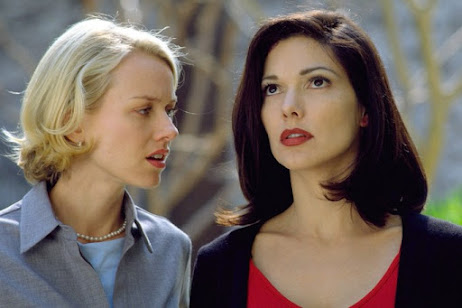


The film was introduced by a great local film critic, INDY Week writer/editor David Fellerath, who I quote the in the piece, which amuses me because like with ERASERHEAD, I was trying to figure it out. I also am amused by something I had forgotten, the confused reaction of one of the attendees at the end of the movie. I believe it’s worth the read:

Seven Years Later, Does MULHOLLAND DRIVE Make Any More Sense? (October 28, 2008)

Lastly, I go back further in time (just a  year earlier) to my first review of a Lynch film, his last feature-length production, INLAND EMPIRE, which came out in late 2006. 


I viewed, and reviewed the DVD when it was released in 2007, and I enjoyed re-reading, and re-living my thoughts on the bizarre film (I know, they’re all bizarre). I had forgotten the line “One can not casually watch INLAND EMPIRE - that would be like casually visiting somebody in prison.” Read the rest:

INLAND EMPIRE Burlesque (September 4, 2007)


So that’s what I had to say in the past (the 2000s) about three of Lynch’s films. I’m definitely going to revisit his work in the weeks to come, and may post some new re-evaluations here. As for the rest of the master’s movies, I saw THE ELEPHANT MAN and DUNE on cable, but was too young to appreciate them as Lynch works. It was BLUE VELVET (1986) on VHS in the late ‘80s that blew me away, and made me a fan. The others that followed, I saw mostly on home video, but did see a Cool Classics showing of WILD AT HEART at the Colony in 2012.

The Carolina Theatre in Durham, NC, is hosting a free screening of BLUE VELVET as part of their Retro Film Series next Tuesday, January 21, at 7pm, which I might attend, and I’m sure there’ll be a number of other showings of Lynch films in the area in the months, and years to come.


In the mean-time, I posted this handy guide on Facebook, and  it’s worth re-posting:


R.I.P. David Lynch


More later…

Monday, May 31, 2010

R.I.P. Dennis Hopper (1936-2010)


"Somewhere in my strange career, someone has liked something." - Dennis Hopper 


Sadly, iconic actor/director Dennis Hopper lost his battle with prostate cancer Saturday morning. Every obituary will understandably point to his breakthrough milestone EASY RIDER (1969), but I'm sure most people who would read this blog know he had a ginormous crazy career spanning almost 6 decades. 


 Impressively IMDb lists over 200 film and television appearances in nearly every genre. In 1986 alone he appeared in HOOSIERS, BLUE VELVET, RIVER'S EDGE, and THE TEXAS CHAINSAW MASSACRE 2, and from the looks of it that was a typical year for the man as he worked constantly until his illness got the best of him - 6 movies in 2008, 26 episodes of Crash 2008-09, and a couple of upcoming projects (THE LAST FILM FESTIVAL, ALPHA AND OMEGA) set for later this year. A career so vast is difficult to cherry pick from, especially since he had so many bit parts in major movies - his roles in friend James Dean's movies REBEL WITHOUT A CAUSE (1955) and GIANT (1956) for example - and also because a few films he directed are unavailable on DVD these days - THE LAST MOVIE (1971) and OUT OF THE BLUE (1980). That said these are my picks for:


10 Essential (And Available) Dennis Hopper Performances


1. EASY RIDER (Dir. Dennis Hopper, 1969)


When I said every obit would highlight this as Hopper's most acclaimed achievement I wasn't saying I wouldn't also. It's inescapable as a classic counterculture event of a movie that helped kick off the "New Hollywood" movement of the late '60s/early '70s. It also solidified the long-haired mustached hippie wiseacre persona that Hopper would return to a number of times throughout his acting career. 


 Concerning a couple of drug dealers (Hopper and Peter Fonda) who make a huge score and set out on their motorcycles to go, in the words of the film's tagline, "looking for America", EASY RIDER is very dated with clumsy artistic cuts, redneck stereotypes, and a cringe-inducing psychedelic trip sequence, but Hopper's glee while riding through Monument Valley out over the sunset on his chopper is infectious. In those moments, which were innovative in their use of rock song scoring, the film's theme of freedom lets its freak flag fly the highest. 


2. BLUE VELVET (Dir. David Lynch, 1986)


Frank Booth, a Nitrous Oxide inhaling sexual deviant, was considered a comeback role for Hopper who had gone through more than one wilderness period in the years since EASY RIDER and the failure of its follow-up THE LAST MOVIE. Booth was scary and a bit funny at the same time; the manner in which he menaces nice boy Kyle MacLachlan being a twisted yet beautiful example: "Heineken? Fuck that shit! Pabst Blue Ribbon!" The part won Hopper a few Critics' Association awards and in 2008 was voted #54 in Premiere Magazine's list of "The 100 Greatest Movie Characters of All Time."


3. APOCALYPSE NOW (Dir. Francis Ford Coppola, 1979) Credited as "Photojournalist" and only given a small amount of screen-time in the final reel, Hopper is one of the most memorable elements of Coppola's seminal sprawling Vietnam epic. His cryptic speeches like this one still resonate 30 years later: "This is dialectics. It's very simple dialectics. One through nine, no maybes, no supposes, no fractions. You can't travel in space, you can't go out in space without, like, you know, with fractions - what are you gonna land on, one quarter, three eighths - what are you gonna do when you go from here to Venus or something? That's dialectic physics, okay? Dialectic logic is there's only love or hate, you either love somebody or you hate them." Marlon Brando as Colonel Kurtz then angrily hurls a book at Hopper in a moment that doesn't feel scripted.


4. HOOSIERS (Dir. David Anspaugh, 1986) As I mentioned earlier, 1986 was a banner year for Hopper. His roles in BLUE VELVET, RIVER'S EDGE, and this Oscar nominated turn as the basketball supporting town drunk had him unstoppably on the comeback trail. It's a folksy formulaic sports film about underdogs triumphing against all odds, but Hopper's gutsy edge is no small part of the film's abundant charms.

Tuesday, October 28, 2008

Seven Years Later, Does MULHOLLAND DRIVE Make Any More Sense?


Short answer: Maybe a little.

Long Answer: Last Friday night as part of a series on film noir, the North Carolina Museum of Art in Raleigh had a screening of David Lynch’s twisted surreal drama MULHOLLAND DRIVE. The film was introduced by Independent Weekly Arts Editor David Fellerath who considers the film a masterpiece and one of the greatest of the last 10 years. 

Fellerath asked how many folks were seeing the film for the first time and a surprisingly huge amount of hands were raised. After some background and an attempt at plot summary, he assured the almost full room that 95% of the film holds up to “logical scrutiny.” I’m not so sure about that, but the film did seem to gain levels of coherence that it lacked for me back in 2001. Fellerath had also stated that if anybody still had problems with the film’s meaning afterwards - “there’s lots on the internet.”

There sure is lots on the internet, starting with one of the lengthiest Wikipedia entries for a film that I’ve ever seen with content headings like "Interpretations and Allusions," detailed character breakdowns, and long intricate paragraphs on the style and critical reception. 

The references for the entry site 82 articles with such titles as “Nice Film If You Can Get It: Understanding Mulholland Drive (The Guardian) and Salon.com’s “Everything You Were Afraid To Ask About Mulholland Drive” (which Roger Ebert considers “the best explanation”). 

Another worthwhile read is Anthony Kusich’s “Mulholland Drive…Explained” which deals which the 10 clues that Lynch included in the notes for the original DVD release. The existence of the clues is curious because Lynch was quoted in the New York Times a few years later as saying that DVD extras can “demystify” a film. 

Perhaps what Lynch and many critics have proposed is the most sensible way to take MULHOLLAND DRIVE – not to try and make sense of it. Just absorb the mood and visual tones winding through the various narrative strands. Naomi Watts and Laura Elena Harring are either friends turned lovers named Betty and Rita in a dream or the former lovers now estranged Diane and Camilla in reality or vice versa. 

It appears that Justin Theroux is one of the only constant characters – an arrogant film director who is pressured by Mafioso types, to cast Camilla in his newest film. In one of the most memorably amusing scenes has Theroux meet a cryptic character called “The Cowboy” (Lafayette Montgomery) who tells him: “A man’s attitude goes some ways. The way his life will be.” 

When The Cowboy can be seen passing through the background of a party scene later on it is impossible not to take as intensely comical.

A turning point comes when Betty and Rita doing some detective work because Rita has lost her memory (she took her name from a Rita Hayworth movie poster) locate a woman’s dead body.

Identities then blend (the Igmar Bergman-esque screen capture above says a lot about the merging of identities I believe) with Rita donning a blonde wig and then they shatter completely with the aid of a shiny blue box (that of course appears with no explanation) and then reassemble or emerge from a dream - as when The Cowboy says: “Hey, pretty girl, time to wake up.”

Many elements familiar to fans of Lynch fill the frames throughout - among them the darkened old fashioned back room of the mysterious movie studio string puller Mr. Rogue (Michael J. Anderson) wouldn’t have been out of place in the dreams of Special Agent Dale Cooper (Kyle MacLachlan) on Twin Peaks and the creepy Club Silencio that Betty and Rita attend one fateful night is somewhere you would expect to see Frank Booth (Dennis Hopper) from BLUE VELVET lounging around in.

Writting before about the “love/WTF?” relationship I’ve had with the films of David Lynch (“Inland Empire Burlesque” and “Hey, I Finally Saw...ERASERHEAD”) I had decided to let go of the idea of determining definitive meanings and just go with the freaky flow. 

Wading through the various analyzing articles previously mentioned of this particular film though is still extremely fascinating because many interpretations can exist side by side, none more valid or more convincing than the other. 

Maybe MULHOLLAND DRIVE doesn’t make any more sense now than it ever did but its captivating spell has indeed grown and its perverse passion is definitely more powerful than when it was first shown in the heady distracting days shortly after 9/11. 

For those who haven't seen it before and lived with it for a while, I have to relate this - while the end credits were rolling at the Art Museum last Friday, a irrate woman who was obviously one of those who had earlier raised their hands, was heard complaining: “I’m very upset - it didn’t make any sense! Even PULP FICTION made sense! At the ending it all came together. I mean even AMERICAN BEAUTY made sense too!” 

So much for discussion, huh?

More later…