Showing posts with label Peter Bogdanovich. Show all posts

Friday, January 07, 2022

The Drew Barrymore Movie That Riffed On Peter Bogdanovich’s Love Life


Sophisticated cinema connoisseur and dapper director Peter Bogdanavich, who passed away this week, inspired indie filmmakers, like Wes Anderson and Noah Baumbach; the many movie critics who dream, and have dreamed of making movies themselves, and folks who wear a bandana around their neck like it’s an ascot.

But a 1984 rom com, IRRECONCIBLE DIFFERENCES, starring Ryan ‘O Neal, Shelly Long, and Drew Barrymore, then a hot commodity because of E.T., used more than an outline of Bogdanovich’s scandalous love life in the ‘70s to beef up the backgrounds of a fame-seeking married couple who are getting sued for divorce by their daughter.


Let’s start with ‘O Neal in the Bogdanovich role. This makes some sort of sense, as O’Neal starred in three of Bogdanovich’s films. O’Neal’s character, Albert Brodsky, earned a Doctorate of cinema at NYU, then had a thesis published which led to an offer for a professorship at UCLA. O’Neal, who plays the part perfectly with crack comic timing and a palpable on-point pathos, his Brodsky hits the road to Los Angeles to accept the job, and pursue his dream of becoming a director.


Bogdanovich also started in New York, working as a programmer of films at the Modern Museum of Art, and writing movie criticism for Esquire. In the mid ‘60s, Bogdanovich and his wife, Polly Platt (1939-2011), moved to LA to pursue his dream of becoming a director.
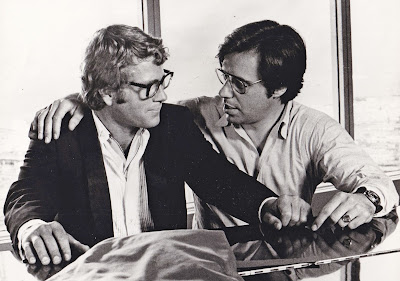

Both film historians, Bogdanovich and Brodsky meet an influential grey-haired director/producer – in Bogdanovich’s case, cult legend Roger Corman; in Brodsky’s case, David Kessler (Sam Wanamaker) - through which they get their first big breaks.


Alongside Brodsky is Long as Lucy Van Patten, an aspiring children-books writer. While her husband is struggling with a screenplay, she works on getting her real estate license, but she quits that to help with screenplay and becomes its co-writer.


Except for the c0-writing, Bogdanovich’s spouse, Platt, has little in common with her big screen counterpart. While a hitch-hiking Allen met Lucy on a muddy road out in the middle of Indiana, Peter met Polly in summer stock in New York, but they did drive across country together to the same destination. 


As Peter (I’ve decided to go with the principals’ first names from here on), learned the ropes as an auteur, Polly became a highly acclaimed production designer, and worked on four of her husband’s films. 


Which brings us to the filmographies of Albert and Peter. We’ll start with the fictional one, Albert. With the help of his wife, Albert’s debut, An American Romance, is a big hit, which puts him on the movie map, while Lucy is left out of the lime light. Their next film, Gabrielle,also connects with audiences, but signals the end of Albert and Lucy’s marriage when Albert falls for the actress cast in the lead. That would be Sharon Stone, in one of her first films, as the gold-digging damsel, Blake Chandler.


The third time isn’t the charm for Albert, whose bloated GONE IN THE WIND-esque “Atlanta” movie-musical project flops big time, and Blake leaves him for the limo driver.


Back in the real world, Peter made double the amount of movies than Albert, but he had to wait until his fourth film for his scandal. The true classic of his filmography, THE LAST PICTURE SHOW, won two Oscars, and slew of other awards, and it won Peter the heart of budding starlet, Cybill Shepherd. Polly left Peter, though she still worked on a few of his films, and Peter and Cybill went on to make two huge financial duds, DAISY MILLER and AT LONG LAST LOVE. Elements of these films are parodied in Albert’s “Atlanta,” and another similarity is that after these failures, Cybill left Peter for an auto parts dealer.

Returning to the world of make believe, Lucy’s arc involves having a best-selling book which seemingly tells all about her and Albert’s relationship, something Polly didn’t do (though there’s reportedly her unpublished memoir that will maybe one day see the light), but she has appeared in numerous documentaries like EASY RIDERS, RAGING BULL, and DECADE UNDER THE INFLUENCE, giving insights into her days with Peter.


Now, I have to address Drew Barrymore, as I have her name in this post’s headline. Her part consists mostly of looking put-out, and pissed-off at her neglectful parents, and she definitely nails that. But some of her line readings are weak, and it’s hard to pin down how good an actress she is. But that’s because she was nine years old! Still, she’s now 46 and I still can’t pin down how good an actress she is.


Putting aside the comparisons between Peter Bogdanovich and Albert Brodsky, IRRECONCILABLE DIFFERENCES holds up as a witty look at divorce among the ups and downs of show biz. It was an interesting idea for them, that being rom com writer gurus Nancy Myers, and Charles Shyer, to fashion much of the plot around the tabloid details of a famous director’s dalliances. But more than interesting is that it largely works.


More later…

Monday, January 28, 2008

Catching Up With The Classics

A young filmmaker recently put this forth to Roger Ebert's Answer Man column:

Q: "As an aspiring young filmmaker, I watch and rewatch as many films as possible, around seven to 14 a week (which is tough with college and work). A lot of the time I feel like because I haven't seen every classic or obscure film, I'm less of a director because I never gleaned that knowledge.

I'm young, but I love film and I hate when that love is questioned because I haven't gotten to a certain film. What are your thoughts on this whole neurotic mess of mine? Can someone of this generation, so far removed from the birth of film, still make something as good as "Citizen Kane," even if they haven't seen it? (And yes, I've seen it several times. And no, I do not think I could match Welles' genius.)" Roy Hatts, Warwick, N.Y.

Ebert's Answer: "Join the club. I feel the same way you do. Friends of mine like Jonathan Rosenbaum and Dave Kehr seem to have seen every film ever made -- and David Bordwell, Bertrand Tavernier and Pierre Rissient probably have. There is a suspicion in Chicago that members of the University of Chicago's Doc Films, the first campus film society in the nation, are born having seen every film. But keep on watching good movies. And don't feel insecure when you make them. After all, Orson Welles watched John Ford's "Stagecoach" 100 times before making 'Citizen Kane.'"

This Q & A hits upon a point I've been noticing a lot lately - we, that is film buff folk, are just as obsessed with what we haven't seen as we are with what we have. This is, of course, silly - there will always be movies we've never seen - many of which will be essential classics to uh, somebody out there so fretting over it will get you nowhere. Better to enjoy the process and keep on watching like Ebert says. I usually mostly write about new movies, whether they are at the theater or new release DVDs but I thought I'd catch up a few older films in the spirit of trying to round out my film education.

First off, a film I caught last week on TCM: BAD DAY AT BLACK ROCK (Dir. John Sturges, 1955)


The opening has powerful modern (for the mid '50s that is) steam engine storming down the tracks shown from every conceivable angle. The vivid urgency of each shot immediately pulls us in to this undoubtable classic. There is one incredible full-on "how the Hell did they do that?" shot in the train opening montage that I won't reveal because even though it's a film well documented from over 50 years ago I still promise no Spoilers.

The train, we're told for the first time in 4 years, stops in a tiny town literally out on the middle of nowhere and Spencer Tracy gets off. He is a well dressed one-armed man with a stern determined nature and immediately is noticed by the townfolk. An ominous group of cowboys led by Robert Ryan attempt to intimidate him.

When you roll with a posse that includes such heavies as Lee Marvin and Ernest Borgnine you can be sure that intimidation of a high order comes pretty easily. Tracy ignores any obstacles and checks into a hotel. We don't know what his deal is - is he a cop? A detective? An insurance salesman? What? We just know he is trying to find somebody - a Japanese farmer named Komoko. We know from the reaction to his arrival that his inquiries threaten to shine a blinding light on a dark secret and will place his life in danger.

What we don't know is how much of a badass Tracy is under his calm demeanor - but again I won't give anymore away. The town isn't all scary hoodlum types; Tracy does makes a few friends - Walter Brennan as the jaded town doc, Dean Jagger as the alcoholic town sheriff, and Anne Francis as well, the only woman in town it seems.

Howard Breslin's screenplay, adapted from the Don McGuire short story "Bad Day At Hondu" is excellent with great lines like: "Tim, you've got the body of a hippo but the brain of a rabbit; now don't overtax it" and "You're not only wrong. You're wrong at the top of your voice."

Building on a brilliant beginning the second half of BAD DAY AT BLACK ROCK is a scorcher with no wrong turns. If you see this coming up on TCM's schedule make a note of it. It's definitely more that worth a rental too - I may put it in my Netflix queue to watch again especially since I heard director Paul Thomas Anderson praise the DVD commentary by film historian Dana Polan.

Sturge's film looks great for its age (it was the first MGM production in Cinemascope) and in these days of likewise lawless desert epics (NO COUNTRY, THERE WILL BE BLOOD et al) it holds up incredibly well. 

THE NAKED PREY (Dir. Cornell Wilde, 1966)


This film just got a fancy schmancy Criterion collection special edition with a newly restored high-definition digital transfer, commentary by film historian Stephen Prince, soundtrack cues, original theatrical trailer, and the icing on the cake - the original 1913 written "John Colter's Escape"- a document of the trapper's flight from Blackfoot Indians which was the inspiration for the film read by Paul Giamatti.

These bells and whistles decorate what is a pretty dated exercise - the opening credits tells us "The music in this motion picture is African Music, played by Africans on African instruments." I can't imagine seeing that notation in a film today.

The plot has a '50s B-movie thing goin' on but fleshed out with real locations rarely seen before on the big screen. In Africa, called "the land of aboriginal tortures", an ivory hunter (Wilde), who is only identified in the credits as "The Man" gets captured by a large tribe and after watching his fellow men tortured (one is covered in mud and baked alive) is stripped down except for his tied hands and given a running head start before the tribal warriors catch and kill him.

He outwits them one by one and fares equally well against the harsh jungle animals and terrain. Colorful and creative in it's use of the before mentioned African music - THE NAKED PREY is ultimately a contrived conceit, I mean there's no way this guy would escape alive in this world better known by his pursuers. Still it's a fine ride through what would soon be action movie clichés and the Criterion treatment yet again works it's magic on its claim to classic status.

It is impressive that Cornell Wilde was 50 years old when he made it. His lean killing machine of a body almost adds plausibility to this star vehicle vanity piece. Almost. Post Note: According to Wikipedia "As teenagers, Joel and Ethan Coen shot their own version of THE NAKED PREY on a Super-8 camera. They called it Zeimers in Zambia and cast a neighbor, Mark Zimering, in the lead role." Man! I'd Sure like to see that!

OTHELLO * (Dir. Orson Welles, 1952)


I've been on an Orson Welles kick for the last several months. I've been plowing through Simon Callow's lengthy bio "The Road To Xanadu" (which at 578 pages is only Volume 1!) and ordering up DVDs from his canon that I hadn't seen before including essential classics as THE LADY FROM SHANGHAI and THE TRIAL, as well as lesser known treasures like THE STRANGER and F FOR FAKE.

The crucial thing one learns over and over in reading Welles's story is that his filmography has been horribly mishandled and few of his films were truly finished. They were either taken away from him and retooled (mostly mangled more accurately) by the studio (best example - MAGNIFICENT AMBERSONS ** which isn't available on DVD in any version) or he ran out of money during production and had to scrounge around to complete the project most likely not to his satisfaction.

Put this epic Shakespeare adaptation in the latter category. It was filmed over 3 years during which Welles took acting work in other's films to pay for the project.

The DVD I got from Netflix (from Image Entertainment) had only a photo gallery as a bonus feature and an awful transfer. The picture is often blurry and the sound is so bad that a lot of the dialogue is indecipherable. Much of it was latter dubbed and redubbed by Welles and the synch is often way off. If you can get past that, and that is quite a task, this is a grand albeit hammily acted production with much of the picturesque style of CITIZEN KANE in its wide shots and deep focus (murky as it is in this edition).

Welles stalks through the shadows and chews scenery with a cagey charisma that only a trained Shakespearean stage actor could possess. His sweaty wide-eyed performance is far from flawless, mind you - in some cringe worthy moments he appears to be wrong at the top of his voice (as Spencer Tracy in BAD DAY AT BLACK ROCK would say) as if he's trying to reach the patrons in the cheap seats. His fellow cast members Micheál MacLiammóir as Lagos and Robert Coote as Roderigo also overact but this material calls for it, actually it broadcasts for it like on a megaphone.

As the object of Othello's obsession Desdemona, Susan Cloutier pretty much just lies there but she's a victum of the Bard's weak writing when it came to strong female characters as much as she is a victum of the plot conventions. This particular edition of the film has the feel of a work print rough cut - reportedely Welles's much criticized business mogul daughter Beatrice Welles had her paws all over this reissue.

Well, there's a great movie in there somewhere so when it comes to a proper restoration I hope next time out somebody will take a better stab at it - pun intended. Paging Bogdonavich...

* Full Title: THE TRAGEDY OF OTHELLO: THE MOOR OF VENICE

** MAGNIFICENT AMBERSONS is on TCM on February 26th at 8:00 AM. Pencil that in! Okay! Next time out I'll cover some movies actually made this decade.

More later...

Tuesday, January 15, 2008

The New Tom Petty Doc: Who Knew Bogdanovich Could Rock?


Who knew Peter Bogdanovich could rock?
This guy - the refined ascot wearing autuer who directed THE LAST PICTURE SHOW but is best known to the masses as Dr. Melfi's shrink on The Sopranos not only can rock but he can rock for a long ass time.

Four hours in fact. That's the length of his new rock documentary TOM PETTY AND THE HEARTBREAKERS: RUNNIN' DOWN A DREAM. I took in the whole thing in one sitting and loved every second of it (I hope my review below won't take 4 hours to read) so let's take in Bogdanovich as he goes off on a Tom Petty tangent: 

TOM PETTY AND THE HEARTBREAKERS: RUNNIN' DOWN A DREAM 
(Dir. Peter Bogdanovich, 2007)


"Marty took 3 hours and 40 minutes to tell 6 years of Dylan and I figured, if that's the case, why shouldn't we take 4 hours to tell 30 years of Tom Petty?" - Peter Bogdanovich on Sound Opinions (broadcast January 7th, 2008)

A big package this is - 4 discs, 2 of which are the 4 hour 15 minute director's cut of the documentary, the 3rd disc is the complete 30th Anniversary Gainesville, Florida concert from September 30th, 2006, and the 4th is a soundtrack CD featuring 9 previously unreleased songs. 

Whew! Hard to claim to be just a casual Petty fan after absorbing all of that. Bogdanovich's film even at its bloated length is engrossing and never lags. Framed by footage from the before mentioned concert we are taken through the history of the band with interview segments spliced with photos, fliers, home movies, TV appearances, grainy videotape material, and every other source available. 

The ups and downs are perfectly punctuated with Petty standards - the punchy pop bright Byrds influence that brought forth the break-through single "American Girl" captures the band on a television stage young and green while the promotional video for "Refugee" shows them freshly on the mend from battles with lawyers and declaring bankruptcy. 

 Of course there are unavoidable rockumentary clichés that are as old than THIS IS SPINAL TAP - recording studio squabbles, the trials of transporting drugs over the borders, and the "Free Fallin'"-out of the band when they aren't on the same page but they are amusingly displayed in a knowing manner that transcends the usual VH1 classic fodder. 

It's hard not to think of Scorsese's landmark Dylan doc when putting in disc 2 of RUNNIN' DOWN A DREAM for the most obvious reason - as Part 2 starts the first words uttered, by Petty, are "Bob Dylan, I don't think there's anyone we admire more". So the collaboration with Petty and Dylan begins - there is great footage from the HBO special Hard To Handle

Bob thrusts his hand behind him while playing his harmonica on the intro of "Knockin' On Heaven's Door" to stop the band from coming in too soon and it's an amazing moment - the greatest songwriter ever (as Petty and I call him) directing the best working class Americana band of the mid '80s and beyond.


Tom and Bob's collaboration led to the Traveling Wilburys - the ultimate supergroup filled out by former Beatle George Harrison, legend Roy Orbison and Jeff Lynne of the elaborately Beatle-esque Electric Light Orchestra. Petty's approach was forever altered - which we see as certain band members have to cope with his new direction. Especially former drummer Stan Lynch, (who refused to be interviewed for the film but is presented in archive footage) who says bluntly of Petty's biggest selling album "Full Moon Fever" - "there were more than a couple songs I just didn't like."

Through the '90s up to now we see Petty and the Heartbreakers weather grunge (Nirvana drummer Dave Grohl played with them on SNL right after Lynch left), a death of a long time but still considered "new kid" bassist Howie Epstein, and the competition from a world in which "rock stars were being invented on game shows" all with their self declared "I Won't Back Down" spirit. 

Though you ordinarily wouldn't think of him in the same company as Orson Welles and John Ford, this masterful showcase of material makes a solid case that Petty is indeed in the pantheon of those previous subjects of Bogdanovich's.

Eddie Vedder of Pearl Jam, who seems to show up in every rocumentary or rock related movie these days (even WALK HARD), appears at one point to sing a duet with Petty on "The Waiting" at a recent concert. When the song ends and the giant audience erupts Petty says to Vedder, “Look at that, Eddie - rock and roll heaven.”

He's right - for 4 hours and 15 minutes it sure is. 

Bogdanovich's Petty opus may just make a dent in Film Babble Blog's 10 Definitive Rock Docs post coming soon.

More later...

Friday, July 13, 2007

Film Within A Film Follow-up Fun!


"Life is like a movie. Write your own ending." - Kermit The Frog in THE MUPPET MOVIE (Dir. James Frawley, 1979)

Looks like I made some serious ommisions according to the many many readers who wrote in about my 10 Definitive Films Within Films (07/01-07/08) post last time out so here's some of the best suggestions, picks, and oversights:

Tony Ginorio suggests: SOMETHIN’S COOKING


It's the cartoon that opens WHO FRAMED ROGER RABBIT (Dir. Robert Zemeckis, 1988). An excellent pastiche of a 1940s Tex Avery short, with Roger and Baby Herman unleashing mayhem as only animated characters can. Halfway through, however, the director yells “Cut!”, and what at first seems like a mere cartoon suddenly becomes a live set, with a flesh-and-blood director chewing out his ink-and-paint actors, completely up-ending our preconceived notions of what is “real” and what is movie magic. 

Not only does this clever device introduce the film’s main concept – that animated characters are real – it also foreshadows the way characters and events in the main story are not what they seem: how a simple infidelity case turns out to be a cover-up for something far more sinister, and how a certain femme fatale turns out to be “just drawn that way.” 

Mike Weber writes: Billy Bright (Dick Van Dyke) watching his old movies on late-night teevee in THE COMIC (Dir. Carl Reiner, 1969) - which I swear was a major part of the inspiration for Firesign Theatre's "Don't Crush That Dwarf" album, which came out the next year and ends with an identical setup.

SEE YOU NEXT WEDNESDAY: in any number of John Landis films (and the"Thriller" video) - but best in AN AMERICAN WEREWOLF IN LONDON (1981). *

Peter Bogdanovich's TARGETS (1968), which uses outtakes from THE TERROR (1963) as the latest film from star Byron Orlok (Boris Karloff), at whose drive-in premiere the ultimate confrontation takes place. 

The whole setup for KISS KISS BANG BANG uses an actual film from1987 (DEAD AIM) that featured one of the cast (Corbin Bernsen). Footage from DEAD AIM was used as a film called "Johnny Gossamer", in which the character played by Bernsen is used as part of the McGuffin.


Though we never actually see any of it, the fictional film "See You Next Wednesday" (based on a quote from 2001 : A SPACE ODYSSEY) is like Mike remarks above a running gag through-out just about every John Landis movie (including KENTUCKY FRIED MOVIE, THE BLUES BROTHERS, & COMING TO AMERICA) it even warrants this Wikipedia entry.

Mike also wrote back : "I completely forgot the double feature from the marquee of the theatre in the beginning of GREMLINS (Dir. Joe Dante, 1984) - "Watch the Skies" and "A Boy's Life" - the working titles of CLOSE ENCOUNTERS OF THE THIRD KIND (Dir. Steven Spielberg, 1977) and E.T. THE EXTRA-TERRESTRIAL (Spielberg, 1982).


A lot of people emailed me that DRIVE-IN (Dir. Rodney Amateau, 1976) should have been noted but Jon Futrell made the case best : As a fan of drive-in movie theaters, I'd have to say my favorite movie within a movie is "Disaster '76" from the 1976 release DRIVE-IN. 

A production of the equally fictional Executive Pictures (complete with Mount Rushmore logo), "Disaster '76" plays on the screen at the Alamo Drive-in one Friday night. A jumbo jet is bombed on a New Year's Eve flight, knocking out the entire crew except for stewardess Margo. A ship's captain (in full uniform no less!) takes the control and tries to land. Instead, he crashes into a high-rise skyscraper creating "a tower of an inferno". Somebody actually said that in "D '76". While the folks at the drive-in have their own romantic and criminal issues at the theater, there's floods, sharks and an overturned cruise ship on the screen. It's almost a shame that Irwin Allen didn't make a similar "all disasters in one" type of film. 

Film Babble sadly notes that DRIVE-IN is not available on DVD at the present time - sigh. 

J Campie a film critic from Managua, Nicaragua (Confidential.com) agrees with many of those who wrote in when he writes: Please include in your list "El Amante Menguante" (you can translate it as "The Shrinking Lover", although it loses the poetic bent of the original spanish title). This is a fake silent movie that Benigno watches in TALK TO HER (Dir. Pedro Almodovar, 2002) In it, a man shrinks so that he can actually enter his complete self inside the woman he loves. I know it sounds....strange and icky to say the least, but on the movie it looks lovely, and works wonderfully to highlight the central themes of the best Pedro Almodovar film ever made. 

Jeff Beachnau states : You forgot the two (well, 3) greatest movies shown in Christmas classics - "The Night the Reindeer Died" starring Lee Majors shown at the beginning of SCROOGED (Dir. Richard Donner, 1988). *

And the greatest movie within a movie of all time (which I didn't even know until I grew up that they weren't real movies), "Angels with Filthy Souls" and "Angels with Filthier Souls" shown in HOME ALONE (Dir. Chris Columbus, 1990) and HOME ALONE 2 : LOST IN NEW YORK (Dir. Chris Columbus, 1992). * It's a TV movie but I'll allow it. 

Other films within films that multiple movie lovers wrote in: 

"Devil's Squadron" in THE STUNTMAN (Dir. Richard Rush, 1980) Living In Oblivion” in LIVING IN OBLIVION (Dir. Tom DiCillo, 1995) SILENT MOVIE (Dir. Mel Brooks, 1976) Was the first major silent feature film in forty years that Mel Funn (Brooks) and cohorts Dom Deluise and Marty Feldman were trying to make actually named SILENT MOVIE? It's been decades since I've seen it so - anybody know the answer? Anybody?


"O Brother, Where art thou" from SULLIVAN'S TRAVELS (Dir. Preston Surges, 1941) This of course is notable because it was a fake movie within a movie that became a real movie almost 60 years later thanks to the Coen Bros. “COVEN” in AMERICAN MOVIE (Dir. Chris Smith, 1999) Another film within that is a film itself on its own - though COVEN is only 40 min. long. "The Spy who Laughed at Danger" from HOOPER (Dir. Hal Needham, 1978)The Old Mill” from STATE AND MAIN (Dir. David Mamet, 2000)


This one I felt truly ashamed as a hardcore Python fan to have not noted - "The Crimson Permanent Assurance" from MONTY PYTHON'S THE MEANING OF LIFE (Dir. Terry Jones, 1983) 

Notable for many reasons but to break it down to the principles - A: Terry Gilliam's tale of elderly anti-globalization office clerks commandeering their workplace structure and turning it into a pirate ship was originally supposed to be inside the movie but it became such an entity itself at over 15 minutes it cost much more than the rest of the production. B: - Matt Frewer (Max Headroom) makes his film debut in it. And C: - It comes back to disrupt the movie from within - an announcer even says "we interrupt this film to apologise for the unwarranted attack from the supporting feature..." 

Okay! Next time out actual film reviews of movies in theaters and movies out recently on DVD -so please stay tuned.

More later...