Showing posts with label Terry Gilliam. Show all posts

Saturday, May 14, 2022

The Many Times John Landis Put His Director Pals In His Projects


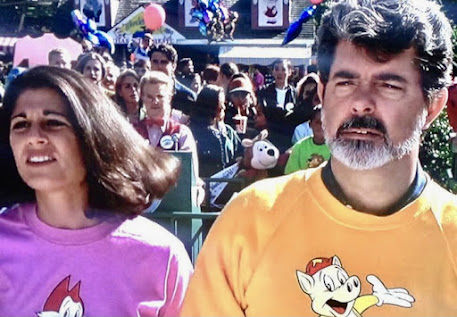
Because today is the 78th Birthday of THX-1138 and AMERICAN GRAFFITI filmmaker George Lucas, I was reminded of his odd cameo in John Landis’s BEVERLY HILLS COP III (1994). Then I thought about how Landis often had his fellow director friends put in brief appearances in his films, and then I thought that might make a good blog post. So before I think about something else, and forget this thread, let’s take a look at some of the most notable times that this crazy event occurred (this post is far from complete as I skipped over as well as probably missed a number of these instances).


The whole Landis and his filmmaker friends cameo calvacade starts with Frank Oz.


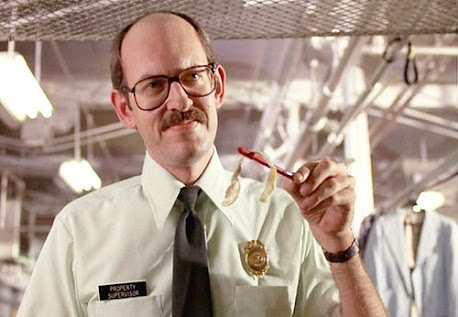
A few years before Oz began his filmmaking career co-directing THE DARK CRYSTAL (1982) with Jim Henson (his solo debut as Director was LITTLE SHOP OF HORRORS in 1986), the voice behind such major Muppets as Miss Piggy, Fozzie Bear, and Animal (among many others), made his in-person film debut as “Corrections Officer” in Landis’s THE BLUES BROTHERS (1980). The part consists of Oz drolly, and displaying much disgust, doling out the possessions of John Belushi’s Jake Blues as he’s being released from Chicago’s Joliet Prison. 

In Landis’s beyond misguided 1998 sequel, BLUES BROTHERS 2000, Oz reprises the role, showing that the character is now the Prison Warden, who has the sad task of having to tell Dan Aykroyd’s Elwood Blues, upon his release from Joliet 18 years after the events in the first film, that his brother has passed. Not sure why this important info wasn’t revealed to Elwood before this, but it actually makes for one of the miserable movie’s only heartfelt moments so I’ll drop the questioning.


Oz also put in cameos, usually as stern authority figures, in Landis’s AN AMERICAN WEREWOLF IN LONDON (1981), TRADING PLACES (1983), SPIES LIKE US (1985), and INNOCENT BLOOD (1992), which was not only his last appearance in a Landis film, but his last in-person part in a movie until his brief bit in Rian Johnson’s KNIVES OUT, in 2019. 


Back to the original BLUES BROTHERS, in which arguably the most famous, and most successful filmmaker in cinema history, Steven Spielberg put in a cameo. It was his film acting debut, as the “Cook County Assessor’s Office Clerk” who helped the black-suited, fedora, and sunglass-wearing music men fulfill their “mission from God.”


After a tragic accident which took the lives of actor Vic Morrow, and two illegally-hired child actors on the set of Landis’s segment for TWILIGHT ZONE: THE MOVIE (1983), the director/writer/producer staged a comeback in the 1985 Jeff Goldblum/Michelle Pfeifer vehicle, INTO THE NIGHT. The film was a decent mid ‘80s comedy throwaway, the kind you’d see and quickly forget on cable, but when it came to director cameos it boasted an embarrassment of riches.


Filmmakers Jack Arnold (IT CAME FROM OUTER SPACE), Paul Bartel (EATING RAOUL), David Cronenberg (SCANNERS), Jonathan Demme (SILENCE OF THE LAMBS), Richard Franklin (ROAD GAMES), Amy Heckerling (FAST TIMES AT RIDGEMONT HIGH), Jim Henson (pictured above with Landis), Colin Higgins (HAROLD AND MAUDE writer/BEST LITTLE WHOREHOUSE IN TEXAS director), Lawrence Kasdan (BODY HEAT), Paul Mazursky (AN UNMARRIED WOMAN), Daniel Petrie (A RAISIN IN THE SUN), Don Siegel (DIRTY HARRY), and Roger Vadim (BARBARELLA) all popped up throughout INTO THE NIGHT as the movie went, well, deeper into the night.


There’s too many of these people to post pics of here (unless I want a blog post a mile long), but here’s one of Cronenberg, whose part, credited as “Group Supervisor” was larger than most of the other directors involved.


Landis’s aforementioned 1985 Chevy Chase/Dan Aykroyd comedy SPIES LIKE US also featured:


Joel Coen, and Sam Raimi as “Drive-in Security.” 


And Terry Gilliam as “Dr. Imhaus.” 


Directors Mikael Apted, Ray Harryhausen, and Martin Brest (the director of the original BEVERLY HILLS COP) also put in cameos in SPIES LIKE US, but, again, I don’t want to take up too much space with pics.

Landis’s 1996 Tom Arnold comedy, THE STUPIDS, again featured Cronenberg, as well as more filmmaker bit parts by Robert Wise, Norman Jewison, Atom Egoyan, and Costa-Gavras.

I’ll finish with the cameo that inspired this post, Lucas as “Disappointed Man” in BEVERLY HILLS COP III. Unlike his other appearances in HOOK (1991) as “Man Kissing on Bridge,” and as Baron Papanoida in STAR WARS EPISODE III: REVENGE OF THE SITH (2005), he actually has a speaking part: “Hey!” – reacting to Eddie Murphy’s Axl Foley stealing his Sky Whirl ride at the fictional theme park, Wonderworld – and “Come on, let’s go.” Okay, those lines obviously aren’t much, but they do constitute Lucas’s only in-person lines ever in a feature film. Watch the scene if you must:


From how awkward, and stiff, the STAR WARS guru was in this scene, one can only guess that Frank Oz was busy that day.


More later…

Saturday, March 27, 2021

JABBERWOCKY: The Monty Python Film That Wasn’t

Now, to get it straight, Terry Gilliam’s 1977 medieval fantasy comedy JABBERWOCKY is not a Monty Python film. But it’s easy to see why it was mistaken and marketed as such. It starred Python’s Michael Palin, and featured Python Terry Jones in a small part, and, of course, Python Gilliam directed and co-wrote. And the movie was following MONTY PYTHON AND THE HOLY GRAIL so its aesthetics were heavily familiar.

Gilliam: “It was probably a mistake for my first film, JABBERWOCKY, to be set in medieval times, when it came out right on the heels of HOLY GRAIL.”

While these obvious similarities helped to keep JABBERWOCKY from being its own thing, its marketing is what really plagued it. Many of the various poster designs were graced with “Monty Python’s…” Let’s begin with one of the most derivative.

This was one of the posters promoting HOLY GRAIL:

Now this is one of the JABBERWOCKY one-sheets:

Pretty blatant thievery, huh? Too close for comfort, for sure. Now, here’s an ad from a newspaper during the era.


And a German poster for the film that features the tagline “Monty Python Unter Den Raubrittern” which translates to “Monty Python Among the Robber Barrons,” which is quite odd.

To be fair, some of the poster designs would tout “From the director of MONTY PYTHON AND THE HOLY GRAIL” and not jump up on the false advertising bandwagon.

Although Gilliam highly objected to these terrible re-brandings of his solo directorial debut, the misleading labeling survived into the ‘80s VHS revolution as you can see on the cover of the first videocassette version of the film:


This post was inspired by a recent viewing of JABBERWOCKY. I realized I had bought a DVD of it well over a decade at a big box store that was getting rid of their video inventory via cheap mark-downs of DVDs. Then my copy would stay on a shelf for ages until I finally decided, just last week, that I should give it a whirl. I had seen parts of it when I was a kid, but that really doesn’t count that as it was nearly 40 years ago.

I hate to say I didn’t care for JABBERWOCKY. Palin’s lead was a bit too earnestly dumbfounded by his squalid environment, and a lot of the dialogue was really dull. The fights with the Jabberwocky monster were the film’s most involving moments although the towering creature seemed a lot like the The Black Beast of Aaaaaargghh from HOLY GRAIL.

See? It always comes back to HOLY GRAIL when discussing JABBERWOCKY. I agree with Gilliam that it was a mistake to do a medieval movie so soon after Monty Python’s comic masterpiece set during the same time period. Gilliam would soar to much greater heights with TIME BANDITS, BRAZIL, THE ADVENTURE OF BARON MUNCHAUSEN, and TWELVE MONKEYS, but despite all the work he’d done with Python, when going solo, he had to start somewhere.

More later...

Monday, March 23, 2015

The Pixies’ Frank Black Blabs About BRAZIL For Film Acoustic


As I wrote in the Raleigh N & O, the third installment of the new series Film Acoustic was a real doozy: Frank Black of the iconic punk rock band the Pixies presenting Terry Gilliam's 1985 classic BRAZIL. The event went down last Thursday evening, March 19th, at the Carolina Theatre in Durham with a screening of the film, which I believe is the best film of the '80s, followed by a chat conducted by Modern School of Film founder and Duke graduate Robert Milazzo, a bit of audience Q & A, and solo acoustic performances of four songs (“Wave of Mutilation,” “Monkey Gone To Heaven,” “Los Angeles,” and “All Around the World”).

Here are some highlights from the fine evening:

Milazzo's introduction: “Terry Gilliam was asked ‘what was your favorite review of BRAZIL?’ from the critics because the critics loved this film. And he said ‘it was from Salmon Rushdie. Salmon said ‘we are all Brazilians. We are all strangers in a strange land.’” I offer you that bit of cultural anthropology because tonight’s guest studied for a moment or two cultural anthropology on his way to making music history. He told me last night though that the classes that he had the most fun were the cinema classes.

We’ll ask him if he feels that way in about an hour. Please welcome to the Modern School of Film, Professor Charles Thompson, everybody, Frank Black.”

(audience applause)

Frank Black: “I should probably mention, I uh, made a bit of a popcorn mess by my seat.”

Milazzo: “Really?”

Black: “I tried to get, I got, I threw half of it before it even started, but thank you for the popcorn. And uh, I didn’t know what to wear tonight – ‘cause my film professor Don Levine, who taught Avant Grade Film 302-B, used to always wear a black turtleneck, and a black jacket, black pants. And he had a black carrying bag also. And I didn’t have any turtlenecks. But uh, so I wore sweatpants because I wanted to be comfortable tonight, so uh, technically, these are pajamas actually. I wore my pajamas, and figured it was black, you know?”

Miliazzo: “The movie, as Jonathan Pryce says the movie is half real, half dreams, so its apropos that you would wear half real, half dreams…and clocks which I love, they tie the outfit together. Thank you man, thank you for being here.

Black: “It’s hard to believe that the suits at Universal would’ve seen any cut of that film and said ‘you know, we’ve got a couple of ideas we’d like to, uh…” (laughs) You know what I mean? It sort of seems like ‘really?’ How could you look at a single scene, you know, ‘we like what you’re trying to do here but…’ It’s sort of shocking but it’s not shocking, I don’t know. The artist is always right the tour manager told me and if, you know, you hire some guy to make a movie, the artist is all obviously making art. Just leave them alone, ‘cause you don’t know and they do because they’re right.

Milazzo: “When we invited you to screen whatever film you wanted to share, why did you pick BRAZIL?”

Black: “Well, it really is like a knee jerk kind of a choice – I liked it! You know, when I first saw the movie, and I’ve seen it many times, and even though you could talk about this film and analyze it, intellectualize it, talk about it on a few different levels I suppose, basically I thought, I really liked it. I was really entertained by it, and I loved the film, all analysis aside. Every time I see it, I’m reminded of that. Now we can talk about it on other levels, but I liked it.”

Milazzo: “When did you first see it? Did you see it in ’85?”

Black: “I saw it when it first came out, I didn’t know what cut it was. I don’t recall it having a completely hacked ending. I believe when it was shown on television, or something, they tried to end it on a happy note. Right? They escaped to the countryside, and lived happily ever after. There was some version of that I heard about, but I think when I saw it in theaters it had the more poignant ending.”

Milazzo: “What were you doing in ’85?”

Black: “I was living in Boston, I had just dropped out of college, and I was starting a band with Kim Deal and Joey Santiago.”

Milazzo: “That worked out.”

Black: “Yeah, I was basically going to the movies. When I was in between jobs, I went to a lot of films. We rehearsed, we had our day jobs, but basically I went to the movies a lot. Sometimes we’d all go to the movies together as a band, ‘cause it would be very important to me: ‘you have to see this film that I’m really into!” You know, and I would drag them with me. They’d go along, and we had kind of a cinematic origin I suppose, you know, in at least that was what I was looking at more than music. Obviously, I loved Husker Du, and Peter, Paul and Mary, but, and I’d go see Husker Du when they came to town, but the art of film, also especially like this, you know, the way it’s supposed to be. We didn’t have computers or laptops or tablets or anything, and if you were a young broke musician you didn’t have TV or anything, so I’d go to the cinema a lot. And I always did then. As soon as I had enough money to go to the movies, I guess from my late teens or whatever, I went to the movies a lot.”

Milazzo: “On a script level, Tom Stoppard wrote, and Gilliam credits him as giving the guts to the movie – the Buttle/Tuttle, the bug falling into the thing – and Charles McKeown, and just a bit of trivia, this is my back-up trivia question, he’s in LIFE OF BRIAN, he’s in the Biggus Dickus scene. The script of this is pretty sophisticated in a sense of how it balances politics, the politics of every day – do you watch it on that level? Do you watch it on the sort of middle management, working in offices, I mean, it’s not been your life per say.”

Black: “I mean, it echoes the past, it echoes the present, it amplifies the future. I mean, it’s so incredibly apropos to any conversation, whether it’s today or whether it was 1985 when they made it. Or, I imagine, in the future, where it will all make a lot of sense.”

Milazzo: “Your son is right.”

Black: “Without getting into any kind of specifics, you know, bombs, control, misidentification, homogenization, pasteurization, whatever, the machinery – where does one begin? It’s all there.”

Milazzo: “One of the cool things, and you said it so well, and it’s even a more intelligent perspective, this film does better watching it more times, maybe in a way, watching it again here – the samurai is made out of computer parts. You can only watch it if you scrutinize the movie. This whole retro-fitting thing – he admits he sort of got it from Ridley Scott and Blade Runner, but this retro-fitting was in.”

Black: “The Samurai I find particularly beautiful. When he’s defeated the first time by Sam, and the flames from the escaping gas coming out of him, something about it is really beautiful and evil and industrial…

Milazzo: “And analog! You know, it’s like the movie is homemade in a sense. When you see Ian Holm with his face and those arms…”

On the cast:

Black: “I love Ian Holm, his tension, his pretending his hand’s broken…the casting is so incredible in this film…Jim Broadbent as the plastic surgeon ‘cut cut, snip snip,’ with his hair and everything, just beautiful.”

Milazzo: “We talked about the performances a lot yesterday – Kim Griest who takes a bad rap in a way is perfect, I mean, the way the casting of that is perfect.”

Black: “One of the things I really liked about it, it involves her character of course, is just the idea of love. There’s this old school romantic thing where he’s just obsessed with this person. And he’s searching for this person, because he loves them…and that’s it. It’s so romantic, and he’s this dorky nervous nellie guy with all this existential ennui and he doesn’t know what he wants – ‘I want her, I think!’ And it reminds me of when I first had a romantic crush when I was young. 

You know, that’s what you would fantasize about, like the backdrop of this film it’s like it’s all gone wrong, the world’s gone wrong, and I wonder what would it be like if there was an apocalyptic war and the world as we know it is falling apart, ‘I’ll go to her house, to her parent’s house and I’ll go get her!’ And we’ll get on a train, or a horse (laughs). We’ll escape, we’ll get out to the countryside just like at the end there. I guess, again there, the influence of BLADE RUNNER, I don’t know. Finally escape the grimy dark urban kind of tubular life that they lived, and they finally make it out to the countryside of the green, there’s the English countryside, much like the end of BLADE RUNNER. Finally we get out of Los Angeles where we can breathe! (Takes a big breath)

On the ending:


Black: “That’s the noir ending, you know it’s like ‘nope!’ It isn’t alright! Nope! Death! No, it’s over. The bad guys win. Of course, that’s the ending you want. That’s the ending that’s gonna ‘cause people to talk about it. We don’t talk about happy endings because, we forget them.”

On “Debaser,” which was inspired by Luis Buñuel’s 1929 surreal silent film collaboration with Salvador Dali, UN CHIEN ANDALOU:

Milazzo: “What was the line between watching the film, 
UN CHIEN ANDALOU, and writing ‘Debaser,’ putting it out into the world, what was the creative chronology?”

Black: “I don’t really know, but I think the way I used to write songs at that time was that I’d use language in a kind of jabberwocky kind of way. I would find syllables and combinations of consonants and vowels that I liked the sound of them. So maybe they’d form a word I was familiar with and maybe they didn’t, but it would begin to take form that way. And then maybe I could, it would ascend into an actual intelligible word, and then maybe that intelligible word might inform the rest of the text, or the lyric, you know? So, it wasn’t like I had the need to write a song that was basically the Cliff’s Notes, sort of a pop song Cliff’s Notes version of UN CHIEN ANDALOU. 


A song is such a shrunk down thing, there’s a universe of ideas but you’ve only got (sings out a bit of melody made up of nonsense sounds) – that’s it! That’s all you’ve got, and so how are you gonna get all this information in? I just took some of the language from my interpretation of the film, and I just, I don’t want to say it’s a hack job! 

But I kind of used something that I liked, you know, it wasn’t like I was saying anything. Other than, to quote Serge Gainsbourg: ‘I am a surrealist!’ So it was my way of saying ‘I am a surrealist too!’ and ‘I’m borrowing your movies for my song!’ That’s a French accent, right?”

On 
“In Heaven,” a cover of a song from the ERASERHEAD soundtrack:

Milazzo: “Another song, ‘The Lady in The Radiator’ song, ‘In Heaven,’ which is an ERASERHEAD draw. Talk about that, watching ERASERHEAD conjuring that song. Do you recall that process?”

Black: “You brought it up, that is was the theme song to David Lynch’s ERASERHEAD, it was written, the lyric is by David Lynch actually, but the music is by a guy named Peter Ivers, and, of course, when I was a teenager I saw the film and I liked it, and we were a band playing nightclubs, we were an artsy fartsy band, so we did our loud version of that kinda simple song, and I thought we were so cool, but I found out that every metropolis on the planet has a band that has that song in their repertoire so we weren’t the only ones.”

On the use of the Pixies' 
“Where Is My Mind?” in David Fincher's 1999 cult classic FIGHT CLUB:

Black: “It was nice that our song was in it, but I was kind of more caught up in my cinema experience so I think I was able to compartmentalize it. I didn’t jump up and go ‘that’s me!’ But I mean, you know, I got a grand out of it, but I was engaged in the film. When it happened it washed over me like everybody else. It’s a great moment in the film, because it’s a great moment in the film not because of the song. The song works, but I think a lot of songs could’ve worked in that same spot. But he picked the right kind of song, I suppose, for his montage.”

On being up for a role in Fincher's ZODIAC

Black: “You know, uh, David Fincher was making the ZODIAC movie, and he wanted me to play the Zodiac killer, because I bore a certain physical resemblance.”

Milazzo: “Wow! That’s cool, man.”

Black: “And so he sent me part of the script and some other materials, you know so I could get all Robert De Niro and really get into my role – it was a little freaky, but, you know, I bought some combat boots that the guy was fond of, and tried to, you know, I went to an acting coach, we talked for a few minutes. And they know I’m not an actor and they weren’t trying to put a lot of pressure on me, but I sat there with him and his producer, and I was literally like, you know, Don Knotts, I was just like (makes unintelligible speech) – I was just reading off a page and I couldn’t even like, it was just so hard. It was so hard to act, to even just read, to put, to get any kind of connection to the drama, even in the most casual setting… ‘It’s okay, it’s alright , Charles’ I said, I literally couldn’t even talk. And they were ‘Thank you very much,’ and I never heard from them again.”

The next installment of Film Acoustic, on Monday, April 13th, looks pretty damn interesting too: Patterson Hood of the Drive By Truckers screens Sidney Lumet's 1976 classic NETWORK. Tickets are on sale now.

More later...

Tuesday, August 12, 2014

Film Babble Blog’s Top 10 Robin Williams Films


I was extremely saddened as well as shocked to hear yesterday evening that Robin Williams was found dead at age 63 of an apparent suicide.

Since I was a huge fan as a kid – it was the era of Mork and Mindy, POPEYE, and his first stand-up comedy album “Reality…What a Concept” (still have the original vinyl, pictured on the left) – and I’d seen nearly every movie the man made in the three decades since (as well as tons of TV appearances on just about every talk show there is), I've been finding it very difficult to process William’s passing.

However, one thing that helps is to look back at his rich career, particularly his legacy on film since this blog is all about babbling 'bout that. I compiled a list of my 10 favorite of Williams' many movies, which I am sharing below. I have to say with a “heavy sigh” (as Mork would say) that it wasn’t easy as he was in many lackluster or just plain sucky films (I’m looking at you PATCH ADAMS, JACK, MAN OF THE YEAR, RV, FATHER’S DAY, CLUB PARADISE, the list goes on and on), but I’m here to praise Williams not bury him.

So I’m going to forget the fluff, flops, and FLUBBER and remember the times he most made me laugh, as well as touch something deeper, on the big screen via these fine, unforgettable films (several of which are available for streaming on Netflix Instant):

1. THE FISHER KING
(Dir. Terry Gilliam, 1991)
  

Williams' performance as Parry, a homeless Holy Grail-seeking New Yorker, garnered him his second Oscar nomination (#4 on this list was his first). It was the perfect mix of his manic madman schtick and his somber sad sack personas, an alteration he could make simultaneously. For instance, an early scene in Parry's boiler room hideout when Jeff Bridges as a down and out former radio shock jock is exiting: “Now that you know where we are, don't be a stranger. Come back. We'll rummage.” Then less than a beat later in a softer tone, “Take care of yourself, Jack. Give my love to the wife.”

Williams also recites tender speeches to Amanda Plummer as a mousy accountant he loves, croons the standard “How About You?” backed by a band of bums, and strips naked in Central Park at night to lie in the grass, look at the sky and participate in what he calls “cloud busting.” Mercedes Ruehl, who won the Oscar (well deserved) for her role as Bridges' long suffering girlfriend, may have held the heart of the movie, but Williams was its bungled and botched soul.

2. POPEYE (Dir. Robert Altman, 1980)


Although its box office doubled its budget, and there were many critics that liked it (including Roger Ebert), Robert Altman's take on E.C. Segar's famous comic strip, and cartoon, character was largely considered a commercial and critical flop (see Mad Magazine's satire “Flopeye”). I had issues with it myself as a kid but it's really grown on me over the years. Williams is perfectly cast as the salty sailor with the comically large forearms (matched with the equally dead-on Shelly Duvall as Olive Oyl), although much of his mumbled dialogue is unintelligible. It really stands out as a film debut for the Julliard trained actor, who despite the rough reaction, proved there was a lot more to him than Mork.

Also check out my post about the film's strange soundtrack scored by Harry Nilsson.

3. THE WORLD ACCORDING TO GARP
(Dir. George Roy Hill, 1982)


Instead of retreating into the conventional comedy comfort zone that would plague much of his career, Williams followed up POPEYE with this lofty adaptation of John Irving's 1978 bestselling novel. The fan that I was at the time, I read the book (my parent's copy) in anticipation, which wasn't really appropriate material for a 12 year old.

Although I loved the ethos of Williams' everyman dealing with the sexual revolution, and John Lithgow's blustery Oscar-nominated portrayal of a former pro football player turned trans woman, I didn't really get the movie when I saw it at that age - but it my opened my eyes way wide for sure. Williams, no doubt, led many youngsters into edgy adult territory with this one.

4. GOOD MORNING, VIETNAM
(Dir. Barry Levinson, 1987)


Williams' first Oscar nomination was for his role as Armed Forces DJ Adrian Cronauer, a real life radio personality who ruled the airwaves in 1965 Vietnam. It's a definitive Williams performance, in a fine film that much like M*A*S*H successfully mixed humor with dark drama, but what's most memorable about is the in-your-face, over-the-top man's many hilarious broadcast booth scenes. The audio of these are well captured on the soundtrack, which you can read more about in my 2009 post 10 Movie Soundtracks That Think Outside The box Office.

5. WORLD’S GREATEST DAD
(Dir. Bobcat Goldthwait, 2009)

Williams' last great movie was also one of his gutsiest. He plays a high school poetry teacher and aspiring writer whose douchey son (Daryl Sabara) accidentally kills himself via autoerotic asphyxiation. Williams writes a suicide note to cover for him, and when that gets a lot of attention he fakes a journal of his son's writing which scores him a publishing deal. It's twisted stuff, right in line with the weird yet intriguing rest of writer/director Goldthwait's output (SHAKES THE CLOWN, SLEEPING DOGS LIE, GOD BLESS AMERICA), and Williams nakedly owns it.

6. THEADVENTURES OF BARON MUNCHAUSEN
(Dir. Terry Gilliam, 1988)


It could be seen as a glorified cameo, but as the floating, disembodied chatterbox head of the King of the Moon for his first feature with Gilliam, Williams stole the movie fair and square.

7. MOSCOW ON THE HUDSON (Dir. Paul Mazursky, 1984)

In another dramatic curve ball, Williams role as Vladmir Ivanov, a Russian circus musician who defects to America, is one of his most believable and grounded performances. It also is the basis of the theory that if Williams is bearded in a film, we're dealing with serious stuff. Soviet born Yakov Smirnov, a sensation in the '80s for his communism mocking comedy, had a small part in the movie. Of course he did.


8. AWAKENINGS (Dir. Penny Marshall, 1990)

Williams' role as a physician experimenting with a new drug on Parkinson's patients in this adaptation of Oliver Sack's 1973 memoir again backs up the beard theory, but more importantly its another dose of weighty yet warm work in which he keeps the wackiness under wraps. Aided by a sharp screenplay by Steven Zaillian (SCHINDLER'S LIST, GANGS OF NEW YORK, MONEYBALL), Williams' relationship with Robert De Niro, yet again Oscar nominated, as a patient who comes out of a long catatonic state, is a joyous collaboration that helps make it Penny Marshall's best film (yes, better than BIG and A LEAGUE OF THEIR OWN imho).

9. GOOD WILL HUNTING
(Dir. Gus Van Sant, 1997)

The fourth time was the charm nomination-wise, as Williams won the Oscar for his part as Matt Damon's therapist (bearded) in this highly acclaimed, crowd pleasing drama scripted by Damon and Ben Affleck (who also won Oscars for Best Original Screenplay). Williams made quite a mark in his sensitive portrayal of a widowed psychologist, and was able to fit in some funniness as well.

10. THE FINAL CUT (Dir. Omar Naim, 2004)

Probably the least well known movie on this list, and possibly the worst reviewed, this is a personal favorite because it came during a period in which I had written off Williams. His sober nuanced performance as “a cutter,” somebody who edits the memories of the newly deceased into two hour movies to be viewed as their funeral (the sci-fi tinged film takes place in the near future) made more of an impression on me than his widely praised part in the way too creepy ONE HOUR PHOTO from two years earlier. 

Other notable Williams film work: 

INSOMNIA, DEAD POET'S SOCIETY (second Oscar nomination), THE BEST OF TIMES, ALADDIN, THE BIRDCAGE, DECONSTRUCTING HARRY, WHAT DREAMS MAY COME, and DEATH TO SMOOCHY (that's right).

R.I.P. Robin Williams (1951-2014)

More later...

Tuesday, July 22, 2014

Monty Python: Older, Fatter, But Still Funny As F***


Last weekend, on Sunday, July 20th, my wife and I attended and laughed a lot at a live broadcast of “Monty Python Live (Mostly),” featuring the legendary British comedy group’s final performance ever (or so they claim) before a sold-out audience of 15,000 at The O₂ Arena in London, England.

The event, the last of a 10 show run, also sold-out at our venue, North Hills 14 in Raleigh, N.C., and from what I hear, at many of the 2,000 theaters around the globe that carried the broadcast, indeed proof that Python still has powerful pull even at this late date.

Despite some annoying sound glitches at the beginning, it was a hilarious delight seeing the surviving members - John Cleese, Eric Idle, Terry Gilliam, Terry Jones and Michael Palin – on stage together for the first time since their Hollywood Bowl concerts in 1980, energetically perform a revue of such classics as “Nudge, Nudge,” “Spam,” “Argument Clinic,” “Parrot Sketch,” “The Lumberjack Song,” and, of course, “Always Look on the Bright Side of Life” on a massive set with an orchestra (conducted by longtime Python collaborator John Du Prez) a couple dozen dancers, giant video screens, and, at one point, during the “Every Sperm is Sacred” number, candy-striped penis-shaped cannons that spewed confetti all over the audience.

The show’s tagline “One Down, Five to Go,” refers to the sad fact that sixth member Graham Chapman died in 1989, but Chapman’s presence was felt throughout the three hour program in the form of footage mostly from their classic BBC program Monty Python’s Flying Circus used to link the live segments and songs, and in lines like “He’s gone to join Dr. Chapman” added to “Parrot Sketch” with the audience’s roaring approval.

Much of the material presented was similar to that immortalized in the 1982 concert film MONTY PYTHON LIVE AT THE HOLLYWOOD BOWL – including the use of the filmed “Silly Olympics” and “The Philosophers’ Football Match” bits from the rare German episodes of Flying Circus – but there were several routines from their last motion picture, MONTY PYTHON’S THE MEANING OF LIFE, that had never been publicly performed before.

Those included an expanded version of “The Penis Song” sung by a cheeky as can be Idle, the aforementioned “Every Sperm is Sacred,” “Galaxy Song,” which is capped off by filmed cameos by physicists Brian Cox and Stephen Hawking (an audience shot afterwards showed Hawking in attendance), and “Christmas in Heaven,” which begins with an excerpt of Chapman singing from the original film.

Sketches that I was pleasantly surprised to see: “Vocational Guidance Counselor,” “Anne Elk's Theory on Brontosauruses,” and “Protestants Can Use Condoms” (also from THE MEANING OF LIFE).

I was also elated that actress Carol Cleveland, who’s been there since the beginning appearing on Flying Circus as well as all of the Python’s movies and stage shows, was there to reprise her pivotal parts. Guest appearances by Eddie Izzard, Mike Myers, and Warwick Davis helped liven things up as well.

Since I, and most watching, knew every line, it was funniest when the Pythons went off book. While quips about Palin’s “boring” travel shows, and Cleese’s multiple marriages were scripted, Cleese’s asides about bad reviews in the Daily Mail in the midst of the “Parrot Sketch”/ “Cheese Shop” mash-up apparently weren’t planned as they amusingly sidetracked, yet still didn’t sabotage Palin’s quick on his feet performance.

Having disliked many previous repackagings of Python, such as Idles’s musicals “Spamalot,” and “He’s Not the Messiah (He’s a Very Naughty Boy),” and the animated biodoc of Chapman: A LIAR’S AUTOBIOGRAPHY, I was so happy that “Monty Python Live (Mostly)” was a cringe free 45th anniversary celebration as well as a fitting send-off to the greatest, most influential comedy group of all time.


Older, fatter, but still funny as fuck, the Pythons put on a Hell of a last performance that I’ll definitely purchase when it inevitably gets a Blu ray/DVD release, with hope later in the year.

For those who can’t wait, however, “Monty Python Live (Mostly)” will be re-broadcast at many theaters on Wednesday, July 23rd and Thursday, July 24th. Click here for more info.


More later...

Friday, June 11, 2010

Blu Ray Review: NOT THE MESSIAH (HE'S A VERY NAUGHTY BOY)


Now out on Blu ray and DVD:

NOT THE MESSIAH (HE'S A VERY NAUGHTY BOY)

(Dir. Aubrey Powell, 2010)

Way before I was a hardcore movie fanatic I was a hardcore Monty Python fanatic - I'm talking when I was a kid in the early '80s here. 

I went to late shows of their movies, I had all their records and books, I saved up money to buy a VCR solely to record episodes of Monty Python's Flying Circus - I had it bad. I still love 'em and go to see revival screenings of MONTY PYTHON AND THE HOLY GRAIL and LIFE OF BRIAN whenever they're in my area despite owning the DVDs, so, of course, whenever there's new product such as last year's excellent documentary mini-series "Monty Python: Almost The Truth - The Lawyer's Cut" I'm all over it. 

However there is a huge threat to all my nostalgic affection: Eric Idle. The former Python has spent the last decade, in the words of another former Python Terry Jones, "regurgitating Python." Idle has toured playing the songs in a show entitled "Eric Idle Exploits Monty Python", mounted a wildly successful Broadway production based on HOLY GRAIL - "Spamalot", and now has turned to LIFE OF BRIAN for the new musical oratorio NOT THE MESSIAH (HE'S A VERY NAUGHTY BOY)

Because I'm a long time fan I just had to see it the second it dropped on Blu ray. With the help of long-time collaborator/conductor John Du Prez, the BBC Symphony Orchestra, and a bunch of trained operatic singers, Idle reduces the savage satire of the classic film into only slightly racy almost family friendly fodder. Appropriating Handel's "Messiah" in misguided attempts to flesh out character threads that were best left as comic asides, we get songs about the Roman Centurion that raped Brian's mother and Idle's beloved bit about an anachronistic wish for a sex change, is now recast as a lame unfunny ballad. NOT THE MESSIAH basically is "Spamalot 2" though there are a few differences. 

It's not an in costume performance - though a few performers are outfitted like their characters - it's a filmed live performance for a radio broadcast. There's also that giant orchestra and chorus involved too. But infinitely more important, because it was the 40th anniversary of the group (October of last year) Python members Michael Palin, Terry Gilliam, and Terry Jones were on hand to reprise their roles or just appear for the sake of good will (like Gilliam appears to). 

The only other surviving Python, John Cleese, was not present presumably because he was off rolling his eyes somewhere. It doesn't improve matters that the singers (William Ferguson and Shannon Mercer) recruited to play the pivotal parts of Brian and Judith, wonderfully previously portrayed by the late great Python leading man Graham Chapman and Sue Jones-Davies (now Mayor of Aberystwyth, Wales), look and sound more like they should be in a Prince Charles and Lady Diana musical.

I was also surprised that Brian's mother Mandy is played by a woman! One of the most hilarious factors of LIFE OF BRIAN was Terry Jones amped-up Pepperpot performance as the protagonist's disapproving ball-busting Mama. Here renowned soprano Rosalind Plowright takes the part, and more than a little of the narrative's point-of-view, and though she's a fine vocalist it's a slap in the face of the brilliant bite of BRIAN. Especially since Jones was there and could have done it. Missed opportunity city.


The music is immaculate in its presentation, but the new songs are repetitive, obvious, and supremely forgettable. The only highlights are the Python cameos - it's funny to see Palin in full Margaret Thatcher-ish drag introduce the show. Palin by contrast is definitely the only Python who has maintained his figure. 

It's also nice to see Palin in his old Pontius Pilate garb proving he can still pull off the lisp. Jones and Gilliam are just there for glorified cameos neither of which really registers and Idle's hammy line readings seriously grated on me, though the packed Royal Albert Hall audience ate it all up, cheering at every familiar phrase. 

The crowd did appear to love it, and maybe I would've too had I been there, but watching it at home, even on a spiffy new Blu ray, was a sad trying experience. Looks like Idle will be singing "Always Look On The Bright Side Of Life" (which was also in "Spamalot") and "The Lumberjack Song" (here acting as the encore) for the rest of his life. I once considered Idle the greediest Python, now I think of him as the Python who can't move on. 

In a few years from now when he unveils his inevitable THE MEANING OF LIFE musical I hope that I've moved on enough to skip it. I'd like to think by then that I would have had enough of these warmed over retreads, but then I am a glutton for punishment... 

More later...

Saturday, January 09, 2010

Ledger’s Last Film: Good But Not Great Gilliam

THE IMAGINARIUM OF DOCTOR PARNASSUS 
(Dir. Terry Gilliam, 2009)


Terry Gilliam is infamous for problems plaguing (and sometimes halting) many of the productions of his fantastically far-fetched films, but as I'm sure folks reading this well know, none have been hit harder than this one. The untimely death of Heath Ledger midway through shooting threatened to squash the project, but Gilliam came up with a solution to cast three of Ledger’s acting peers to fill in for his remaining scenes.

It helps the conceit that in the story Ledger’s character steps through a magic mirror into another world in which he could be somewhat plausibly changed into another person. It also helps that the 3 actors filling in just happen to be very big names in the business: Johnny Depp, Jude Law, and Colin Farrell.

Given these circumstances, the finished film works better than it has a right to. Working with a much lower budget than before, Gilliam knows how to draw an audience in to a strange setting, one that’s familiar to fans with its ratty stage folk and tall tales that just might be true. 

In the title role, Christopher Plummer, made to look ten times scragglier than usual, leads a group of show folks making their way around modern day London in a make-shift stage vehicle. The group is made up of the Doctor’s daughter (Lily Cole), a clever but neurotic magician (Andrew Garfield), and an out-spoken dwarf (Verne Troyer) who has many of the films best lines.


Plummer tells his daughter (and us) his bizarre back story (well, bizarre if you’ve never seen a Gilliam film before) involving a deal with the Devil (a terrific Tom Waits) and the darkening of his visions. When crossing a bridge in the middle of the night the traveling troupe comes across Ledger hanging from a noose. They get him down and find he’s still alive. 

When he comes to the next day he asks where he is. Troyer answers: “Geographically, in the Northern Hemisphere. Socially, on the margins. Narratively, with some way to go.”

Ledger has no memory of his life before his suicide attempt so he joins the Imaginarium players, soon making changes to their set and presentation. A crumbled newspaper page blowing around the rubble of the seedy dank underworld they call home reminds Ledger of his shady background, but he continues to go along with the troupe especially after learning that the Doctor’s Imaginarium is no scam.

The film beautifully builds up to when Ledger first goes through the mirror and the transition to Johnny Depp is successfully smooth. Depp has the briefest bit of the guest replacement actors, but makes the most of it with his patented eyebrow exercises and dance moves. 

Jude Law and Colin Farrell are well suited for the smarmy greedy parts of Ledger’s personality that emerge in further mirror excursions if indeed that’s what they were supposed to symbolize.

Such errant elements in the second half don’t gel well and key plot points are muddled or clumsily glossed over, but that Gilliam was able to complete this film to as coherent as it is makes up for a great deal of defects.

THE ADVENTURES OF BARON MUNCHAUSEN is the closest relative IMAGINARIUM has in Gilliam’s canon. 

Both deal with wizened old men spinning legends out of their outrageous realities; performing their fables on the sideshow circuit, laying in wait for fortune or death - or both. IMAGINARIUM has a much lower budget that MUNCHAUSEN, yet it benefits from less aesthetic indulgence and its smaller scale gives it more intimacy.

It’s far from Gilliam’s best movie, and it’s far from Ledger’s best performance, but as a salvaged final project, I’m glad THE IMAGINARIUM exists. 

It’s a mixed bag of a movie (and may still have been had Ledger lived), but it’s a still a fairly fun film and a fitting tribute. At the end we are told that this is “A film from Heath Ledger and friends.” I know it's lame to say that 'it's the thought that counts', but dammit - it counts the most here.

More later…

Wednesday, January 06, 2010

The Terry Gilliam Repertory Role Call 1977-2009

In anticipation of the new Terry Gilliam film THE IMAGINARIUM OF DOCTOR PARNASSUS opening wide this Friday here's a listing of Gilliam's stupendous stock company. This is excluding the Monty Python films, because Gilliam only co-directed one of them (MONTY PYTHON AND THE HOLY GRAIL). So let's get right to it:

Jeff Bridges (THE FISHER KING, TIDELAND) 7 years before "The Dude", Bridges abided as pony-tailed radio shock jock Jack Lucas who finds redemption by way of a crazy homeless Robin Williams (see end of list). Bridges' fate was less rosy in TIDELAND (2005) - he plays a crusty old rocker reminiscent of Kris Kristopherson (a foreshadowing of CRAZY HEART?) who dies of a heroin overdose and spends most of the film as a rotting corpse sitting upright in a chair in a rustic farmhouse. Also notable: Bridges narrated the excellent heartbreaking documentary LOST IN LA MANCHA that focused on Gilliam's aborted 2000 production of THE MAN WHO KILLED DON QUIXOTE.

Jim Broadbent (TIME BANDITS [1981], BRAZIL [1985]) The small but juicy role of a sleazy Compere of the game show "Your Money Or Your Life" was one of Broadbent's first film roles. He appeared again in Gilliam's next film, the bizarre but brilliant BRAZIL, as Dr. Jaffe - a plastic surgeon for one of the other notable cast members on this list (Hint: skip ahead 2).


Winston Dennis (TIME BANDITS, BRAZIL, THE ADVENTURES OF BARON MUNCHAUSEN 1988) A couple of bit parts as "Bull-headed Warrior" who battled King Agamemnon (Sean Connery) in TIME BANDITS and "Samurai Warrior" in BRAZIL led to an actual character name for Dennis, actually 2, Bill/Albrecht, an intertwined duo in Gilliam's overblown but still incredibly charming epic comedy: THE ADVENTURES OF BARON MUNCHAUSEN (1988).


Johnny Depp (FEAR AND LOATHING IN LAS VEGAS, THE IMAGINARIUM OF DOCTOR PARNASSUS, ) A Hunter S. Thompson adaptation is not a characteristic project for the dogged director, but with the demented Depp as the Gonzo journalist, Gilliam found his fantasist footing in the trippy terrain. Depp lent a hand famously filling in for Heath Ledger as "Imaginarium Tony #1" in the upcoming IMAGINARIUM... and is slated to be Sancho Panza (a role he was unable to complete in 2000) in THE MAN WHO KILLED DON QUIXOTE (2011). Barring any unforeseen incident, mind you.

Katherine Helmond (TIME BANDITS, BRAZIL, FEAR AND LOATHING IN LAS VEGAS)

While she's best known for her US television sitcom work on Soap, Who's The Boss, and Everybody Loves Raymond, Helmond has an almost alternate reality film career in the alternate realities of Gilliam. 

In TIME BANDITS she's fittingly named Mrs. Ogre as she's the wife of "Winston the Ogre" (Peter Vaughan), in BRAZIL she's Ida Lowry - the mother of protagonist Sam Lowry (Jonathan Pryce), and in FEAR AND LOATHING... she's "Desk Clerk at Mint Hotel" - a study in uncomfortable disapproving scowling. You'd think she'd be used to Gilliam's grotesqueries by that point.

Ian Holm (TIME BANDITS, BRAZIL) To go from the legendary Napoleon to the lowly office boss Mr. M. Kurtzman in just a few years is quite a demotion. And perhaps it's adding insult to injury that neither role has any positive light shed on them but Holm puts in perfect performances that actually provoke sympathy. Incidentally Holm would go on to portray Napoleon again in THE EMPEROR'S NEW CLOTHES (2001).

Michael Jeter (THE FISHER KING, FEAR AND LOATHING IN LAS VEGAS)


Jeter died in 2003 leaving behind an eclectic career that stretched from musical theater to television comedy to the silver screen and back again. His parts in 2 of Gilliam's finest films as "Homeless cabaret singer" and "L. Ron Bumquist" are as memorable as character acting can be - especially when he belts out a medley of show tunes in drag to Amanda Plummer in THE FISHER KING.

Simon Jones (BRAZIL, TWELVE MONKEYS) These are pretty blink and miss them cameos (as an "Arrest Official" and "Zoologist" respectively) from Python pal Jones best known as Arthur Dent on the BBC TV version of The Hitch Hiker's Guide To The Galaxy (1981). 

Heath Ledger (THE BROTHERS GRIMM, THE IMAGINARIUM OF DOCTOR PARNASSUS) Of course, the tragic death of Heath Ledger in 2008 deprived the world of an amazing young talent, but a blossoming Gilliam leading man is how he'll remain frozen in time as "Tony" in his last film: THE IMAGINARIUM... Ledger was reported as being close to Gilliam beginning with their work on BROTHERS GRIMM, so it's not so far-fetched to imagine them collaborating often had he lived. 

Charles McKeown (TIME BANDITS, BRAZIL, THE ADVENTURES OF BARON MUNCHAUSEN, THE IMAGINARIUM OF DOCTOR PARNASSUS)


McKeown has been on hand to fill in random bit player parts in these 4 films simply because he co-wrote them with Gilliam. His work as "Theater manager", Harvey Lime, Rupert/Adolphus, and "Fairground Inspector" may go majorly un-noticed but such a solid player should at least get a shout out from this blogger.


Christopher Meloni (TWELVE MONKEYS, FEAR AND LOATHING IN LAS VEGAS) Before he was Detective Elliot Stabler on Law & Order: Special Victims Unit, or criminal Chris Keller on Oz for that matter, Meloni played Lt. Halperin in TWELVE MONKEYS then "Sven, Clerk at Flamingo Hotel" in FEAR AND LOATHING...