Showing posts with label Andrew Garfield. Show all posts

Monday, February 07, 2022

Adventures In The Spider-Verse Part 2

This post picks up right from where Part 1 left off. Here, we follow Spider-Man as he enters development hell, slinging from deal to deal between studios until he finds a home with Sony.

After acquiring the rights to our friendly neighborhood Spider-Man, Cannon Films execs Menahem Golan, and his cousin Yoram Globus hired Tobe Hooper (TEXAS CHAINSAW MASSACRE, POLTERGEIST) to direct. You see, Golan and Globus had never read the comic, and thought it would be a horror film like THE WOLF MAN. Marvel and co-creator Stan Lee hated their concept, Hooper left the project, and the producers went back to Spider-Man’s original premise.

I remember seeing this ad in Variety (I think) in 1986:


This reminds me of a scene in Tim Burton’s ED WOOD, in which filmmaker Wood (Johnny Depp) asks producer George Weiss: “Is there a script?” and Weiss answers “F***, no, But there’s a poster!”

There was also a trailer:


Cannon tried to keep the momentum going with a new Director, Joseph Zito (a few Chuck Norris flicks, one FRIDAY THE 13th sequel), and new screenwriters. They wanted Tom Cruise for the role of Peter Parker/Spider-Man, but settled on actor/Stuntman Scott Leva. Leva had portrayed Spider-Man at Marvel events and in print ads, but the whole enterprise was derailed by budget cuts, and bad business dealings that had Cannon headed for bankruptcy.

SPIDER-MAN: THE MOVIE continued to be in development hell, as it was re-written and re-written as it went from studio to studio. In 1990, another company that’s no longer with us, Carolco Pictures obtained the rights, and set about making a big ass action film helmed by James Cameron, a hot property after the successes of THE TERMINATOR, ALIENS, and THE ABYSS. Not a lot is known about this attempted version, that Cameron co-scripted, but Arnold Schwarzenegger was discussed as a candidate to play Doctor Octopus, one of Spider-Man’s biggest adversaries.

Of course, this fell through too, and despite the many millions spent, the series of screenplays written, the studios’ efforts, and all the lawsuits, our friendly neighborhood Spider-Man’s tour in development hell continued. Finally MGM acquired the rights, but exchanged them with Columbia for the rights to the James Bond series.


That brings us to Spider-Man’s big cinematic comeback in Sam Raimi’s epic 2002 adaptation SPIDER-MAN, which was a huge hit. Tobey Maguire became the first live-action Spider-Man in nearly quarter of a century. But what’s now become a bit of trivia is that the film’s first trailer, the first look at the new Spider-Man caused controversy because it featured our hero building a web between the twin towers of the World Trade Center, and was in heavy circulation in theaters when the tragedy of 9/11 occurred. Sony removed the trailer from theaters (you can find it on YouTube), and nixed a poster that also used WTC imagery.


I loved the newfangled SPIDER-MAN, and I remember thinking that I wished I could somehow send a copy of it to my six-year old self, because that kid would be blown away. It was the big-budget, star-studded, effects-driven epic that fans had waited a lifetime for.

SPIDER-MAN 2 was damn good too, with a great villain in Doctor Octopus (or Doc Ock), played by Alfred Molina. The special effects were even better than the first, as evidenced by its Academy Award win. Though it had its moments, the third entry was a bit of a comedown in quality. Sadly, it was the end of the Raimi/Maguire era of Spider-Man movies, and it would be five years until the franchise would be rebooted.


While I like Andrew Garfield, and am a big fan of Emma Stone, I wasn’t on board for 2012’s THE AMAZING SPIDER-MAN. It felt like the Maguire installments had ended unsatisfactorily, and it was too soon to redo the character’s origin story. Ditto for its 2014 sequel, which for the most part, I barely remember.

Although THE AMAZING SPIDER-MAN and its follow-up were box office smashes, its critical reception called for a new direction. Garfield was replaced by 19-year old British actor Tom Holland, whose Spider-Man made his debut in the Marvelverse in CAPTAIN AMERICA: CIVIL WAR. This was thanks to a rare deal between Sony and Marvel, that led to Holland appearing in two AVENGERS movies, and three solo Spider-Man films.


Following SPIDER-MAN: HOMECOMING and SPIDER-MAN: FAR FROM HOME, the third entry, SPIDER-MAN: NO WAY HOME, may be fronted by Holland, but its real stars are his supporting cast. For this franchise does something that no other franchise has done before, it brings back two of the previous actors who starred in the role. Maguire and Garfield show up as the alternate versions from the multiverse of the character that we experienced in their movies. This concept was introduced in the 2018 animated adventure, SPIDER-MAN: INTO THE SPIDER-VERSE.

The summoning of past Spider-Mans isn’t the whole show, as seemingly every villain all three of our heroes fought in their films returns. There’s Doc Ock (Molina), The Green Goblin (Willem Dafoe), Electro (Jamie Fox), Lizard (Rhys Ifans), and Sandman (Thomas Haden Church), a roster of baddies that brings to mind the gathering of famous adversaries brought together in THE LAST ACTION HERO. 


NO WAY HOME could be seen as a sequel to Maguire’s trilogy, a follow-up to Garfield’s two film reign, as much as it is Holland’s third effort as Spider-Man, which will definitely not be his last as it’s the highest grossing movie of 2021.

The Spider-Man enterprise looks to be in good shape, maybe the best shape it’s been in since SPIDER-MAN 2 in 2004. The move to pay tribute to what’s come before is obviously fan-service, but it’s damn fine fan-service as it ties up some loose ends, particularly in Garfield’s case. The only thing that would make it better is if they had found a way to work Nicholas Hammond into it too. You know, for completist’s sake.

The takeaway here has got to be: You can never have too many Spider-Mans.


More later...

Adventures In The Spider-Verse Part 1


Not long ago, I finally caught up with the latest Marvel movie, SPIDER-MAN: NO WAY HOME, which opened last December. I enjoyed the film, and it made me wax nostalgic about the different incarnations of Spider-Man I’ve experienced over the years. So join me as we take a trip back to a groovy time.


Note: Despite the image at the top of this post, this walk down Memory Lane doesnt include, except in passing, the many animated versions of Spider-Man, or the comics that ran through the decades covered here.


When I was a five or six year old in the ‘70s, I became a fan of the web slinger via his appearances on The Electric Company. This was an educational PBS program that ran from 1971-1977, and featured such stars as Rita Moreno, Morgan Freeman, and, uh, Bill Cosby. The show posited itself as the hip alternative or companion to Sesame Street, and one way they grabbed kids’ attention was to align themselves with one of the hippest comic book characters of the day.


The recurring sketches entitled “Spidey Super Stories,” starred Danny Seagren, a puppeteer and professional dancer, who made history as the first live-action Spider-Man. Seagren’s version of the superhero never spoke (except in silent word bubbles), never appeared unmasked as Peter Parker, and never fought any of his normal foes like Lizard, Dr. Octopus, the Green Goblin, who were replaced by such supposedly evil entities as the Can Crusher, Mr. Measles, and Spoiler (who I guess spoils endings to movies, ‘cause what else can it mean?). Freeman apparently honed his narrator chops here as he lent his distinctive voice to explain Spider-Mans motives to kids.


Over the run of 29 mini-episodes, Spider-Man was very popular with my elementary school mates who started collecting Spidey comics, and toys. My Mom even made me a Spider-Man costume, which I weirdly wore to school one regretful day. Anyway, the widespread love for The Electric Company shorts must’ve inspired somebody at CBS to give the already iconic character his own show.


The result, The Amazing Spider-Man, starring Nicholas Hammond (LORD OF THE FLIES, THE SOUND OF MUSIC, ONCE UPON A TIME IN HOLLYWOOD), made its debut in September 1977. One could say Hammond was the first feature-length live-action Spider-Man as the series started off with a 2-hour TV movie, and was released theatrically overseas.


I remember watching the show, but feeling bored by it. Like in his previous post, he didn’t fight any classic baddies, and his demeanor was cold, devoid of the snappy one-liners that he spouted as much as he spun webs. 
Spider-Man co-creator Stan Lee said in an interview, “They left out the humor. They left out the human interest and personality, and playing up characterizations and personal problems.” 


I liked Hammond, and the effects were actually pretty good for the time, but the show wasn’t given any chance to grow as it was cancelled after only 13 episodes. So in 1979, after two television adaptations, the concept of a live-action Spider-Man was dead in the water.


That is, until the mid ‘80s, when Orion Pictures, and the B-movie master, Roger Corman, attempted to resurrect his corpse. Corman had the film rights to Spider-Man, but only briefly as his option expired, and Cannon Films swept in to give Marvel Comics $250,000, and a percentage of the gross, to make the first real SPIDER-MAN movie.


Coming up: The fate of the Cannon collaboration, the time that James Cameron was poised to take over the character, and the rebirth of the iconic web-slinger in the wake of 9/11.


Click here for Part 2


More later...

Thursday, January 12, 2017

SILENCE Tests My Faith In Scorsese

Now playing at a multiplex near you:

SILENCE (Dir. Martin Scorsese, 2016)


It is well documented that, in his childhood, Martin Scorsese attended a Roman Catholic seminary, and dreamed of being a priest.

Of course, he later chose making movies over practicing religion, but that didn’t mean that he ever abandoned his spiritual faith.

Religious themes and imagery appear in all of Scorsese’s films whether they’re in your face like Christ himself on the cross in his controversial adaptation of Nikos Kazantzakis’ equally controversial novel, THE LAST TEMPTATION OF CHRIST, or subtly, like the tiny cross around Henry Hill’s neck in his adaptation of Nicholas Pileggi’s “Wiseguys,” GOODFELLAS.

But in this, his adaptation of a book he read between making LAST TEMPTATION and GOODFELLAS, Shūsaku Endō’s 1966 novel “Silence,” Scorsese dives deeper into the questions that have plagued him his entire career: how far can or should one go to save his and/or others’ souls? How can we serve a God that allows such extreme suffering? What if we are praying to nothing at all?

Set in the early 17th century, SILENCE concerns Adam Driver and Andrew Garfield as two Jesuit priests, named Sebastião Rodrigues and Francisco Garupe, who travel to Japan to find a former mentor of theirs, Cristóvão Ferreira (Liam Neeson), after hearing that he renounced his religion to escape persecution.

This is during what was called the “shogun era” of Japan, in which Christianity was outlawed, and those captured practicing it were interrogated, tortured, and killed.

With the questionable help of an alcoholic guide named Kichijiro (Yosuke Kubozuka), Sebastião and Francisco sail to the coastal town of Tomogi where they administer to the villagers.

The priests stay in hiding, nightly meeting with the Kakure Kirishitan (“hidden Christians”), but they are found out and after having to endure witnessing some intense torture scenes that I’ll refrain from describing, they separate and the film follows Garfield’s Francisco while Driver’s Sebastião disappears for a large chunk of screen-time.

Francisco gets captured by Japanese authorities and is taken to Nagasaki to be interrogated by Inquisitor Inoue (Issei Ogata), an elder, sinisterly smirking Japanese official, via Inoue’s sleazily charismatic interpreter (Tadanobu Asano).

In captivity, Francisco is given a choice: either step on “fumi-e,” a plate that has an image of Christ or the Virgin Mary carved into it, to repudiate his faith, or they will torture and kill the other captives.

Neeson’s Ferreira, looking like a shamed version of the Jedi master he played in THE PHANTOM MENACE, even shows up to help Francisco make this difficult decision.

For most of its two hours and forty minute running time, SILENCE moves very slowly with cinematographer Rodrigo Prieto’s camera staying very still for lengthy shots.

You’ll feel like you’re really out in the harsh, grayish green mountain terrain of Japan, waiting for something, anything, to happen through long passages of this often plodding narrative.

The hardcore Scorsese fan in me was scanning the screen with excitement during the first 20 minutes, but that lost momentum as the film did the same for roughly the next 40, then that fading enthusiasm got regularly jolted back into temporary immersion by various violent moments up until the end.

Garfield, who as he gets shaggier on his journey looks more and more like Jesus as the film progresses, puts in an invested performance, as do his cast-mates (Driver does a lot with a little), but it might be Kubozuka as the desperately conniving Kichijiro that gives the film the most energy.

This last year, Garfield also played another devout Christian in a historical drama whose belief system gets put to the test under extreme circumstances. That would be HACKSAW RIDGE, where he portrayed conscientious objector Desmond Doss, who saved many lives in World War II. I hate to say this, but HACKSAW RIDGE is a better, much more compelling film about conviction and sacrifice than SILENCE.

Obviously, I hate to say that because HACKSAW RIDGE was made by Mel Gibson, and this is, you know, f-in’ Scorsese!

Since this was a 30 year in the making passion project, I so wanted to love it, but there was a serious disconnect between the action and imagery on screen, which admirably is as straight forward as can be, without visual trickery or flashing editing; and my fully surrendering myself to the experience. That’s something I’ve been able to do with so many of Marty’s movies throughout my movie-loving life, but it just wasn’t happening here.

Then again, I’m still processing it so maybe one day I’ll see it differently. There have been a number of Scorsese films that get better with repeated viewings (like CAPE FEAR, BRINGING OUT THE DEAD), and those that I appreciate more (NEW YORK, NEW YORK, KUNDUN), as I get older, and wiser and all that crap.

But, you see, the reason I’m saying these kind of things, that is, making excuses for not liking a movie by one of my heroes, is because I’m a devout follower, who wants to believe that all of the man’s works are masterpieces – some blinding, some in hiding.

SILENCE is as much a test of Francisco’s faith as it is a test in my faith in Scorsese. I so want to believe his latest film is a masterpiece in hiding, and not the seemingly passionless project I suffered through, but I just can’t put that in a prayer yet.


More later...

Friday, May 02, 2014

THE AMAZING SPIDER-MAN 2: Here We Go Again...Again

Now playing at a Marvelplex near you...

THE AMAZING SPIDER-MAN 2  
(Dir. Marc Webb, 2014)
 

I tried to go into this sequel to the re-boot with an open mind, but it wasn't easy as my enthusiasm for the Spider-Man franchise is at an all-time low these days. I so wasn't into Marc Webb's first entry 2 summers ago; I wrote on this very blog that it seemed "more like a reconfigured remake than a brand new beginning." Well, the sequel is more of the same as it matches a lot of story beats from Sam Raimi's SPIDER-MAN 2 from 10 years ago.

Andrew Garfield is back as the web-shooting super hero who is now haunted by the ghost of NYC Police Captain George Stacy (Denis Leary), who I forgot had died in the first one (shows how much it left my memory). A flashback reminds us that Garfield's Peter Parker had promised Leary's Stacy that he would leave his daughter Gwen (Emma Stone) "out of it," so after a late entrance at their graduation - Spider-Man had to chase down a Russian mobster (Paul Giamatti) who had hijacked a truck filled with tons of Oscorp plutonium, you see - our conflicted protagonist breaks up with the love of his life.

Meanwhile some half-assed villain origin stories are being set up concerning Peter's childhood friend Harry Osborn (Dane DeHaan), who we all know becomes the Green Goblin, and Jamie Foxx as a Oscorp maintenance man who has the bad luck to fall into a tank of genetically modified electric eels.

This happenstance turns Foxx into a blue glowing electric generator that engages in a Times Square-set battle with Spider-Man that's one of the better sequences. Unfortunately its more MAN OF STEEL than SUPERMAN II as there's loads of messy bombastic destruction that had to cause some deaths but you never see them. Instead they cut to a comical shot of Spidey wearing a fireman's helmet and holding a running hose while firefighters are laughing it up all around him.

The plot gets messier with DeHaan scheming to get a transfusion of Spider-Man's blood to fight off his growing illness, Stone considering going to study at Oxford, and Garfield trying to solve a mystery left behind by his late father (Campbell Scott) involving a briefcase and a secret lab. Garfield does this by constructing a Homeland-style cork board of documents, pictures, notecards, press clippings, string tying them all together, etc. I bet that's not far off from how screenwriters Alex Kurtzman and Roberto Orci (STAR TREK INTO DARKNESS) along with Jeff Pinkner (James Vanderbilt is also given a story credit) constructed the screenplay.

At an overstuffed 142 minutes, THE AMAZING SPIDER-MAN is tiresome and uninspired franchise filler. There is some charming chemistry between Garfield and Stone, who are dating in real life, but the insipid dialogue they're given sabotages them on almost every line.

That's just one of many of the movie's problems. The humor feels off, Hans Zimmer's score is generically overwrought, Giamatti is too ridiculously over-the-top, the theme of Peter trying to sell the world (or at least his still unseen Editor J. Jonah Jameson) on Spider-Man being here to help is cheesily handled, Leary's ghost is a poor plot mechanism, Sally Field as Aunt May isn't given anything to do, and a major character getting killed (I'm not Spoiling who) doesn't have anywhere close to the emotional impact it's going for. Even the Stan Lee cameo falls flat.

One of the film's few plusses is its design, and ace cinematography by Daniel Mindel. But even with the effects advancing further forward, Webb's SPIDER-MAN is still toiling in the aesthetics of the Raimi/Tobey Maguire trilogy. It's like they are content to stand in those superior chapters' shadow, without any motivation to put their own distinct stamp on the classic comic book character.

Sony has unsurprisingly got SPIDER-MAN 3 and 4 already scheduled for 2016 and 2018 to fill the spaces between the more promising installments of the Marvel Universe (THE AVENGERS, IRON-MAN, CAPTAIN AMERICA, et al). This is really only good news to the diehard fanboys, because I bet the rest of us will think twice about ponying up for such subpar Spider-man entries like this one.

More later...

Tuesday, July 03, 2012

SPIDER-MAN Restarts


THE AMAZING SPIDER-MAN (Dir. Mark Webb, 2012)


Sure, it may seem too soon to re-boot the Spider-man franchise, but it’s a big profitable series for Sony so, of course, they’re going to keep it going.

That’s fine, but despite a likable new cast, headed by Andrew Garfield taking over from Tobey Maguire as the webbed crusader, and an intriguing variation on the origin story, THE AMAZING SPIDER-MAN seems more like a reconfigured remake than a brand new beginning.

Director Webb (fitting, huh?), recreates the aesthetics, tone, and formula of Sam Raimi's Spider-man trilogy so precisely that the movie can’t help but seem redundant. Especially when it hits the same story beats as the 2002 original. In this film’s origin story, Garfield’s Peter Parker, who is less of a dweeb than Macguire mostly due to his hip bedhead hair-do, gets bitten by a genetically-modified spider at an Oscorp Industries lab while trying to get to the bottom of mysterious death of his parents.

Oscorp, as folks well versed in Spider-man mythology should well know, is the ginormous weapons manufacturer, whose cross-species experiments really need to be better regulated.

Garfield’s love-interest (Emma Stone as Gwen Stacey), and adversary (Rhys Ifans as Dr. Curt Connors, later The Lizard), both work at the Oscorp Tower, which was almost added to the skyline in THE AVENGERS, where the film’s finale, arguably its most impressive CGI sequence, takes place.

We get to go through Uncle Ben attempting to be a father figure to our hero again, but since he’s played this time byMartin Sheen - I’m not complaining. Sally Field is also a successful, yet underused recasting, but Dennis Leary is the best change-up present as NYC Police Captain George Stacy (played in Spidey 3 by James Cromwell), Gwen’s father.

Leary has the best lines (such as“Thirty-eight of New York's finest, versus one guy in a unitard”), and his gruff cynical attitude fills in for the missing Daily Bugle Chief J. Jonah Jameson appropriately.

Garfield, Stone, and Ifans put in fine thoughtful performances, but there isn't much room for them to truly embody their characters. Though, in a movie like this, could there ever be?

As I said before, THE AMAZING SPIDER-MAN covers many of the same plot points as the 2002 take but it doesn’t have as much fun with the material. Raimi’s version had a zip to it, and a strong sense of humor, that this film can’t match. Through an equally excellent sequel and a less liked, but still okay, third film, Raimi and Macguire rebranded the super hero for the modern age.

Here the web that Webb weaves (sorry, couldn’t resist), along with screenwriters James Vanderbilt (ZODIAC), Alvin Sargett (co-writter of SPIDER-MAN 2 & 3, and Steve Kloves (screenwriter of the bulk of the HARRY POTTER film series), is taken from the strands of the previous trilogy’s DNA.

THE AMAZING SPIDER-MAN is a reasonably well made comic book action film that has its moments - including possibly the best Stan Lee cameo in a Marvel movie ever - yet it still reeks of ‘been there, done that.’

There's just not enough of a new angle or fresh invention to make this essential viewing.

But if you haven’t seen any Spider-man movies before, maybe you’ll dig it. Or maybe if you just want another noisy summer super hero movie to take the kids to. If you haven’t already taken them to see THE AVENGERS, eh - this should do.

More later...

Friday, October 15, 2010

NEVER LET ME GO: The Film Babble Blog Review

NEVER LET ME GO (Dir. Mark Romanek, 2010)


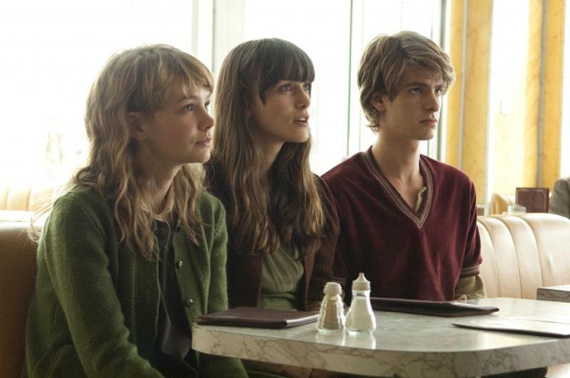
The set-up for this film based on the best selling book by Japanese author Kazuo Ishiguro: a trio of young students (Keira Knightly, Carrey Mulligan, and Andrew Garfield) growing up in a English boarding school discover they are clones grown for the sole purpose of organ donation.

The school is called Hailsham and in ominous gray tones we find these youngsters – at first played by Ella Purnel, Izzy Meikle-Small, and Charlie Rowe – in a love triangle that lasts until their later teenage years.

Knightly and Garfield pair up while Mulligan is left out. Another couple in their new living quarters they are moved to after their school years called “The Cottages” tell the trio about a rumor that lovers might be granted a stay of execution for several years into their adulthood.

The story is told in flashback from the point of view of Mulligan who after “Wall Street: Money Never Sleeps” you’d think was all cried out.

But no, there’s plenty here to make her all misty eyed. Especially when things takes tragic turns. The icy cold Charlotte Rampling as Hailsham’s headmistress has harsh answers to the kid’s questions – ignore the trailers if you don’t want spoilers about that.

It’s an affecting and haunting film in many respects. Romanek’s imagery is bleak but purposeful and the performances hit the right unrestrained notes.
Garfield, who can also be seen at a theater near you in THE SOCIAL NETWORK and will be a household name in the next few years as the new Spiderman, uses his angsty shakiness to his advantage while Knightly overcomes her previous performances’ emptiness nicely.

It’s Mulligans movie however, and she owns it. Her refined acting matched with the stirring score by Rachel Portman elevates the movie’s emotional core.
The sci-fi elements of the screenplay are at a minimum so it’s easy to buy this poignant premise and savor the sad soulfulness on display.

NEVER LET ME GO may be too somber and strained for some folks, but it got under the skin of this reviewer.

More later...

Tuesday, February 16, 2010

Taking On The RED RIDING Trilogy

This set of 3 feature length films based on David Pearce's semi-true crime novel series "Red Riding Quartet" is currently playing in limited release theatrically and is available on IFC Films On Demand.

RED RIDING: 1974 (Dir. Juliam Jarrold, 2009)


This first "episode" starts off with an air of a British ZODIAC, but a darker prism of power is revealed beyond the smoky newsrooms and seedy cop dives as the film reaches its brutally unsettling conclusion.

In "The Year Of Our Lord" 1974, wet-behind-the-ears yet arrogant Yorkshire journalist Eddie Dunford (Andrew Garfield) sums up the scene as he arrives at a press conference: 

"A little girl goes missing. The pack salivates. If it bleeds, it leads, right?" When the girl in question is found murdered Dunford makes the connection to similar crimes involving children committed in the same area in the years before. Like a classic film noir caper, there are many competing plot-lines for our intrepid reporter.


A fellow scribe (Anthony Flanagan) has files full of proof of police corruption, the land where the girls were found is owned by a menacing local mogul (Sean Bean) who has plans to build a major shopping complex there if he can get rid of squatting gypsies, and, the icing on the cake, Dunford has just begun an affair with the mother of the most recent missing girl (Rebecca Hall).


The grim wasteland of the English countryside in the mid 70's is the perfect backdrop for this study - not of serial killings, but of the twisted knots in the fabric of society that naive newbies like Garfield's Dunford get tangled in with little hope of struggling free.


Despite getting roughed up by thug cops on the take, Dunford routinely mocks his elders, but the suave cunning Bean posits that he and the rookie reporter are a lot alike: "We like to fuck and make a buck and we're not choosy how."

Although it doesn't quite earn its TAXI DRIVER-ish climax, RED RIDING: 1974 is a compelling piece of cinema with a minimum of artsy touches and depth to its grit. Despite director Jarrold employing few gratuitous period flourishes it could be mistaken for an actual 70's era thriller - one that's as concerned with the darkness itself as much as what lurks in it.


RED RIDING: 1980 (Dir. James Marsh, 2009) MAN ON WIRE Documentary film maker Marsh helms this second installment which centers on Paddy Considine as Investigator Peter Hunter being brought in on the case of the Yorkshire Ripper in, again, as the title ominously tells us "The Year of Our Lord" 1980.

Hunter believes that one of the murders, the girl from the first film, wasn't committed by the Ripper. It muddies the waters that one of his team (Maxine Peak) is a former colleague with whom he once had an affair. It also impedes the investigation that seemingly every policeman on the force opposes Hunter for reasons that become shockingly clear in the second half.

RED RIDING 1980 takes its time getting going but when it does it becomes a Hell of a potboiler and, perhaps, the strongest of the trilogy. Considine anchors the film admirably, convincingly descending from confident determination to a mode of desperate obsession. The film itself is sturdier than its predecessor especially as its pace tightens with Marsh displaying a palpable mastery of tension.

RED RIDING: 1983 (Dir. Anand Tucker, 2009)


"This is the North - where we do what we want!"

This phrase is repeated throughout these films as both a declaration and a warning to outsiders, but its full impact is not really felt until this concluding chapter - or maybe that's just the power of repetition.

While the first one was seen through the eyes of a journalist and the second the eyes of a police detective, the third has 2 protagonists - a public solicitor named John Piggott (Mark Addy) and returning character Detective Superintendent Maurice Jobson (David Morrissey). Each is on the opposite end of the case making their way into the murky middle.

The loose ends of the first 2 films are tied up competently here but there's unnecessary usage of stylistic abstraction present. The sex scenes in the series before had a perfunctory feel to them but here they're completely stitched in with no passion present.

Only the spare moments of violence have visceral energy and those don't come off as effectively as in the previous chapters. Though Morrissey effectively personifies repressed stodginess, the 2 leads aren't strong enough to guide us through the subdued action which drags down the pace.

It's certainly possible that these 3 films could've been much better if tightened into a single epic movie, but maybe we'll see how that well that works out if Ridley Scott takes on an Americanized remake (yes, I know he's British).

All 3 RED RIDING films are worthwhile but the first 2 are the essential ones - the third provides resolution. Oddly, only the first one has English subtitles. Since this helps a lot with the heavy accents, it's a pity that the others don't follow suit.

Yet even with the matter of some impenetrable dialogue and though the films' total running time of over 5 hours makes taking in the whole trilogy into a bit of a slog - it's a mostly satisfying slog.

More later...