Showing posts with label Kevin Costner. Show all posts

Monday, February 21, 2022

Musician Movie Cameo Monday: Tom Petty In THE POSTMAN

In Kevin Costner’s ridiculously awful 1997 sci-fi adventure, THE POSTMAN, legendary rocker, the late, great Tom Petty, appears in an odd, and amusing cameo. Taking place in a post-apocalyptic America, Costner plays a drifter that finds an old postman’s uniform and mail sack, and goes about delivering its contents which leads to the rebuilding of society.

We’re never told what exactly caused the collapse of civilization, but we assume it was a nuclear war. In his travels, Costner, only credited as “The Postman,” comes upon a city built on top of a dam. He is encountered by Petty, dressed in MAD MAX-style garb, as “The Mayor of Bridge City.” Seems that nobody wanted for these characters to have proper names, but since the Postman in the book the film was based on by David Brin was named Gordon Krantz, maybe that’s for the best.

The first exchange between Petty’s Mayor and Costner’s Postman, goes like this:

The Mayor: “You’re in Bridge City! Where we don’t allow guns. Sentry said you were coming.

The Postman: “I know you, you’re famous.”

The Mayor: “I was once. Not anymore.”

Get that? One has to think that Petty is playing himself. THE POSTMAN was released in 1997, and takes place in the then near-future of 2013, which means the 47-year old musician was playing a 63-year version of himself. There was no attempt to make Petty look older than he did in 1997, but since, albeit aging, he basically looked the same as he turned out to look in 2013. 

There are no mentions of his music in the movie, and no other reference to Petty’s past stature. All you need to know is that this guy used to be somebody, but now he’ll do what he can to help you rebuild the good ole U.S. of A. It’s an extended cameo, as he appears in more than one scene, and has around a dozen lines, but they are mostly about pushing the plot forward, and then The Mayor’s screen-time is over. He may be in the crowd at the film’s climax, but I’m not re-watching it to find out.


Two years after it came out to middling reviews, and poor box office, Petty discussed how his role in The Postman came about in an interview with Fred Schruers in Rolling Stone (July 8, 1999):


“Kevin called me up and asked me to play the mayor of a post-apocalyptic city. And it was at a time when I really needed to do something. I was, like, lost. The band had stopped touring. I lived alone. I needed to do something with my time, and this sounded perfect, so I took off and went up to Washington, in the middle of the woods somewhere, bald eagles going over and freezing cold in July. Kevin was the director, and he really got on my case about how to do it – “We do this different than you do music.” I’m grateful to Kevin. He taught me, or tried to, a lot of things about how to get this or that across on camera.”


So this is Petty’s only real major motion picture appearance - that is if you don’t count his brief pop-ups in the 1978 comedy FM, and in the long-forgotten 1987 fantasy film, MADE IN HEAVEN, in which he is billed as “Stanky.” Yeah, let’s not count those. So let’s say it’s his only movie appearance where he’s not credited as himself, yet he is playing himself.


On the small screen, Petty portrayed comic versions of himself on It’s Garry Shandling’s Show, King of the Hill, The Larry Sanders Show, and The Simpsons. In each, Petty is a very funny, appealing presence with great timing. 


Petty’s
 close to humorless, and lackadaisical walk through THE POSTMAN can be read as lazy, but it’s still consistent with his well-known persona. In other words, the man seems just as stoned as he is in his television cameos, but his purpose is more gravitas than levity.  
 

It’s still a very scene in a very silly, pretentious movie, which most likely even hardcore Petty fans have long dismissed. Maybe the only thing worth taking away is that there may be a connection to a music video that Tom Petty and the Heartbreakers made for their 1982 single, “You Got Lucky.” The video was also set in a post-apocalyptic landscape, and obviously was based on the aesthetics of the aforementioned MAD MAX movies.


It’s doubtful that many people in the actual future will remember Petty as an actor, or even remember THE POSTMAN for that matter. His cartoon cameos will likely be the appearances that will be thought of as his show-biz side-hustle. 


THE POSTMAN was a critical and financial disaster, which swept the Golden Raspberry Awards in 1998 taking home awards for Worst Picture, Worst Actor, Worst Director, Worst Screenplay, and Worst Original Song. If Worst Cameo had been a Raspberry category, I bet Petty would’ve been spared because he’s actually the most likable element of the film.


More later...

Friday, February 18, 2022

Film Babble Blog Fun Fact: Oliver Stone's JFK Flips The Script

The real Jim Garrison as Earl Warren in Oliver Stone's JFK (1991)

Oliver Stone’s 1991 conspiracy classic JFK was largely based on New Orleans District Attorney Jim Garrison’s 1988 book, On the Trail of the Assassins, that heavily criticized the Warren Commission’s handling of the assassination of JFK in the early to mid ‘60s. Garrison made a cameo in the film, JFK, as his adversary, the then Chief Justice of the United States Earl Warren.

The real Earl Warren of the infamous Warren Report in the '60s

This means that in the film, Garrison’s Warren was criticizing Garrison, played by Kevin Costner; for criticizing the Warren Report. Got that? 

There are other cases of actors or non-actors playing roles based on public figures that they oppose, but it’s getting late, and that’s all I got right now.


More later...

Tuesday, January 10, 2017

HIDDEN FIGURES: A Cornball Crowd Pleaser That Is Inspirationally On Point

Now playing everywhere:

HIDDEN FIGURES (Dir. Theodore Melfi, 2016)


There are times in this film, currently the #1 movie at the box office (take that, ROGUE ONE!), that young moviegoers may feel like the filmmakers are comically stretching reality way too thin to make a point.

Like in the scenes that show mathematician Katherine Johnson (Taraji P. Henson) having to walk, and sometimes run, a half mile across the campus of Virginia’s Langley Research Center, to the “colored” ladies room several times a day during her long shifts.

But, as folks who know history will attest, this was the era of “separate but equal” segregation, and their framing of Ms. Johnson’s predicament is apt as it symbolizes how rough it was for many African Americans in the workplace.

There are other times when it seems that director/writer Theodore Melfi’s (ST. VINCENT) movie takes some liberties with some major moments as when astronaut John Glenn (Glenn Powell, portrayed as much as a dreamboat as possible) tells the team of engineers that he’ll be “good to go” on the launch of the rocket that officially put a man in space for the first time if they “get the girl to check the numbers” – referring to the aforementioned Ms. Johnson.

But according to transcripts of the event, that actually happened, and this film portrays it perfectly. There’s just no way around that being a feel-good, empowering moment in which we see how important the contributions of black women like Johnson, and her colleagues - Dorothy Vaughan (Octavia Spencer), and Mary Jackson (Janelle Monáe) – were to NASA, back when the space program mattered the most.

That would be the ‘60s, when the U.S. was in a space race with Russia to being the first to put a man on the moon. The story focuses most on Henson’s Johnson as she adjusts to being assigned to the Space Task Group headed by group director Al Harrison (Kevin Costner). Costner’s Harrison is a stern by-the-book boss who doesn’t appears to have a racist bone in his body, but Johnson’s co-workers, especially NASA engineer Paul Stafford (Jim Parsons) all give her disgusted looks (it should be noted that Stafford didn’t exist; he’s an amalgam).

Things get worse when Johnson finds that her all-white office mates have labeled a small empty coffee pot “colored” for her.

Henson’s Johnson also gets a love interest in the form of Mahershala Ali, who’s really been making a name for himself lately in such worthy projects as Luke Cage and MOONLIGHT. Here Ali, as a smooth-talking military man, gets to join the movie’s male contingent in having to learn that the times are indeed a-changin,’ and they should never underestimate any woman’s abilities.

Meanwhile, Spencer’s overworked Vaughan, told repeatedly by her boss Vivian Mitchell (Kristen Dunst) that she won’t be getting a promotion, learns the programming language needed to program the new IBM computer which leads to her being made NASA’s first black supervisor.

The third lead, Mary Jackson as played by musician/model Monáe in her first starring role in a major motion picture, may not get the lion’s share of screen-time, but makes the sassy best of her storyline involving sweet talking a judge into letting her take classes at an all-white school so that she can get a degree in Engineering and become NASA’s first black female engineer.

Many critics have called HIDDEN FIGURES: “THE HELP meets THE RIGHT STUFF,” and, yeah, that’s valid. There is certainly a lot of cheesy, made-for-TV-style packaging surrounding this unapologetically inspirational history lesson, but at no times does that diminish the film’s earnest tone and heartfelt spirit.

Henson, best known as Cookie Lyon on the Fox series Empire, owns her role as the central protagonist as she holds her own with Costner, who’s right at home here as he’s been in a bunch of movies set during this era, and Parsons, whose character is like a racist Sheldon Cooper without any snarky one-liners.

Spencer gets the film’s maybe funniest and most on point moment in a bathroom scene where has a supremely cutting comeback to Dunst as her superior. I won’t spoil it, but will say it really riled up the audience at the advance screening I attended.

It’s a big cornball crowd-pleaser for sure, but HIDDEN FIGURES earns its place as a piece of primo entertainment with an important message. That being, if, as a people, we can overcome assholish, bigoted oppression, we can reach the stars.


More later...

Sunday, February 28, 2016

Film Babble Blog’s Top 5 Oscar Best Picture Beefs


Just like every year, in anticipation for the latest Academy Awards ceremony (this year's, the 88th, airing tonight on ABC), film buffs/blowhards like me can't help bitching about the great movies that didn't win Best Picture in previous years while some incredibly undeserving film took home the gold. 

I've had these conversations many times, especially when I worked at a video store (remember those?), about how a favorite movie, like, say PULP FICTION, got passed over for some forgettable piece of fluff, like, say, FORREST GUMP, that was nowhere as influential and hasn't held up in the long run.

So these Top 5 picks are pretty f-in' obvious, and predictable if you know me (2 Scorsese films are on the list), but they stand as the five instances where I most thought the Oscars got it dead wrong.

Counting down:

5. Robert Benton's (who?) KRAMER VS. KRAMER winning over Francis Ford Coppola's APOCALYPSE NOW. (1979) 

That's right, this:


won over this:


Crazy, huh?

4. THE ENGLISH PATIENT winning instead of the Coen brothers' crime comedy drama masterpiece FARGO! (1996) Yeah, I mean who even mentions Anthony Minghella's weepy war rom drama THE ENGLISH PATIENT now? It's probably better remembered as a reference point on a episode of Seinfeld than as an actual film that people saw and liked. At least Frances McDormand won Best Actress for her peppy portrayal of police woman Marge Gunderson, one of the greatest movie characters of all time.

3. Robert Redford's ORDINARY PEOPLE winning instead of Martin Scorsese's RAGING BULL. (1980) This is just silly. However, I did appreciate ORDINARY PEOPLE, but just thought it came nowhere near the majesty that was Scorsese's fourth film with Robert De Niro.

2. John Ford's HOW GREEN WAS MY VALLEY won over Orson Welles' CITIZEN KANE! (1941)


Now I obviously wasn't around when this happened, but I can sure feel the 7 decades plus ripple effect from what many consider the greatest film of all time losing out to a movie that has been pretty much left in the dust bin of history. Actually, HGWMV isn't a bad film - I watched it a few years back and found it be a well made drama. And it's much better than the next film for sure:


1. Kevin f-in' Costner's DANCES WITH WOLVES winning over Martin Scorsese's mangum opus mob epic GOODFELLAS. (1990). This one still kills me. Scorsese makes two of his greatest movies and they both lose to pretty boy actor's directorial debuts. I'd like to think that Marty and co.'s reaction to the announcement looked like the picture above. At least Joe Pesci won the Best Supporting Actor award, and Scorsese went on to grab the gold with 2005's THE DEPARTED. That one was one of the biggest example's of payback in the entire history of Oscar.

#5 on this list also has to do with my biggest Best Actor beef ever, that Peter Sellers' brilliant work in Hal Ashby's BEING THERE, one of my all time favorite films, was passed over.


Sellers could walk on water, but he still lost to Dustin Hoffman in that damn divorce drama.

Anyway, let's see what beefs tonight's Oscars show will give me. You'll know immediately as I'll be live tweeting the event (follow @filmbabble).

More later...

Friday, January 17, 2014

JACK RYAN: Shallow Reboot


Opening today at a big ass multiplex near you:

JACK RYAN: SHADOW RECRUIT 
(Dir. Kenneth Branaugh, 2014)


I just got through the painful process of accepting Chris Pine as Captain Kirk in the relaunched STAR TREK series, now I have to accept him as Tom Clancy's Jack Ryan in another reboot of a Paramount franchise too?

Apparently so as Pine is the fifth actor to fill the shoes of the intrepid CIA agent since the techno thriller series based on Clancy's novels started in 1992 with Alec Baldwin in THE HUNT FOR RED OCTOBER. Harrison Ford took over the role for two entries - PATRIOT GAMES and CLEAR AND PRESENT DANGER in 1992 and 1994, then after a break of eight years, Ben Affleck made an unsuccessful stab at the Ryan role in THE SUM OF ALL FEARS (2002).

Now, after another long break we've got JACK RYAN: SHADOW RECRUIT, helmed by Kenneth Branaugh, who also plays the cold-eyed Russian villain. This being his directorial followup to THOR, Brannaugh has now officially re-branded himself as a big studio action movie maker.

David Koepp and Adam Cozad's screenplay, which isn't based on any particular Clancy novel, rewinds to the beginning of Ryan's career - we first see him as a student at the London School of Economics watching the terrorist attack on the World Trade Center towers on television. After a stint in the Marines where he almost loses a leg in a helicopter accident, Pine's Ryan gets recruited by Kevin Costner as a CIA operative to be a deep-cover financial analyst working on Wall Street. This is something he keeps secret from his fiancé (Keira Knightley), TRUE LIES-style, into the present day.

So far, so formulaic.

Learning of a possible terrorist attack that would lead to an American financial crash, Pine travels to scenic Moscow to thwart Branaugh's evil industrialist plotting to bring on what he calls the second Great Depression.

I feel like J.K. Simmons as a befuddled CIA man in the Coen brothers' BURN AFTER READING when I ask “the Russians?” I mean, I know that the roots of Ryan are based in Cold War espionage, but here it seems that the Soviet backdrop is aping recent similarly set spy capers like MISSION IMPOSSIBLE: GHOST PROTOCOL or, worse, the fifth DIE HARD movie which came out this same time last year.

The lack of genuine suspense is palpable in this routine mess in which the fight and chase scenes are horribly edited, the dialogue stiff, and the pacing scattered through the distractingly shiny surfaces.

And the film has no business being in IMAX as it wasn't shot by IMAX cameras and it has no big cinematic money shots that warrant such presentation. Even in what's supposed to be the movie's big climax, involving a van carrying a nuclear device going off the side of a bridge into the Hudson river and exploding, they don't show it long enough to make any impact.

There's also a mind-numbing Russian restaurant-set centerpiece sequence in which Knightly (who should go back to Victorian-era costume dramas and not attempt an American accent again) tries to distract Branaugh over dinner while her hubby is breaking into Branaugh's office that drags the whole narrative down. Hard to believe that screenwriters Koepp and Cozad thought that this was inspired material at all.

In a confident yet somewhat wooden performance, Pine is fine as the reluctant title character, but beyond his egghead calculations there's not much of a persona on display. 

JACK RYAN: SHADOW RECRUIT (such a generic title) is a shallow reboot that doesn't know how to elevate its hero into anything approaching the heights of Bond or Bourne, and make itself out to be anything better than standard issue spy fodder. 

More later...

Friday, November 22, 2013

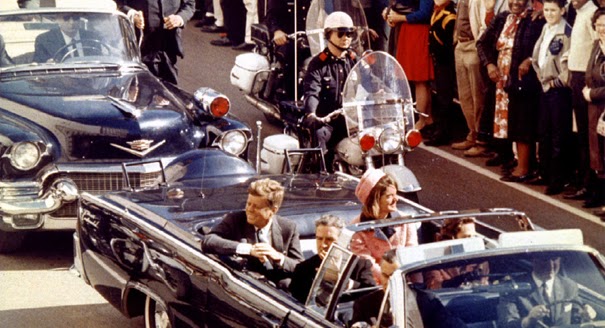
The Cinematic Legacy Of The Kennedy Assassination

As today is the 50th anniversary of the JFK assassination, Film Babble Blog looks back at the cinematic legacy of the history changing event:


I’m 44 years old, so I wasn’t alive when President John F. Kennedy was assassinated. But since the events of that tragic day in November of 1963, 50 years ago today, have been so thoroughly covered from every conceivable angle in countless movies, TV shows, and documentaries, not only do I feel like I was alive then; I feel as if I had actually been there smack dab in the middle of Dealey Plaza, Dallas, Texas, on that fateful date with a better view of the historic hit than Abraham Zapruder had.

Oliver Stone’s 1991 conspiracy theory epic, JFK is largely to blame for planting such vivid yet false memories in my psyche, but it was an obscure film that I saw on television when I was a kid that laid the foundation. It was David Miller’s 1973 political thriller EXECUTIVE ACTION, the first film * produced about the assassination.


Told from the point of view of the evil men in power, including Burt Lancaster and Robert Ryan as shadowy co-conspirators who plot Kennedy’s killing right down to the last detail, the low budget docudrama postulates many of the same theories, mostly having to do with alleged murderer Lee Harvey Oswald being a patsy, that Stone would later do up with higher production values in JFK.

EXECUTIVE ACTION largely drew upon the work of New York Legislator Mark Lane, whose 1966 bestselling book “Rush To Judgement” heavily criticized the Warren Commission’s conclusion that Oswald acted alone. Throughout the ‘70s, the consensus that something much more sinister was up than what the public record allowed, was evident all over pop culture.

Alan J. Pakula's THE PARALLAX VIEW (1974) defined the label “paranoid thriller” (see also Sydney Pollack's THREE DAYS OF THE CONDOR, 1975) by building upon assassination theories with a premise about an evil company (the Parallax Corporation) that's behind pivotal political plots. Warren Beatty plays a reporter that tries to unravel the conspiracy, but ends up being unwittingly trained to be an assassin himself. A scene in which Beatty is brainwashed by a recruiting film, satirized in Ben Stiller's ZOOLANDER, gives a good idea of the movie's sinister tone:


In Woody Allen’s Oscar winning 1977 comedy ANNIE HALL, comedian protagonist Alvy Singer obsesses over the possibility that there was a second assassin to the point that a girl he briefly dates (Carol Kane) states bluntly the he’s “using this conspiracy theory as an excuse to avoid having sex” with her. This surely received a lot of laughter from hip in-the-know audiences at the time, since post Watergate distrust of the government was at an all time high.

That same year, John Landis' KENTUCKY FRIED MOVIE, the first film to feature the comedy stylings of ZAZ (David Zucker, Jim Abrahams, and Jerry Zucker) of AIRPLANE! and NAKED GUN fame included a commercial parody for a fictitious Parker Brothers' board game called Scot Free. A four member family is seated around a kitchen table playing the game, made up of a miniature mock-up of Dealey Plaza, as a voice-over announcer sets up the premise: “Your team has just assassinated the President - can you get away scot free? Shake the dice and see...


A few years later, a surreal and somewhat comical take on the clusterfuck of conspiracy theories came along: William Richert’s WINTER KILLS (1979), starring Jeff Bridges as Nick Keegan, the brother of a slain President, of course, the victim of secret forces. The controversial film didn’t get much of a theatrical run, VHS copies of it were rare, and its out of print now on DVD (a 2003 edition of it can be found on eBay) so it’s a bit of obscure title that few people have heard of, but it’s well worth seeking out.

Bridges’ very un-Dude performance as the Robert Kennedy-ish hero neatly heads an impressive cast including John Huston, Anthony Perkins, Sterling Hayden, Elizabeth Taylor and Toshirô Mifune in an outlandish scenario yet again involving evil men pulling the strings from behind the scenes. The usual suspects of mobsters, the military, and power hungry oil barons are trotted out, as Bridges investigates the wide-ranging suspected cover-up.

Apart from the TV miniseries Kennedy starring Martin Sheen, and various PBS documentaries, the ‘80s were relatively free of movie treatments of the mysteries surrounding the Kennedy assassination, but it’s funny to note that in Ron Shelton's BULL DURHAM (1988), Kevin Costner’s character Crash Davis delivered a speech to Susan Sarandon listing his core beliefs, and one of them was “I believe Lee Harvey Oswald acted alone.”

A few years later, Costner would be speechifying the complete opposite at length as New Orleans investigator Jim Garrison in Stone’s before mentioned opus, which recently played at the Crossroads in Cary to mark the anniversary. 


Stone’s movie is the biggest production to date dealing with the events of November 22nd, 1963, and definitely the most star studded. The film is largely accountable for the Six Degrees of Kevin Bacon parlor game because Bacon appears alongside a cast that features seemingly everybody who was working in the early ‘90s including such A-listers as Tommy Lee Jones, John Candy, Walter Matthau, Jack Lemmon, Joe Pesci, Gary Oldman, Michael Rooker, Donald Sutherland, Ed Asner, Sissy Spacek, and so on.

These folks help distill the information Stone displays down to further his theory, informed by decades of other’s research and speculation, that Kennedy was killed by a conspiracy that stretched through the military industrial complex, involving the CIA, and anti-Castro Cuban nationals. Newsweek welcomed Stone’s movie with a cover story that had the headline: “The Twisted Truth of ‘JFK’: Why Oliver Stone’s New Movie Can’t Be Trusted,” yet in the same issue had a very favorable review of the film by David Ansen. That sums it up neatly: JFK is an entertaining and thought provoking movie, but it’s just a movie, it shouldn’t be taken as historical record.

In the years after JFK, Danny Aiello played Jack Ruby, the Texas nightclub owner who shot and killed Oswald in RUBY, Clint Eastwood played a Secret Service agent who was in Kennedy’s detail that day in Dallas in IN THE LINE OF FIRE (1993), and the long running Fox television program The X-Files revealed that its chief antagonist, the Smoking Man played by William B. Davis, was the real gunman who shot the President from inside a sewer drain along the route of the motorcade.

Yep, JFK’s tagline, “The story that won’t go away,” really is truth in advertising.

More recently, Peter Landesman’s drama PARKLAND, concerning the aftermath of the assassination with another cast of big names (Paul Giamatti, Billy Bob Thornton, Zac Effron) partly set at Parkland Hospital where Kennedy’s body was taken after the shooting, played briefly last September at the Raleigh Grande. The film effectively captures the chaos and confusion in the air on Nov. 22, 1963 and the days after, but it’s not concerned at all with conspiracy, and it doesn’t really add anything to the cinematic history of the world-changing events of that date.

Neither does the National Geographic Channel’s telefilm adaptation of Bill O’ Reilly’s best seller “Killing Kennedy,” which premiered earlier this month, though there’s some fun to be had watching Rob Lowe take on the President’s Boston accent. O’Reilly isn’t a fan of conspiracy theories so it’s a pretty dry run through the facts.

We may never get the answers to the questions about what really went down that day, but one thing’s for sure: whether it’s another feature film, a new documentary (there are tons of them on cable these days), or an episode of a ‘60s-set TV show (Mad Men did their Nov. 22, 1963 episode in their third season), we are destined to relive the JFK assassination again and again until we shuffle off this mortal coil.

* Mel Stuart's 1964 documentary FOUR DAYS IN NOVEMBER was technically the first film produced about the assassination, but this essay concerns the dramatizations of the event.

More later...

Friday, June 14, 2013

SUPERMAN: The New Nolan-ized Reboot


Now playing at mulitplexes from here to the Phantom Zone:

MAN OF STEEL (Dir. Zack Snyder, 2013)


The time is as good as any for a new take on the most powerful comic book superhero ever, but Zack Snyder’s (300, WATCHMEN, SUCKER PUNCH) reconstruction of the Superman movie mythos is a big bombastic bore.

A great cast has been assembled, including Henry Cavill as the caped crusader, Russell Crowe as Superman’s Kryptonian father, Kevin Costner as his Earth dad, Amy Adams as Daily Planet reporter/love-interest Lois Lane, Lawrence Fishburne as her editor/boss Perry White, Richarh Schiff (The West Wing) as some sort of all-knowing scientist, and, best of all, Michael Shannon as the evil bent-on-revenge General Zod, but Snyder working from a screenplay by DARK KNIGHT co-writer David S. Goyer, overcrowds the storyline with spectacle, repetitive dialogue, and needless convolutions making it difficult to connect with anything on screen.

You know the drill – before Krypton explodes, Papa Crowe (probably the actor who brings the most gravitas to the film) puts his new born baby (touted this time as the planet’s first natural birth in centuries) in a spaceship to Earth, where he’s found by a kindly middle-aged couple (Costner and Diane Lane) living on a farm in Kansas, who name him Clark Kent.

As the boy grows up he recognizes that he has great powers, learns of his origin, and heeding the advice of his step-dad Costner to conceal what he can do, he goes on the road anonymously going from town to town working different jobs until his powers get in the way and he has to move on just like David Banner (Bill Bixby) did on the old Incredible Hulk show.

Huh? Wait a second, that’s not really part of the classic Superman story is it? Sure doesn’t feel like it should be here, but whatever. In this version, Lois Lane figures out that Clark Kent has powers before he even puts on the suit; she never knows Clark and Superman as 2 different people. I’m fine with that – it would be too much to ask for an ace investigative reporter (one that’s won the Pulitzer Prize, mind you) to be fooled by a pair of glasses, so they don’t introduce the element of our hero working at the newspaper until the end. Makes me miss the comically over-sized glasses that Christopher Reeve wore as Clark back in the original ‘70s-‘80s SUPERMAN movies, but, oh well.

Also unlike that run of movies, that got progressively worse (the first two were great, the third and fourth ones, not so much), there’s no Fortress of Solitude made out of new age crystals, no Lex Luthor, and barely any humor.

Shannon is perfectly cast as General Zod (stepping into the mighty shoes worn by Terrence Stamp in SUPERMAN: THE MOVIE and SUPERMAN II), but it’s an exposition-heavy role, with the actor looking like he’s in a permanent bad mood (resembling grumpy cat at times), but it’s still one of the more successful elements on display in MAN OF STEEL, because of how invested Shannon is in it.

Zod and his minions attack Metropolis, with tons of buildings getting destroyed (we don’t seeing many people dying but from what we see it’s impossible that there wasn’t a large death toll) and start taking over Earth so that they can make it New Krypton or something. The cityscape alien attack sequence was much better done in THE AVENGERS (not to mention SUPERMAN II), and the climatic one-on-one battle between Superman and Zod just has them pummeling each other from one set-piece to another with no excitement (they punch each other through buildings over and over).


Meanwhile Fishburne and a few other Daily Planet folks are running through the rubble, for some reason they’re some of the only survivors of the attack, but the film never took anytime to establish them as characters to care about.

The British-born Cavill makes for a fine Superman aesthetically, and he’s got the American accent down, but his is also a blank slate of a character that I had trouble forming any connection to. The charisma that Reeve had in the iconic role, and that Bryan Singer tried to capture with Reeve clone Brandon Routh in 2006’s SUPERMAN RETURNS is sorely missing, but that fault lies more with the writers/filmmakers than with the man in the cape.

One thread that really didn’t work for me had to do with the scrambled narrative that jumps around, and way too often to flashbacks of Earth dad Costner saying that the world isn’t ready for a man of incredible powers yet. They draw this out too long, when you know that the world is as ready as it’s ever going to be, and Costner’s death in a tornado, which his son could’ve saved him from, doesn’t make any sense.

In SUPERMAN: THE MOVIE, Glenn Ford as our hero’s adoptive father died much more poignantly from a heart attack – something Superman could never have saved him from (well, unless he spun the world back in time), and it had a richer meaning to his maturation; here the man’s death doesn’t teach any lesson except that he’s wrong and his son should’ve revealed himself much earlier. I really don’t get what they’re waiting for. The movie doesn’t give any discernible reason except to stretch out Superman’s angsty development and Costner’s part.

The dark gritty approach to the material, which undoubtedly came from Executive Producer Christopher Nolan, who shares a “story by” credit with Goyer, isn’t right for this area of the D.C. Comics universe. I’m not saying Superman should be nothing but sunny warmth, but there’s no triumphant thrill to seeing our hero save the day here – he doesn’t even show concern for the many who undoubtedly died in the huge devastation on Metropolis.


MAN OF STEEL is a by-the-numbers summer blockbuster wannabe that forgot to have any fun with its source material. Ultimately, it's a ginormously fussy film pulled in so many directions that it's un-engaging and dull. 

Technically, with its well chosen cast and vast array of nonstop visual effects, Snyder and crew have made a serviceable popcorn picture, but next time out (and with all the money that it has already made, there certainly will be a next time) I’m hoping they’ll remember to add more heart, humor, and actual heroism to this not quite re-booted franchise.

More later...

Thursday, December 20, 2007

Post GRADUATE Studies


This Friday, director Mike Nichols' latest film, CHARLIE WILSON'S WAR, is getting a full release but it's another Nichols' movie released 40 years ago to the day (Dec. 21st, 1967) that I'm blogging about here - THE GRADUATE.

That's right, the much beloved classic that starred a young then unknown Dustin Hoffman as Benjamin Braddock, a college graduate who's worried about his future. Braddock's affair with Mrs. Robinson (Anne Bancroft), his courtship of her daughter Elaine (Katherine Ross), and the famous wedding crashing climax are all the stuff of legend so let's celebrate its 40th anniversary with this deluxe post. 

There are Spoliers here so if you have not seen THE GRADUATE go immediately get a copy and watch it then get back to me. Everybody else should know the cast, the plot, and remember its widely quoted dialogue (even the currently playing I'M NOT THERE quotes the "good evening Mr. Gladstone" line) as well as the Simon & Garfunkel soundtrack but here's some things that you may not know: 

5 Fun Facts About THE GRADUATE:


1. Paul Simon's soundtrack submission was originally called "Mrs. Roosevelt" - According to Wikipedia Simon played the director a bit of a new composition and said "'It's a song about times past — about Mrs. Roosevelt and Joe DiMaggio and stuff.' Nichols advised Simon, 'It's now about Mrs. Robinson, not Mrs. Roosevelt.'" 

2. It was Richard Dreyfus's first movie - Albeit a brief appearance but he's visible over landlord Norman Fell's (yep, he was also the landlord on Three's Company) shoulder in the boarding house scene. Dreyfus's only line: "Shall I call the cops? I'll call the cops."


3. The could have beens - Imagine alternate universe versions in which Benjamin is played by either Robert Redford, Charles Grodin (who both tested for the part) or Warren Beatty (who did BONNIE AND CLYDE instead) with Natalie Wood or Sally Field in the role of Elaine. Pretty much impossible to picture, huh? Also consider that Marilyn Monroe was originally slated to play Mrs. Robinson and that the part was also offered to Doris Day and you really get a Bizarro world thing going. Thank goodness the stars aligned casting-wise because if it went any of those directions I don't think I would be blogging about it today. 


4. The leg in the poster isn't Anne Bancroft's - it's Linda Gray's. Gray, the Dallas TV star, later played Mrs. Robinson on stage in the West End and Broadway play adaptations. 


5. Benjamin is driving in the wrong direction - In Dustin Hoffman's DVD commentary * he says "I remember after the film opening, for years, people coming up and saying 'you know you're going the wrong way?' " It's true Benjamin is driving his Alfa Romeo west on the upper deck of the San Francisco Bay Bridge though he's supposed to be on his way to Berkeley, which is to the east. On a separate commentary track Nichols tells Steven Soderbergh: "If you went to Berkeley you wouldn't be visible to a helicopter - you'd be on the lower level - I said screw it, you know? What are they going to do to us?". 


* The new 40th anniversary DVD set has a recently recorded and very entertaining commentary with Dustin Hoffman and Katherine Ross. Hoffman does most of the talking - even when he confesses to Ross that he had a crush on her back in the day she has little to say.


I recently re-read the 1962 Charles Webb novel of THE GRADUATE (that's my own personal yellowed beat-up paperback pictured on the left) and was surprised at how close an adaptation the movie was. Only a few notable differences - Benjamin shortly after coming home to Pasenda takes a hitchhiking trip for a few weeks and claims to his father upon his return that he helped fight a large forest fire, washed dishes, and spent time with prostitutes. Since Benjamin twists the truth throughout the whole story we are not sure whether to believe him but it's a telling footnote. Also the iconic line "plastics" is not in the original text. However, "Mrs. Robinson, you are trying to seduce me" is. 

There has been much talk of a sequel - Buck Henry's (playing himself - he was the original co-screenwriter of THE GRADUATE) pitch to studio exec. Tim Robbins in THE PLAYER (Dir. Robert Altman, 1992) of course comes to mind: ‘‘Okay, here it is: The Graduate, Part II! Ben and Elaine are married still, living in a big old spooky house in Northern California somewhere. Mrs. Robinson, her aging mother, lives with them. She’s had a stroke. And they’ve got a daughter in college — Julia Roberts, maybe. It’ll be dark and weird and funny — with a stroke.’’ In 2004 Nikki Finke in LA Weekly resonded angrily when she came upon a report of a sequel being produced with Kevin Costner, Jennifer Aniston, and Shirley MacLaine. 


The resulting film RUMOR HAS IT... (Dir. Rob Reiner, 2005) turned out not to be a sequel but a regular ole rom com with the premise that a woman (Aniston) with the same Pasenda background discovers that her family was the inspiration for the characters in the book and movie. 

Costner plays Beau Burroughs (get it?) and MacLlaine is the boozy cynical Mrs. Richelieu (of course you get it) and the whole affair is lame and badly written (they should've gotten Buck Henry to do a re-write) adding nothing to THE GRADUATE legacy. Looks like it has finally quashed the possibility of a sequel and uh, that the fact that one of the pivotal principles is no longer with us - the late great Anne Bancroft (1931-2005).


Okay! So once more Happy Birthday THE GRADUATE! Yet again, Benjamin and Elaine board the bus that drives off into the sunset and we all sigh.


More later...

Monday, November 05, 2007

Some Fall New Release DVDs If You Please

Catching up on some new DVDs fresh out of the red Netflix envelope into my DVD player then onto my blog. Let's start with yet another movie I recently regretted missing at the theater:

NO END IN SIGHT (Dir. Charles Ferguson, 2007)

I was not the only one that missed this one in its brief limited release, from what I've heard it played to mostly empty theaters. 

Seems like most are tapped out when it comes to another liberal hatin' on Bush anti-war documentary so folks stayed away in droves. That's a damn shame because this is such a different animal than such staples as FAHRENHEIT 9/11 or WHY WE FIGHT, in that it gives us much more of a precise and sobering overview of the war in Iraq from one horrible decision to the next. 

Campbell Scott's straight narration (some have called it flat but I think it has more gusto than that) lies over the many interviewees that this manifesto is mostly made of. The ones interviewed are so high up in there that it can't be denied - sorting out the good guys from the bad can be quite a game.

I figure Colonel Paul Hughes who was director of strategic policy for the U.S. occupation in 2003 to be one of the good guys; Walter Slocombe (who comes across as a 'dumbfuck' as Natalie Maines would say) - senior advisor for National Security and Defense and head of CPA is, by my guess, one of the bad guys. 

It's funny how the line - "refused to be interviewed for this film" is so dramatically used again and again but not so funny when it pertains to administrator of the CPA L. Paul Bremer (whose 3 central mistakes make up the bulk of this film's crux), Dick Cheney, Condolezza Rice and asshole golden boy Donald Rumsfeld whose glib remarks like "I don't do quagmires" will anger any reasonable human.

Less an ALL THE PRESIDENT'S MEN than a 'All Satan's Men' this documentary is the definition of 'incendiary.' As a blogger pretending to be a substantial film critic I would say this is a "must see," but as a guy watching this in an apartment sitting on a couch with a cat - I just can't help from tearing up.
 
MR. BROOKS (Dir. Bruce A Evans, 2007) 


Without a doubt the best Kevin Costner film in ages, yeah I know that's not saying a lot, but hear (or read) me out. Costner plays Earl Brooks, a box company CEO who is in the dark of night a cold calculating serial killer. His murderous impulses are personified to him and us in the presence of Marshall (William Hurt) - an alter ego or better yet -an evil imaginary friend.

After a murder of a young couple in the bed of their townhouse, Mr. Brooks finds himself being blackmailed by a voyeur played by Dane Cook who has compromising photographs (the curtains were left open in the couple's bedroom). Cook though wants to be a killer himself, and wants Mr. Brooks to show him the ropes. This idea scares Brooks but amuses and challenges Marshall so on they go off into the night following a measured, but still convoluted scheme.

Meanwhile Demi Moore (who is far from believable but that may just be my own personal problem with Moore) as a beleaguered police detective suffering through a tortured and costly divorce is on their trail and Costner's daughter (Danielle Panabaker) is home from college under mysterious circumstances so the plot thickens. Maybe some would say it gets too thick, in more than one sense of the word.

I am reminded by the late Pauline Kael, several years after she retired from writing, speaking in a Newsweek interview about a little late '90s dog called THE DEVIL'S ADVOCATE (starring Al Pacino as the devil disguised as a big-time New York lawyer taunting up-start Keano Reeves).

Kael said that that film had a "hambone quality" to it that she enjoyed. I strongly feel the same thing can be said about MR. BROOKS. It has a lot of meticulously plotted psychological edges but they all frame what is essentially pulp - highly entertaining but kitsch all the same. This is what makes it work though, you don't employ Dane Cook if you are not aware of the diciness of your material, so director Evans and screenwriter partner Raynold Gideon (both collaborated on MADE IN HEAVEN, STARMAN, and STAND BY ME) know what they're doing to some degree.

Costner with his charisma in check coupled with Hurt's smug leering sociopath repartee, and a strangely sober yet almost satirical hold on the material makes MR. BROOKS resemble at more times than I'd like to admit a really good movie. Ham-boned as it is.

THE HOAX (Dir. Lasse Hallström , 2006) 
Definitely the best Richard Gere film in like...forever! In this tasty tale of a man who lies his way into a major book deal, Gere hits all the right marks. The man was struggling novelist Clifford Irving, and the lie was that in the early ‘70s, he conducted a book’s worth of interviews with Howard Hughes. Irving boasted that the resulting book would be “the most important book of the twentieth century.”

Hughes had been legendarily reclusive and completely out of the public eye for well over a decade so Irving, and professional partner Richard Suskind, portrayed by the always “on” Alfred Molina, speculate he would not come forward to denounce the fabricated project.

Gere and Molina also figure that Hughes denies everything anyway, so who would believe him. How could they go wrong?

The how is a huge part of the fun as is the amusingly audacious Gere and Molina’s back and forth banter. The cast is “on” as well, including Marcia Gay Harden as Irving’s exasperated wife and Julie Delphy as actress Nina Van Pallandt, who was Irving’s mistress.

THE HOAX takes some truthiness liberties that at times turn towards the surreal. That comes across in the almost cartoonishly pretentious people at MacGraw Hill that Irving pitches to, and the overwhelming sense that we don't know what to believe of what we’re seeing, especially when the supposed hired goons of Hughes’ show up at Irving’s door.

These fantastical touches though are executed in a more successful manner than in George Clooney's CONFESSIONS OF A DANGEROUS MIND - a likewise questionable, yet still engrossing, adaptation of ‘real’ events. Irving is credited as “technical advisor” on this film, but reportedly he disowns it, and has heavily denied its accuracy.

Irving really should get over himself! This may be the best thing he's ever had anything to do with.

More later...