Showing posts with label Joe Strummer. Show all posts

Friday, May 20, 2022

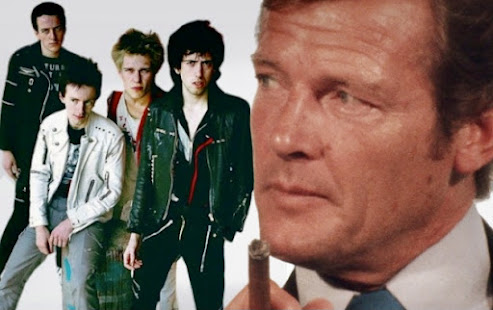
That Time The Clash Did A Diss Track On Roger Moore


While many of the songs in the all-too brief repertoire of the punk icons, The Clash, are rock classics, there are a handful of lesser known tunes by the British band that are really worth seeking out. One such is a non-album track that only appears on the 1991 box set, The Clash on Broadway, entitled “One Emotion.” It’s an outtake from their second album, Give ‘Em Enough Rope (1978), and it’s a pleasingly punchy number that was amusingly inspired by the acting styling (that’s right, one styling) of Roger Moore.


Moore famously portrayed the legendary secret service agent James Bond in seven films from 1973-1985, but there is some dispute by the song’s writers, Joe Strummer and Mick Jones, about whether it was Bond or Moore’s earlier role as Simon Templar in the TV series, The Saint(1962-69), that sparked the song into existence.

In excerpts from the booklet for the Clash on Broadway box, Strummer recalls, “The phrase ‘One Emotion’ came when we were watching Roger Moore. I think it might have been reruns of The Saint, it struck us how one dimensional he was. Then we wrote a more serious song around it, trying to jib our way out of a hole.”

But Jones offers alternate facts: “We used to nip in the cinema just to catch a film in our spare time. I think it was Roger Moore in a really bad James Bond film.”

At the time of the Clash’s recording of “One Emotion” in 1978, the most likely Bond movie to be playing in British cinemas was 1977’s THE SPY WHO LOVED ME, which wasn’t a really bad Bond film in my, and many critics and fans’ minds (it’s even Moore’s personal favorite of the 007 films he made), but still may have been seen as establishment dreck by Strummer, Jones, and their bandmates, Paul Simonon, and Nicky “Topper” Headon. 

But reruns of The Saint were possibly prevalent during that period as well, so it’s plausible that it was a combination of these influences that gave the song its title and hook. A promotional disc for the Clash on Broadway collection featured a soundbite of Strummer talking about the song, but this time he said it was from the gang watching a James Bond movie on television, and that it was Jones that exclaimed, “This guy’s only got one emotion!”

The song is worth YouTubing as, aside from the Moore takedown, it’s an infectious performance that captures the early Clash sound in all its edgy punk pop purity. 

Check it out:


One of the first concerts I ever attended was the Clash at Carmichael Auditorium on the UNC campus in my hometown of Chapel Hill, N.C. on April 6, 1984 (tickets were $11.50!). Now this was the band on their last legs as Jones, and Headon had left, and Strummer and Simonon were joined by hired hands Pete Howard, Nick Sheppard, and Vince White, but it was still The Clash, and therefore a rousing, thrilling experience for my 13-year old existence.

I vividly recall was that there was a wall of television sets on the stage behind the band that were all showing news clips of war footage, and other violent events to punctuate the power of the Clash’s performance. A bit of film that repeatedly appeared interspliced into the mix of vicious visuals was a moment from the 1965 James Bond smash, GOLDFINGER, in which Sean Connery is engaged in a fight with the villain’s henchman, Odd Job in the vault at Fort Knox.

I think that makes it pretty damn obvious which Bond the Clash really preferred.


More later...

Wednesday, August 11, 2010

Blu Ray Review: MYSTERY TRAIN (1989)

MYSTERY TRAIN (Dir. Jim Jarmusch, 1989)


There are several notable elements that Quentin Tarantino took to the bank a few years later heavily on display in Jim Jarmusch’s 3rd feature film MYSTERY TRAIN, now out on a special edition DVD / Blu ray courtesy of the Criterion Collection.

First off, there’s the non linear story-line that gives us three different scenarios that happen at the same time from different perspectives.

Second, there’s the hipster soundtrack that posits Elvis Presley (of course, it being a Memphis movie), Otis Redding, and the Bar-Kays to decorate the film’s scrappy edges. Third, there’s an ultra hip disc jockey who is heard throughout the movie (think: Steven Wright in RESERVOIR DOGS) spinning that cool soundtrack - Jarmusch regular Tom Waits does the duty here. Fourth, there’s Steve Buscemi.

MYSTERY TRAIN is an independent gem that was for a long time endangered to be a forgotten film. This spiffy new Criterion Collection edition not only saves it from that fate; it presents it as the classic that anybody who saw it in the last 20 years knew it was all along.

It’s a movie in which the locale is as much a character as any of its cast. Memphis comes off as a ghost town with dilapidated buildings, dive bars, and a very decrepit hotel – the Arcade Hotel which was raized the year after the film finished shooting. All 3 separate storylines, the names of which are “Far From Yokohama”, “A Ghost”, and “Lost In Space”, take place on the same hot night in Memphis, Tennessee.

In the first story, Youki Kudoh and Masatoshi Nagase play a young couple on somewhat of a religious pilgrimage – they want to visit the old stomping grounds of the King of Rock and Roll and his minions. Their tour of Sun studios tasks them and they constantly bicker about who’s better: Carl Perkins or Elvis Presley.

The next narrative involves Nicoletta Brasch as a recent widow stranded in Memphis while escorting her husband's coffin back to Italy. At a diner she listens to a creepy Tom Noonan telling a story about the ghost of Elvis and later with Elizabeth Bracco as a woman fleeing an abusive ex she re-tells the story. Bracco reacts harshly: “Is this the one where the guy has to go to Graceland and it turns out to be Elvis? I think I’ve heard this a hundred times. I think almost everybody in Memphis has picked up Elvis’s ghost hitchhiking.”


In the third storyline, Steve Buscemi, Joe Strummer (of the Clash), and Rick Aviles navigate through a drunken criminal night ending up at the same hotel as the previous protagonists. The ghost of Elvis lingers as Strummer is referred to as “Elvis” much to his chagrin: “Don't call me Elvis! If you can't use my proper name, why don't you try 'Carl Perkins, Jr.' or something?”


The details concerning a gunshot that is heard in the preceding stories are made clear in the final story and with it the arc is complete. As the night clerk and bellboy of the Arcade Hotel, Screamin' Jay Hawkins and Cinqué Lee are the most consistent characters in the movie – they encounter all the movie’s players in all 3 scenarios and handle them with memorable flair. “Mystery Train” concerns the intertwining stories of foreigners in a quintessential American city.

Like in many of his other films Jarmusch comes off like an American film maker who makes foreign films about America. In my humble opinion this is his best.

Bonus features or as Criterion calls them – Supplements: A rambling but highly amusing Q & A with Jarmusch in lieu of a commentary (his words there not mine) and a couple of cool featurettes including a documentary on the film’s locations and Memphis's musical history and on-set photos by Masayoshi Sukita. 

There’s also an excerpt (19 min.) of a 2001 documentary on Screamin’ Jay Hawkins entitled “I Put a Spell on Me”. All excellent extras on an essential indie classic.

More later...

Thursday, July 10, 2008

Clash Frontman Joe Strummer Gets The Julien Temple Treatment With Great Rock Doc Results

“I need some feeling of some sort - hey, we’re all alive at the same time, at once, you know!” - Joe Strummer yelling at the US Festival crowd 5/28/83 


I sadly missed this film on its extremely brief theatrical run in my area but happily just viewed the newly released DVD so here’s my review:


JOE STRUMMER: THE FUTURE IS UNWRITTEN (Dir. Julien Temple, 2007)
Tracing Joe Strummer’s life from a “mouthy little git” to “punk rock warlord” (Strummer’s words) Julien Temple’s lively and loving documentary is full of insights and powerful ideology that render it immediately essential.

As the frontman for the seminal British punk rock band The Clash, Strummer was rawly outspoken, always passionate, and brutally honest so he’s the best one to tell his story and by way of BBC radio recordings of him as guest DJ and audio from many interviews over the course of his career - he does.

These archival Strummer soundbites are helped along by a bountiful bevy of talking head comments from such stars including Johnny Depp, Steve Buscemi, Bono, and John Cusack as well as those with a more personal connection - former bandmates, girlfriends, and family members who I wish were better identified.

That’s one of the only beefs I have with this project - we know who Matt Dillon or Bono are when they appear at a campfire shot to offer their takes on Strummer but without a name and caption many folks like girlfriend Palmolive (from the lesser known but still vital bands The Slits and The Raincoats) fly by with their context not properly placed *


Also would be nice to have concert dates and events better titled. Small quibbles though, the rest is rockumentary gold or at least rock doc crack. *


Luckily the DVD has an over an hour and a half of bonus extended interviews which does identify each participant and is also essential. A couple of the highlights: Angela Janklow tells of a hilarious chance meeting of Strummer and Monica Lewinsky & Martin Scorsese relays how Clash music fueled his inspiration making RAGING BULL and later GANGS OF NEW YORK. Born as John Mellor, the son of a British diplomat and a Scottish nurse, his family moved quite a bit during his childhood; living in Eygpt, Germany, and Mexico before John ended up at a boarding school in London. 


It was there that he was turned on to The Rolling Stones, learned to play the ukulele, and starting going by the name of “Woody” ostensibly because of an affection for Woody Guthrie. He went to art school with cartoonist aspirations (many of his drawings are sprightly animated and interspersed throughout) but music was his real calling and he was soon playing guitar in a band called the Vultures which didn’t last long. 


At the same time he toiled in such vacant career opportunities as carpet salesman and grave-digger. Because of his style of guitar playing he changed his name to Joe Strummer and angrily derided anybody who called him by another moniker. As it certainly was suspected the center piece here is Strummer’s years with, as the hyped phrase goes, the “only band that matters.”


Having disbanded another band - the popular pub rockers The 101ers, Strummer met guitarist Mick Jones and manager Bernie Rhoades. With bassist Paul Simonon, drummer Terry Chimes, and another guitarist Keith Levene they formed The Clash. 


They were immediately embraced by the blossoming British punk scene and signed to CBS within a year of their live debut (in 1976) with Chimes replaced by Topper Headon and Levene being axed. Great grainy footage abounds - most notably The Clash playing to a giant crowd of pogo-ing punksters at an Anti-Nazi League benefit. 


Their political themes, fueled by Strummer's leftist views, were not lost on their fans as Bono from the mega-band U2 pretentiously but accurately explains: “I never knew who the Sandinistas were or where Nicaraqua was, the lyrics of Joe Strummer were like an atlas; they opened up the world to me and other people who came from blank suburbia.”


“I couldn't believe we turned into the kind of people we were trying to destroy” Strummer laments as we see The Clash reap the rewards of success/excess.


Contrasting professional arena concert footage from the early 80's with the grimy black and white basement video of their early days of the same song illustrates beautifully his case: “we were part of the audience, part of the movement. 


Once it became thousands of miles removed from that I began to freak out.” Mick Jones final appearance was at the US Festival in 1983 (which again, is not properly identified) at which point Strummer, most likely way after the fact, describes the band as a “depleted force.”


The Clash carried on however with some replacement blokes but the glory was gone so yep, here comes death. The death of the band that is, Strummer had many years of soundtrack work, acting roles (he appeared with Buscemi in my favorite Jim Jarmusch film MYSTERY TRAIN, solo recordings, and powerful performances with his band the Mescaleros. 


As a former global punk superstar he struggled a bit: “You meet a 17 year old guy and he's never heard of The Clash; that's the moment my feet touch the ground again.” Strummer died of a congenital heart defect on December 22nd, 2002. 


Just weeks before he played with Mick Jones for the first time since 1983. It was an impromptu appearance with Jones getting on stage to join Strummer and the Mescaleros on the Clash classics “Bankrobber”, “White Riot”, and “London's Burning.”


The footage from that gig, albeit brief, adds enormously to the emotional last third of the documentary. 


Temple’s clever construction of the different strains of pop culture, even utilizing clips of ANIMAL FARM and the classic British flick IF.... to symbolize oppressive British society, is incredibly compelling from the before mentioned concert footage to even an appearance on South Park (1998). 


As both a enjoyable touching tribute for the long-time fan and a teaching-tool for the uninitiated, Julien Temple’s JOE STRUMMER: THE FUTURE IS UNWRITTEN is one of the best of its kind and a new addition to the definitive rocumentary checklist.

More later...

Wednesday, April 28, 2004

Elvis Impersonation On Film: 10 Pretenders To The Crown


Inspired by the inspired casting of cult legend Bruce Campbell (The EVIL DEAD movies) as Elvis Presley in BUBBA HO TEP (2002) (to be released on DVD on May 25th) we thought it would be fun to take a look at:


ELVIS IMPERSONATION ON SCREEN: 10 PRETENDERS TO THE CROWN

1. KURT RUSSELL


Russell took on the roll of the King in the 1979 made-for-TV ELVIS : THE MOVIE (his first of five films for director John Carpenter), and also voiced Presley in FORREST GUMP. His uncanny likeness to the King was further exploited when he played an Elvis impersonator in Demian Lichtenstein’s 3000 MILES TO GRACELAND (2001). Amazingly Russell's first feature film role when he was only a child was in an Elvis movie, Michael Taurog's IT HAPPENED AT THE WORLD'S FAIR (1963). The best Elvis on this list for sure.

2. MICHAEL ST. GERALD: Also a convincing look-a-like, Gerald did a brief cameo as Elvis in Jim McBride's unfortunately lame-as-Hell Jerry Lee Lewis bio-pick GREAT BALLS OF FIRE (1989, but he had better material and a more respectful forum in the sinfully short-lived Elvis TV series (1990). Like with Russell's turn as the King, Gerald's vocals were provided by Ronnie McDowell.

3. NICHOLAS CAGE: Never played Elvis on film but appeared as Tiny Elvis on Saturday Night Live in 1992, disguised himself as a sky-diving Elvis impersonator in HONEYMOON IN VEGAS, was a curled lipped Elvis fanatic in David Linch’s WILD AT HEART, and he was briefly married to Lisa Marie Presley. Whew!

4. ANDY KAUFMAN


Only on stage and SNL did Kaufman do his full blown Elvis impression but he’s one of a kind on this list because he was approved by the King as his own favorite impersonator. In Milos Forman's 2000 biopic MAN ON THE MOON when Jim Carrey did Andy doing Elvis I heard that somewhere in the cosmos John Belushi's caller ID exploded. I have no idea what that means.

5. VAL KILMER: Not content with having nailed the Lizard King, Jim Morrison in Oliver Stone's THE DOORS (1991), Kilmer inhabited the character of Elvis' ghost who counsels Christian Slater in Tony Scott's Quentin Tarantino-scripted TRUE ROMANCE (1992).

6. DAVID KEITH: An awful unconvincing portrayal in Chris Columbus' awful unconvincing 1988 comedy HEARTBREAK HOTEL, a severely misguided attempt to theorize that Elvis’s last sad years in Vegas could have been turned around by idealistic teenager who kidnaps him as a gift for his depressed mother Tuesday Weld. Weld was actually in a movie with the King, Philip Dunne's WILD IN THE COUNTRY (1961), but I digress.

7. DON JOHNSON: What the…?!!? Yep, that's right. In Gus Trikonis' long forgotten 1981 TV movie ELVIS AND THE BEAUTY QUEEN, the later stubbled, sockless, pink T-shirt wearing Miami Vice superstar was actually cast as the King. 

8. DALE MIDKIFF: Who?!!? I dunno, just a guy who played the King in ELVIS AND ME, another bad Elvis made-for-TV movie based on Priscilla Presley’s book of the same name. Shame shame shame.

9. RICK PETERS


Any Elvis impersonator would be doomed in Allan Arkush's extremely lowbrow 1997 cable movie ELVIS MEETS NIXON, but this guy doesn’t cut it at all.

10. STEPHEN JONES: Just for a haunting moment in Jim Jarmusch’s MYSTERY TRAIN (1989) Elvis’s ghost appears to Nicoletta Braschi giving this execellent movie another layer in it’s depiction of late 80’s Memphis. Also in the same movie the late great Joe Strummer spouts: “Don't call me Elvis! If you can't use my proper name, why don't you try "Carl Perkins, Jr." or something? I mean, I don't call them "Sam & Dave", do I?”

Until next time: 
Elvis has left the building.

More later...