Friday, February 06, 2015

Two Epic Fantasy Fails: JUPITER ASCENDING & SEVENTH SON


This last week hasn’t been a good one for me in the big ass 3D CGI-ed fantasy film dept. I had the displeasure of donning the annoying plastic glasses for screenings of two duds: The Wachowskis’ newest sci-fi flick JUPITER ASCENDING, and Sergei Bodrov’s medieval adventure SEVENTH SON, both opening today at a multiplex near you.

Despite admiring the first MATRIX movie, and enjoying segments of CLOUD ATLAS (co-directed by Tom Tykwer), I can’t say I’m a big fan of The Wachowskis’ canon. Yet I appreciate that they do have a distinct, undeniable vision, and the fact that their latest isn’t based on a book, graphic novel, video game, or any pre-existing entity of any kind did appeal to me.

But the story, involving Mila Kunis as Jupiter, a lowly maid scrubbing toilets in Chicago who learns that she’s alien royalty, never came together amid its strained set-pieces and overly talky passages.

Channing Tatum, sporting pointy ears and eyeliner as he’s a “splice” of wolf and man, plays Kunis’ protector/love interest. Tatum, whose appearance reminds me of John Candy’s half man, half dog SPACEBALLS character, seems to not have completely shaken off his stoical Marc Shultz persona from FOXCATCHER, which leads to some charisma-less exchanges with Kunis.

Eddie Redmayne, Oscar nominee for his role as Stephen Hawking in THE THEORY OF EVERYTHING (itself nominated for Best Picture), plays the villain, Balem Abrasax, who wants to kill Kunis and harvest the earth – what else? The Wachowskis have surely taken a queue from STAR TREK in making their villain all Shakespearian, and Redmayne, whose every line of dialogue is either whispered or screamed, left no piece of scenery unchewed.

A centerpiece action sequence over the skyline of Chicago – Tatum has these anti-gravity boots you see – was one of the most cluttered and unexciting chases I’ve seen in a long time, and I’ve seen a lot of cluttered and unexciting chases in the last several years.

Sadly, The Wachowskis’ effort here recalls the worst of sci-fi fantasy in film; the intergalactic cities, landscapes, and costumes are nearly identical to the imagery and aesthetics of the lame ass STAR WARS prequels, and the cosmically convoluted scenarios are straight out of the notorious king of sci-fi flops, BATTLEFIELD EARTH.


JUPITER ASCENDING is a generic looking space opera that is without gusto or invested invention. Worse of all, Kunis looks really bored. That might be me just projecting, because I know I sure was.
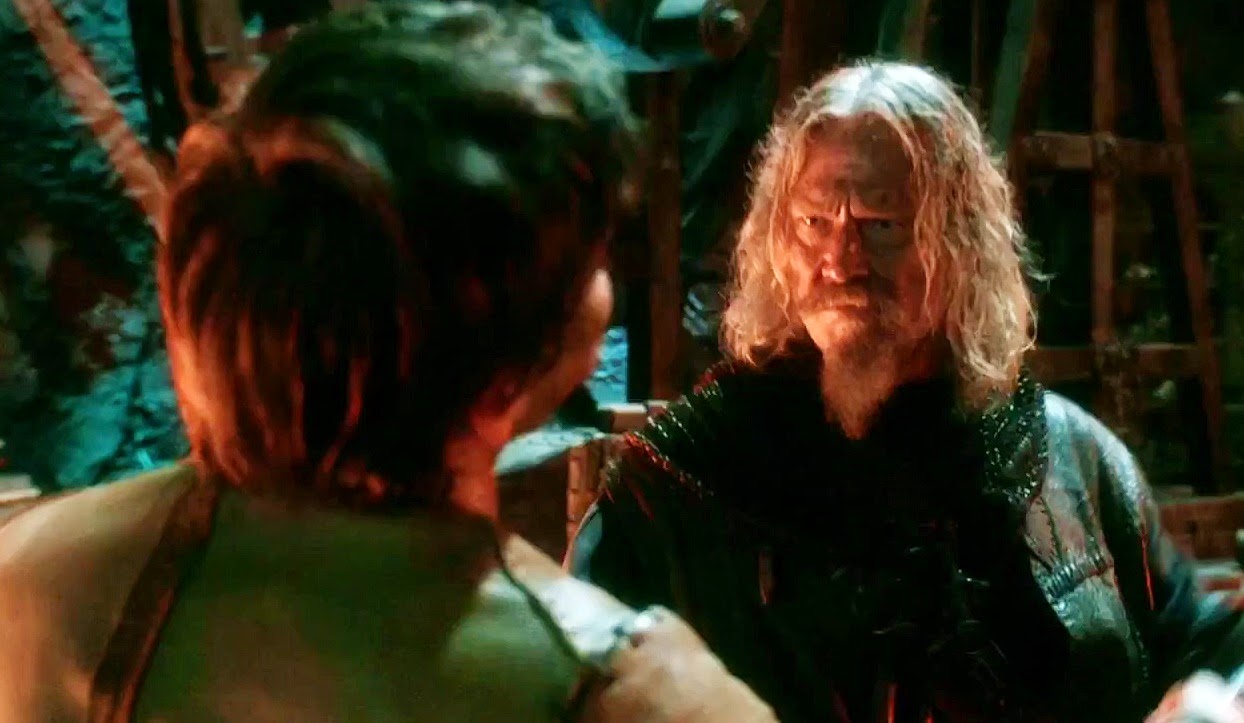

Now quick, before it leaves my brain, let me see what I remember of Bodrov’s SEVENTH SON, which I just saw last night but is evaporating rapidly. Based on Joseph Delaney’s young adult novel “The Spook’s Apprentice” (I can see why they changed that), the film stars newcomer (well, new to me) Ben Barnes as the seventh son of a seventh son who joins the grizzled Master Gregory (Jeff Bridges in another very “undude” later day role) in hunting down a witch queen played by an energetic but not entirely convincing Julianne Moore. Here’s hoping this misappropriation of her talents doesn’t overshadow her vastly more essential, and Oscar nominated work in STILL ALICE (opening in my area on Feb. 13th).

Now I love Bridges, and seeing him reunited with his BIG LEBOWSKI co-star Moore did give me a little bit of a charge, but his character, a crochety blend of Gandalf and Rooster Cogburn, isn’t very imaginatively written or acted. The old coot even mumbles “fuckin’ witches” when exiting the room at one point. Maybe after winning the Oscar for TRUE GRIT, the guy decided he doesn't need to try anymore. Hence crap like R.I.P.D. and this.

Barnes, with his bedhead and spare stubble that makes him look like an indie rocker or a boyfriend on Girls, has little or zero presence. He blends into the background of battles with witches that turn into dragons, and is even upstaged by Bridges’ ogre servant (John DeSantis).

Awful special effects, the badness of which is enhanced by the fiercely unnecessary 3D conversion; atrocious dialogue, sloppily edited swordplay, and incompetent pacing make SEVENTH SON a dreadful, dreary slog. Even their attempts to scare with random monsters, dragons, ghosts, and even a bear screaming right 
in-your-face didn’t keep me from almost nodding off.

So, that’s two genre pictures that really didn’t gel for me, getting released in the cinematic off season of February. As that’s roughly four hours of bloated CGI-saturated fantasy blather that I’m so glad is over, here’s hoping neither will be successful enough to spawn a sequel.

More later...

Friday, January 30, 2015

A MOST VIOLENT YEAR: The Film Babble Blog Review


Now playing at an indie art house near me (and a few multiplexes):

A MOST VIOLENT YEAR

(Dir. J.C. Chandor, 2014)


The poster picture for this movie lists actors Oscar Isaac and Jessica Chastain in succession with the description “New York City, 1981.” That seems to suggest that New York City, circa ’81 is as much a star of the movie of those two leads. But really it’s just the NYC skyline, with the World Trade Center’s twin towers present in many shots, that counts as a principle player here.

Isaac commands the screen with cool, cunning confidence as Abel Morales, a Columbian immigrant who’s looking to close a major waterfront land deal (that happens to have an amazing view of Manhattan) so he can expand his heating oil company. 


With his delicately coiffed hair, Armani suits, cashmere camel coat, and cultivated demeanor, Isaac channels GODFATHER PART II-era Al Pacino. Close-ups of Isaac even brought to my mind Mort Drucker’s caricatures of Pacino in old ‘70s issues of Mad Magazine.

But Isaac’s Abel is like if Pacino’s Michael Corleone actually meant it when he told his wife he wanted the family business to be completely legitimate. “I've spent my whole life trying not to become a gangster,” Abel tells his wife Anna, sharply played by Jessica Chastain, dressed in chic ‘80s fashions.

Abel believes in the American dream, but Anna, the daughter of a local mob boss, has a more lived-in cynical perspective, especially since recent events involving their trucks getting hijacked by unknown rivals, and a smooth district attorney (David Oyelowo, in quite a distinctly different persona than MLK Jr. in SELMA) building a case to charge them for white-collar tax fraud, have placed their deal in jeopardy.

Because of the violent hijackings, one of which put a young driver (Elyes Gabel) in the hospital, a Teamster rep (Peter Gerety) tells Abel to arm his employees but he refuses, saying that it “would be the end of everything we worked for. If one of these guys shoots someone, they will bring me down for it.”

Abel also refuses to live in a fortress with guards, even after he chases off a man with a gun lurking outside his new palatial mansion in the suburbs of Westchester.

Albert Brooks, who, like in his Oscar-nominated part in DRIVE (which also featured Isaac), is again playing against type, this time with a wig of thin blonde hair as Abel’s wise lawyer and confidant. Except for a couple of well-worded scenes, notably one in which he asks Isaac: “Why do you want this so badly?”, Brooks isn’t given a lot to do, but his presence is still seriously appreciated.

The pressure is on as time is running out for Abel to raise the needed cash, and find out who’s behind the hijackings, but Abel keeps his cool. That is until he personally involves himself, chasing down one of the hijacking thugs and trying to beat out of them who they work for.

A MOST VIOLENT YEAR, which is only intermittently violent, doesn’t much resemble writer/director J.C. Chandor’s previous films - the financial cliffhanger MARGIN CALL, and the Robert Redford lost at sea drama ALL IS LOST - except in being about practical-minded people trying to survive. Just three films in, Chandor is already building an impressive filmography, one that’s steeped in styles learned from the masters, yet tempered by his own edgy vision.

While Chandor layers his film with echoes of Francis Ford Coppola, Brian De Palma, Sidney Lumet, and Martin Scorsese, the cinematography of Bradford Young, who also shot SELMA, brings to mind the darkness of the late, great Gordon Willis’ camerawork. The spare lighting adds shadowy nuance to the proceedings, particularly in a scene involving the meeting of the oil company heads around a table in the back of an Italian restaurant (yes, another GODFATHER-ish bit).

Sadly this excellent, moody, impeccably acted film was overlooked Oscar nomination-wise. For her tough, take-no-shit, New Jersey-accented performance, I thought Chastain would get one for sure. When she takes charge, like when she shoots a deer that they hit with their car because Isaac was hesitating to kill it with a crowbar or when she calls her husband a “pussy,” she’s completely convincing as a woman who’s been around and knows the real stakes.

But Isaac is the true owner of the film. A simple closing of his eyes in disappointment conveys volumes, and his determination to gain more power and control (witness the aforementioned war council scene) without losing his dignity provides the foundation for Isaac’s finest acting yet. Despite his headlining the Coen brothers’ INSIDE LLEWYN DAVIS and a bunch of other choice roles, Isaac isn’t a household name yet, but while roles in STAR WARS and X-MEN sequels may change that in the next year, this film is the one that really deserves to be his breakthrough.

The film strains to emphasize that this guy is a better, more moral minded man than Michael Corleone, but as much as he feels that he’s immune from corruption, it’s a necessary evil with which he must compromise.

So many New York movies set in the same period shy away from showing the WTC towers in the skyline, but here they are always present – often out of focus, way off in the background, but always present. Chandor’s film doesn’t have to spell out what they represent in Abel’s quest for success in a harsh, dangerous economy; one can feel it every time they are glimpsed.

More later...

Wednesday, January 28, 2015

Lucinda Williams’ Pick For Film Acoustic: John Huston’s WISE BLOOD


Late last year when I heard about a new series starting up at the Carolina Theatre, programmed by The Modern School of Film, called “Film Acoustic,” which pairs special guests with their favorite movies, I was very intrigued. Yet, I regretfully skipped the first installment in December with Wayne Coyne of the Flaming Lips presenting and discussing a 40th anniversary screening of Liliana Cavani’s THE NIGHT PORTER. Yeah, sure wish I’d gone to that.


So, the second in the series, I made sure I attended, especially when I heard that it would feature Grammy-winning singer/songwriter Lucinda Williams, one of my favorite artists. 


Williams’ pick was WISE BLOOD, John Huston’s 1979 adaptation of Flannery O’Connor’s 1952 debut novel of the same name. It was announced that in addition to taking part in a talk about the movie with Modern School of Film founder and Duke graduate Robert Milazzo, Williams, unlike when Coyne appeared, would be playing a few songs after the screening. But the real kicker was that the event was, scheduled by happy accident, on Williams’ 62nd Birthday! (Monday, January 26th)

The Birthday girl’s choice, the darkly humorous WISE BLOOD, is one of the weirdest in the iconic Huston’s filmography, far removed from the Humphrey Bogart classics he helmed (THE MALTESE FALCON, TREASURE OF SIERRE MADRE, KEY LARGO, THE AFRICAN QUEEN), and way less epic than the film that came before it, his 1975 Rudyard Kipling adaptation THE MAN WHO WOULD BE KING, starring Sean Connery and Michael Caine.

Brad Dourif, best known for his roles in ONE FLEW OVER THE CUCKOO’S NEST, Deadwood, and, as Milazzo reminded us in a trivia question, as the voice of Chucky in the CHILD’S PLAY franchise, stars as Hazel Motes, a young Southern man who’s trying to establish what he calls the Church of Truth Without Christ.

Although referred to as the town Taulkinham (from the book), the film is clearly set in Macon, Georgia (the name Macon can be seen on buildings throughout). Dourif’s Motes travels to the area to set up his ministry, which is basically just him and his constantly breaking down Essex automobile, which he stands on the hood of to preach to people on the street.


Somewhere around the time that Motes finds himself a room at a boarding house, chosen because Harry Dean Stanton as a scam artist posing as a blind preacher and Amy Wright as his airheaded, horny daughter live there, I realized that I had seen this before. Or at least a large chunk of it, because a lot of its imagery, acting, and story points were very familiar to me. Ned Beatty’s role as Hoover Shoates (love that name), a boisterous guitar-playing rival to Motes, and an odd subplot involving Dan Shor as a needy, racist halfwit who steals a gorilla suit, rang bells of recognition in my mind too.

I believe I had happened upon it when devouring every movie I could as a kid watching cable in the mid ‘80s. What I saw of WISE BLOOD back then had been locked away in some file in my mind, and this special screening rekindled those memories.

That was a cool thing to recall, and it enhanced this viewing quite a bit. But, of course, what really elevated the evening was Williams. Relaxed, drinking a glass of red wine, the woman who Time Magazine once called “America’s best songwriter” came out to warm applause, and yelled birthday wishes, and seemed very satisfied with how the movie had been received by the audience there in Fletcher Hall that evening.

One of the key points of her discussion with moderator Milazzo was Williams’ recently passed father, award winning Arkansas poet Miller Williams (1930-1915), who was a student of O’Connor’s.


Williams spoke about how her father’s agnosticism influenced understand what Motes meant by a church of Christ without Christ, and, alone with only her acoustic guitar, she performed two songs that were directly influenced by the film: “Get Right With God,” from her 2001 album Essence; and “Atonement,” from its 2003 follow-up Worlds Without Tears.

Williams’ comments around those striking performances were priceless. On “Get Right With God” winning a Grammy: “It won Best Female Rock Vocal Performance, which doesn’t make any sense – it wasn’t a rock song.” On the new solo arrangement of “Attonement”: “That sounded really cool, we might have to start doing it that way.”

Among some more lively discussion, which included her amusing recollection of meeting Bob Dylan for the first time, and some nifty audience Q & A, Williams also performed a blistering cover of Robert Johnson’s “Stop Breakin’ Down,” which appeared on her 1979 debut album Rambling, and a sweet version of “Compassion,” adapted from one of her father’s poems, from her excellent 2014 album Down Where the Spirit Meets the Bone.

All in all, a great evening. Seeing WISE BLOOD, a pleasingly warped piece of Americana in the presence of one of its biggest fans, the wonderful Lucinda Williams, who sang its praises in both meanings of the phrase, on the occasion of her birthday, is something I’m sure I’ll never forget.


The next Film Acoustic, set for Monday, February 23rd, looks incredibly promising as well: Neko Case presents Alex Cox’s 1984 cult classic REPO MAN, with Very Special Guest Mike Nesmith. Being a big fan of Case, both solo and with the New Pornographers, and even a bigger fan of Nesmith, who executive produced REPO MAN, but, of course, is best known for being one of the Monkees, there’s no way I’m missing that.

More later...