Wednesday, April 27, 2022

The Set Design Wore Warhol


When a scene in a movie or television show is set in a lavish, extravagant mansion or penthouse, there is often a familiar sight. That would be large, square artwork featuring the same image repeated, often in different colors, each a portrait of the rich, usually famous resident of the posh palace.


The style is recognizable as being of iconic pop artist, Andy Warhol. He produced many of these screen-print works of such ‘60s and ‘70s stars as Elvis Presley, Marilyn Monroe, Audrey Hepburn, and, of course, Campbell’s Soup cans. 


Sets that include the fake movie versions of Warhol’s art are designed to emphasize that the character depicted is an extremely wealthy, and influential figure. So powerful that an artist of Warhol’s stature would add their visage to their oeuvre.


Several years ago, the Whitney Museum in New York hosted a retrospective entitled “Andy Warhol –From A to B and Back again.” Joelle Magazine explained how this status symbol came into being:From 1968 to 1987, Warhol received hundreds of portrait commissions from business moguls, art collectors, socialites, fashion designers, models, royals, and celebrities of all kinds.” So basically it’s an extremely plausible detail to add to a fictional rich character’s decor.


Slate’s Heather Schwedel in the 2019 article, “Why Warhol Became the Symbol for Characters With Big Bank Accounts and Bigger Egos,” pointed out one of the first films to include faux Warholian artwork, Mike Nichol’s 1988 comedy WORKING GIRL. Melanie Griffith’s character happens upon a wall graced with four canvasses portraying her boss, played by Sigourney Weaver (see picture at top).


But there is an earlier example from four years previous, in Charles Shyer’s IRRECONCIBLE DIFFERENCES. A scene set in a mansion owned by Shelley Long as a bestselling author, appears on a wall behind Long and her failed filmmaker ex-husband, Ryan O’Neal (I blogged about the film a bit back). 


Over the years, this opulent aesthetic has appeared in such movies as:


AUSTIN POWERS: INTERNATIONAL MAN OF MYSTERY (1997)


ZOOLANDER (2001)
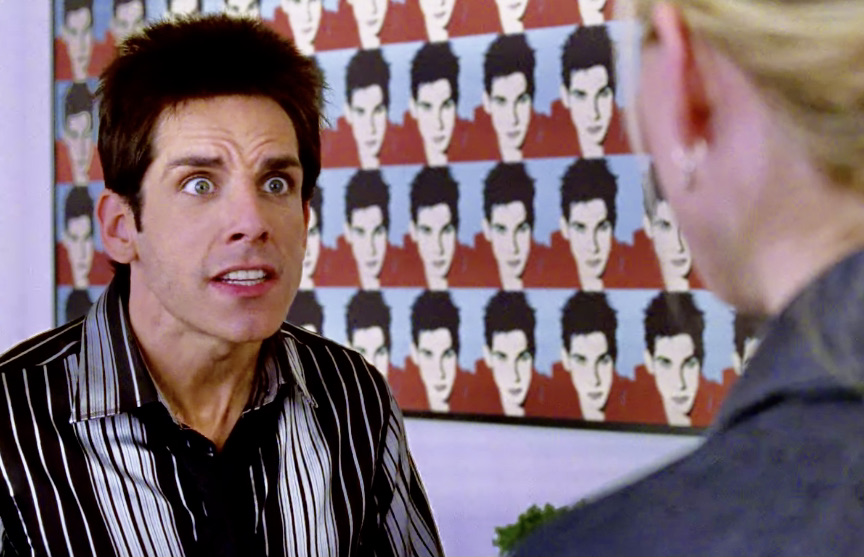


POPSTAR: NEVER STOP NEVER STOPPING (2016)


And such TV shows as:


The Watchmen (HBO, 2019)


The Office (2008)


This one, from the fourth season fan favorite episode, “The Dinner Party,” is pretty easy to miss as you can tell from my hard-to-get-a-good-shot screen capture that it only appears for around 10 seconds, and not in full. It’s pretty hilarious that Melora Hardin’s arrogant character, Michael Scott’s girlfriend Jan, would have such a portrait of herself. Delusions of grandeur indeed.


The Good Place (2016)


I must give credit where credit is due to Schwedel, who in addition to writing the Slate piece I referenced above, posted a bunch of other examples of the Warholian set designs on her Twitter, @heathertwit. In sharing these screen shots, she tweeted that it’s “one my favorite movie tropes, which is when you can tell a certain character is stuck up because they have a Warhol portrait of THEMSELVES in their home.”


It’s only right to give Schwedel a plug, since I’ve taken some of the pics above directly from her feed. 


Now, I’ll leave you with one more, even though Schwedel says it “only sorta counts.”


Bojack Horseman (2015)


More later...

Tuesday, April 26, 2022

Spoiler Alert: This Post Is About Spoiler Etiquette

Not long ago, I was hanging with friends, and I mentioned that I been catching up with a new show on HBO (I’m not going to say which one) in the midst of a conversation about shows that everybody had been watching lately. I said to one of my friends that I wished he hadn’t, at a previous meeting, dropped a Spoiler from the third episode of the series – it was actually just one word that he said when he remarked about how nothing was really happening in the show’s first few episodes, and then - the one word. Now, it was a loaded word – think a major plot point that can be summed up with one or just a few words like murder, or car accident, or divorce. So I was miffed that I had heard that word before I had gotten to that point on my own. 

I had only seen one episode, which was largely set-up, and was still trying to feel out the tone of the show. When that word was spoken by father, my brain noted it, and it greatly affected how I watched the show from then on. Since my friend knew that I had only seen one episode, I would think he’d keep mum, so I told him that when I got to the point where the event happened that he so sloppily spoiled, and that his careless blurting out of the word diluted the impact of the scene.


His reaction floored me - he laughed like what I said was ridiculous, and invalid. Nobody else laughed at this, mainly because nothing funny was said at all – just somebody offering their opinion on something that they found important – the experience of viewing a program or movie with somebody who has already seen it obnoxiously spoiling a key moment.


Which brings us to the Urban Dictionary’s definition of Spoiler:


The thing that maybe bothered me most is that my friend reacted as if this was the first time anyone had ever voiced this opinion. Now, I’ve been a big fan of film since I was a kid, and the idea of not ruining people’s experience is one that has been big in the pop culture conversation that I’ve been in for over four decades. I’ve worked in video stores, and movie theaters where I’ve had thousands of conversations with co-workers, and customers, about keeping important plot points to yourself unless you know that the person you are talking to is caught up with whatever TV show, movie, or book you may be discussing. I seriously, but stupidly thought this was something that everybody knew - in fact, I hesitated even blogging about this because these points feel so redundant, so obvious, and so universally relatable.


But instead of being reasonable, and respectful to a world that he knows his son has passion for and has written about for decades, my friend just said, “I don’t care about Spoilers.” In all of those previous conversations, and the many many many that I’ve had or read online, I’ve never heard or read or seen that statement. That’s because it’s a bullshit thing to say. Everyone I’ve ever known or talked to about this cares about not having their experiences spoiled, and I know there are shows that it would’ve highly annoyed him if, say, someone spouted out who was the murderer in in a show he had invested a number of hours viewing. 


I mean, that’s why we watch these things in the first f-in’ place! We want the real storytellers to reveal this stuff to us, not somebody who says that they don’t care about others experience. This is major common courtesy stuff! I comfort myself in thinking he just said that in the defensive. Some people just can’t concede a point in the moment, you know. Even one as rock solid as my argument.


It was also sad to me because in the 18 years of maintaining this blog, I’ve referred to Spoilers hundreds and hundreds of times (Google it). I’ve started many reviews with Spoiler warnings, and I’ve highlighted the word Spoiler in red so that readers will be aware that they might be coming. So I guess I learned that my friend doesn’t read my blog although they've often said they did. I’ve long suspected that they just skimmed it, and now I know for sure what’s up.


Fun fact: The phrase “Spoiler Alert” has existed long before the internet - it has been traced back to a review of STAR TREK II: THE WRATH OF KHAN in 1982.


I received an invite to the latest Marvel movie, DOCTOR STRANGE: THE MULTIVERSE OF MADNESS (love that title), and it had this request for critics:


I mentioned this to another friend – sent them the screen capture above – and they replied, “Hmm. You’d think that would go without saying.” Well, apparently not. I mean, again, I hesitated to write this post because I would think that everybody reading a movie blog would know this drill. But, yeah, apparently not.


So millions and millions of people care about spoilers. Movie studios spend a lot of money and time trying to hide the things that DOCTOR STRANGE request specified so that audiences can have a fresh experience going in. Iconic film critic Gene Siskel (of Siskel & Ebert fame) notably would wait in the lobby while trailers for other movies were playing because he didn’t want to see anything from upcoming movies before seeing them himself. Siskel passed away in 1999, so I wonder how if he had lived, he would maneuvered during the internet age when a glance at any social media platform can reveal something from some current film without any warning. I bet he would and just not go on the internet, just like he didn’t enter the theater until after the coming attractions.


Here ends my rant. Good Gawd, that felt good to get out of my system!!!! I guess I was triggered by the shocking event of somebody being so clueless to something that’s so embedded in our pop culture experiences. Revealing spoilers to somebody, especially without asking or acknowledging where they are in viewing said show or movie, is a definitive cultural taboo. The rule of respecting others experiences by not spouting out spoilers is something I’m very glad exists for the people that do care. You know, everybody, but my so called friend.


More later...

Wednesday, April 13, 2022

The Final Fest Report: Full Frame 2022: Part 3

Russian opposition leader Alexei Navalny and pictures of his poisoners in Daniel Roher’s NAVALNY

My coverage of the 25th Annual Full Frame Documentary Film Festival now concludes with my musings on the last three docs I watched while exercise-biking, and wearing pajama pants - the only pluses to having to watch the festival’s offerings at home instead of at the Carolina Theatre, and the surrounding venues in downtown Durham, N.C. Here’s hoping we can all get back to that in 2023. I’ve made this joke before, but when Full Frame does return in full effect from all the pandemic-set conditions, the program will be nothing but documentaries about the pandemic. Yeah, it’s not really that much of a joke.

Anyway, onto Daniel Roher’s NAVALNY, which has been likened by many critics to a thriller for its detailing of the investigation into the poisoning of Russian opposition leader Alexei Navalny. The 44-year old anti-authoritarian was infected with a nerve agent, later to be revealed as Russian president Vladimir Putin’s “signature poison,” on a flight home to Moscow from Siberia in 2020. After recuperating from a coma in exile, Navalny goes undercover in Germany to find the men behind the assassination attempt, and further expose the wide-ranging corruption of Putin’s regime with the help of journalist/hacker Christo Grozev.


The media-savvy Navalny is a charismatic, jovial dude who makes a great protagonist/narrator for the film, as he takes us through the paces of his procedural, which involves an elaborate evidence board (also known as a “crazy wall,” or “murder map”) - you know, a wall covered in pictures of people, newspaper clippings, charts, etc. connected with strings - and, funnily enough, tik tok videos. One of the film’s most crucial moments comes when Navalny, posing as a fellow conspirator in the poisoning plot, gets a Federal Security Service (FSB) scientist to confirm in great detail how the state-sanctioned murder endeavor went down.


NAVALNY is indeed a thrilling portrait of a driven man, and his mission, and is the best film I experienced at Full Frame 2020. Look for it on the festival circuit now, and, with hope, in theatrical release later, before it finds its eventual home on HBO and CNN, the outlets responsible for its production.


Next up, Jon Ayon’s doc short NO SOY ÓSCAR, which insightfully displays s a lot in its 15-minute running time as it follows the journey of the filmmaker through the treacherous border regions between the U.S. and Mexico in search of the area where Salvadoran migrants Óscar Alberto Martínez Ramírez and his young daughter, Angie Valeria, drowned. 


While it contemplates harrowing, heady issues, the film is more meditation on the meaning of the definitely divisive, and deadly dangerous border wall which Ayon describes as a “Trump inspired, ridiculous monstrosity of concrete and steel.” NO SOY ÓSCAR won the President’s Award for Best Short at this year’s fest, but no word yet as to its availability either theatrically or streaming in the coming months. I’ll keep you posted. 

Finally, a very fascinating doc that ended my Full Frame 2022 experience nicely, Yaara Bou Melhem’s UNSEEN SKIES, which explores the work of landscape artist, photographer, geographer, and author Trevor Paglen, who specializes in studying mass surveillance. We witness his processes via his time-exposure photographs showing the streaks of light left by classified satellites taken in the Nevada desert, as his prepares to launch a 100-foot-long mylar sculpture into space, a $1.5 million project dubbed Orbital Reflector.


The project runs into red tape as it apparently didn’t fit into Trump’s concept for Space Force, but the bureaucratic hassle doesn’t deter Paglen from his life’s passion of watching the skies. The film has a glossy look, but it well contains Tom Bannigan’s cinematography, which captures the rocky terrain, and the milky way above it so stunningly that it certainly makes this the doc with the most eye-popping scenery at the fest this year. Bou Melhem’s film equally honors technology, and art, but like many of the best docs at Full Frame (or docs in general) it most celebrates perseverance in the face of odds no matter what size. 

So that’s my coverage of Full Frame 2022. While there were a good number of worthwhile docs, the festival as an online-only event is wearing thin. There were times throughout the four-day event that when I took a break from the films and would do other stuff, that I would almost forget the fest was happening, and that is unacceptable in my world. This can’t be how it goes down next year, new strains of coronavirus be damned. Come April 2023, this thing better be back on in full. You hear this lowly blogger? You Full Framers get on it!


More later…