Showing posts with label Working Girl. Show all posts

Thursday, April 11, 2024

That Time The Travelling Wilburys Stole A Line From An ‘80s Melanie Griffith Movie

That’s right, the rock supergroup made up of Bob Dylan, George Harrison, Jeff Lynne, and Tom Petty (Roy Orbison was a member, but passed after their first record’s release) lifted a line (and twisted it), from Mike Nichols’ 1988 Melanie Griffith comedy WORKING GIRL, and it’s a doozy.

At a party scene, Griffith’s ambitious Tess McGill schmoozes with a colleague she’s just met, played by Harrison Ford at his ‘80s prime, and says (after a few tequila shots):


“I’ve got a head for business, and a bod for sin. Is there anything wrong with that?”


Cut to the first single off of the Travelling Wilburys second album in 1990, jokingly entitled Vol. 3, “She’s My Baby,” featuring this couplet that comically reverses the line:


“She’s got a body for business, got a head for sin/She knocks me over like a bowling pin”


The line is sung by George Harrison on the single (the same version of which kicks off the record), but there is a demo of the song that has Dylan singing the entire song so it’s safe to assume that he’s the one that had the idea to co-opt Griffith’s line, which came from WORKING GIRL screenwriter Kevin Wade. 


Lynne said in a Rolling Stone interview at the time of Vol. 3, the band heavily relied on Dylan for their lyrics: “We all throw in ideas and words, but when you’ve got a lyricist like Bob Dylan — well, what are you gonna do?” So it’s highly likely that it was Dylan, who has a history of quoting without credit from movies, Civil War-era poetry, and even an episode of Star Trek, that thought it was a line worth stealing, and toying with.


Dylan didn’t have to have seen the movie either to have been exposed to the dialogue; it was featured in the trailer, and in TV spots that ran throughout the film’s successful release in late December 1988 through the next year, in which it was nominated for six Oscars (it only won one, Carly Simon for her song “Let the River Run”).


So I’ll again quote His Bobness, “Steal a little and they throw you in jail/steal a lot and they make you king,” and leave you with the rousing video from the song in question - “She’s My Baby”:


More later...


Wednesday, April 27, 2022

The Set Design Wore Warhol


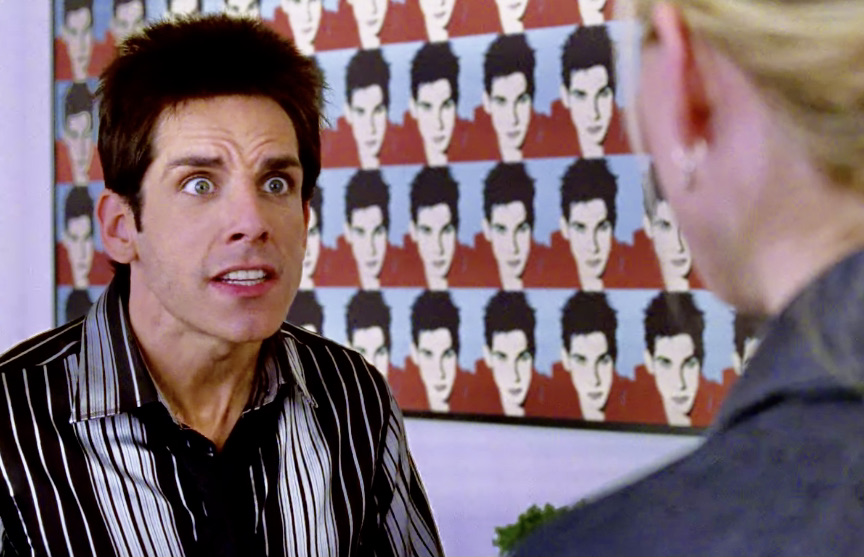
When a scene in a movie or television show is set in a lavish, extravagant mansion or penthouse, there is often a familiar sight. That would be large, square artwork featuring the same image repeated, often in different colors, each a portrait of the rich, usually famous resident of the posh palace.


The style is recognizable as being of iconic pop artist, Andy Warhol. He produced many of these screen-print works of such ‘60s and ‘70s stars as Elvis Presley, Marilyn Monroe, Audrey Hepburn, and, of course, Campbell’s Soup cans. 


Sets that include the fake movie versions of Warhol’s art are designed to emphasize that the character depicted is an extremely wealthy, and influential figure. So powerful that an artist of Warhol’s stature would add their visage to their oeuvre.


Several years ago, the Whitney Museum in New York hosted a retrospective entitled “Andy Warhol –From A to B and Back again.” Joelle Magazine explained how this status symbol came into being:From 1968 to 1987, Warhol received hundreds of portrait commissions from business moguls, art collectors, socialites, fashion designers, models, royals, and celebrities of all kinds.” So basically it’s an extremely plausible detail to add to a fictional rich character’s decor.


Slate’s Heather Schwedel in the 2019 article, “Why Warhol Became the Symbol for Characters With Big Bank Accounts and Bigger Egos,” pointed out one of the first films to include faux Warholian artwork, Mike Nichol’s 1988 comedy WORKING GIRL. Melanie Griffith’s character happens upon a wall graced with four canvasses portraying her boss, played by Sigourney Weaver (see picture at top).


But there is an earlier example from four years previous, in Charles Shyer’s IRRECONCIBLE DIFFERENCES. A scene set in a mansion owned by Shelley Long as a bestselling author, appears on a wall behind Long and her failed filmmaker ex-husband, Ryan O’Neal (I blogged about the film a bit back). 


Over the years, this opulent aesthetic has appeared in such movies as:


AUSTIN POWERS: INTERNATIONAL MAN OF MYSTERY (1997)


ZOOLANDER (2001)


POPSTAR: NEVER STOP NEVER STOPPING (2016)


And such TV shows as:


The Watchmen (HBO, 2019)


The Office (2008)


This one, from the fourth season fan favorite episode, “The Dinner Party,” is pretty easy to miss as you can tell from my hard-to-get-a-good-shot screen capture that it only appears for around 10 seconds, and not in full. It’s pretty hilarious that Melora Hardin’s arrogant character, Michael Scott’s girlfriend Jan, would have such a portrait of herself. Delusions of grandeur indeed.


The Good Place (2016)


I must give credit where credit is due to Schwedel, who in addition to writing the Slate piece I referenced above, posted a bunch of other examples of the Warholian set designs on her Twitter, @heathertwit. In sharing these screen shots, she tweeted that it’s “one my favorite movie tropes, which is when you can tell a certain character is stuck up because they have a Warhol portrait of THEMSELVES in their home.”


It’s only right to give Schwedel a plug, since I’ve taken some of the pics above directly from her feed. 


Now, I’ll leave you with one more, even though Schwedel says it “only sorta counts.”


Bojack Horseman (2015)


More later...