Showing posts with label Disney. Show all posts

Thursday, May 23, 2024

THE BEACH BOYS Doc Makes Its Disney+ Debut, But Does It Offer Anything New?

THE BEACH BOYS (Dir. Frank Marshall, Thom Zimny, 2024)

There have been plenty of Beach Boys, and Brian Wilson documentaries before so fans that know their story backwards and forwards may wonder whether what this film, which debuts today on Disney+, brings new to the table. 


Well, famed producer/filmmaker Frank Marshall, and Thom Zimmy (best known for a handful of acclaimed Bruce Springsteen doc projects) give us loads of never-seen before photos, lots of previously unshown footage, and a bunch of brand-new interviews with the principles (Wilson, Mike Love, Al Jardine, David Marks, and Bruce Johnston) so that’s what.


But with this wealth of material, it’s surprising that the program’s length is less than two hours (1h 53m, to be exact), as one might reasonably expect an epic three-hour (or even two part) event. This means that THE BEACH BOYS is heavy on the early years (1961-1969), going into detail about their beginnings in as a Four Freshman-inspired garage singing act from Hawthorne, California, giving focus to the creation of their sound, and their run of chart-topping singles, and speeds through their later career in the last thirty minutes.


However, despite this doc’s uneven presentation, it contains a very entertaining exploration of how a band that was defined by the surf ‘n sun Californian dream (so much so that their first three records had the word “surf” in their titles), came of age in the mid ‘60s rock era with the Beatles as their rivals/later friends, and went through various re-births via the two then concurrent incarnations of the band.


As Brian Wilson refrained from the road to conjure up studio genius with the aid of The Wrecking Crew, “The Beach Boys effectively became two groups, the touring group and the recording group,” Love reflects as the doc gets into edgier territory with the ground-breaking Pet Sounds sessions, and the shelving of the ambitious Smile album. 


The main arc (or arcs) concerns how the band goes from being cool to embarrassingly unhip to cool over and over again, but, as it skips over huge chunks of their output in the ‘70s, ‘80s, and even the ‘90s, it doesn’t feature how the touring and recording versions of the group later became two camps.


Firstly, the long-running Mike Love-led hits-centric outfit that largely performs at state fairs and casinos under the banner of the Beach Boys (Love has the exclusive license of the name), and the Brian Wilson-fronted pop orchestra that has played loftier venues, recreating Pet Sounds, and Smile in full, as well as a ton of fan favorites with Jardine, and later BB member, Blondie Chaplain (who is also featured in a new interview in the doc).


There are many, many elements from the band’s canon that are either glossed over, or skipped completely while the most attention is paid to Wilson toiling over the mixing console conjuring up his eccentric brand of melodic magic with almost a half an hour spent on Pet Sounds and SMiLE, and the ending’s declaration of its sacred place in musical history.


Not that I’m complaining as those are amazing works, and BB enthusiasts will dig the insights and delight in all the footage finally seeing the light of day here, but there really is too much that’s left out of this treatment. The stories around their later day attempts to recapture the band’s glory days would be nice, and I believe necessary to have been included, for example their 50th Anniversary album, That’s Why God Made the Radio, which re-united all the principles in 2011 for a surprisingly solid effort, but isn’t even mentioned here.


Keep in mind, these are the quibbles of a fan who has grown up with not just the BB catalogue, but with the narrative behind the music, and would probably still have issues with a three-four hour version. Overall, whatever it lacks, THE BEACH BOYS is a highly recommended watch for what it has, and I was impressed that when it was wrapping up, it had gone its entire running length with no instance of “Kokomo,” the unbearably cheesy 1988 single that was the band’s last top 20 hit. 


But I had thought too soon, as when the black screen credits starting rolling, “Kokomo” kicked in. Sigh. I’m not usually a fan of medleys, but there’s an early ‘80s single, officially sanctioned by Capitol Records, “Beach Boys Medley,” made up of bits from eight smashes from their ‘60s heyday, that would’ve worked so much better, especially as this doc is more about those times than any others.


More later...

Thursday, June 16, 2022

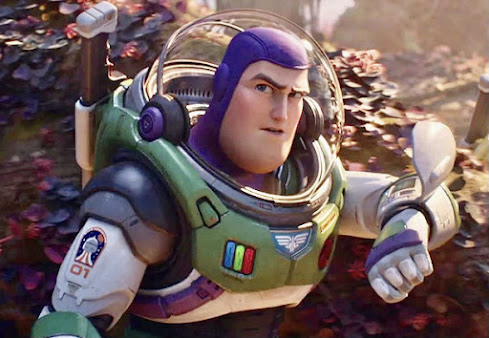
LIGHTYEAR: Mildly Amusing, But Light On Real Movie Magic

Opening tonight at a multiplex near you:

LIGHTYEAR (Dir. Angus MacLane, 2022)


For those who are wondering why Chris Evans is voicing Buzz Lightyear in this TOY STORY spin-off, and not Tim Allen, it’s because in the TOY STORY series, Allen is the voice of an action figure based on an astronaut character that was the star of a movie that was popular in the shared TOY STORY universe.

So, as an opening disclaimer tells us, this is the movie that the toy-owning kid, Andy Davis, saw in 1995, that made him want the Buzz Lightyear toy, and the rest is DISNEY/PIXAR history!

As voiced by Captain America himself, Evans’ version of the character isn’t the self-satirical, goofy concoction that Allen gave us in four films (plus lotsa short films, and video game appearances); he’s a driven, fearless, and earnestly heroic construction.

But while that hardened persona makes this Lightyear a sturdy, serviceable action protagonist, it also makes him to be, well, a kinda boring guy. Evans is a solid, likable presence in the role, but it’s a generic alpha male voice however you cut it.

The immaculately animated film posits Buzz and his fellow Space Rangers getting stranded on a hostile planet in which they have to constantly fight off alien tentacles that comically appear to drag off people out of shot. Buzz attempts to save the colony by testing a new hyperspace crystal in a four-minute space flight, but fails, and finds that it takes him four years into the future.

However, Buzz doesn’t give up, and he tries to pull off the hyperdrive over and over, failing every time, and sadly sees his best friend, Commander Alisha Hawthorne (Uzo Aduba) age over time - getting married, having a child, having a grandchild, growing old, and passing. This makes for the movie’s most effective emotional material, but, it’s no UP when it comes to real tearful time-moves-on impact, that’s for sure.

This is all setup for the premise of Buzz joining up with the granddaughter of Alisha, Izzy (Keke Palmer), the clumsy Mo Morrison (Taika Waititi), and ex-convict Darby Steele (Dale Soules) to save the colonists from an evil robot, Emperor Zurg, whose star-destroyer-style ship is hovering above their city that’s trapped inside a big-ass lazer dome.

The principle source of comedy in LIGHTYEAR comes from Sox, Buzz’s robot cat companion. Voiced by Pixar veteran Peter Sohn, Sox does provide a number of funny moments - I enjoyed his firing of knockout darts at attackers (“I bought you five minutes”) – but he’s a pretty predictably cutesy element that teeters on the edge of wearing out its welcome throughout the adventure.

And maybe I was bothered that the design for Sox reminded me too much of BRIGSBY BEAR.


LIGHTYEAR’s greatest strength is its wondrous imagery. When the visuals aren’t focused on the characters, and function as foregrounds, they are as convincing as live action cinematography in every detail. The scores and scores of digital artists, whose names you’ll have to get through to get to the post-credits stinger, really outdid themselves here.

Unfortunately all the eye-popping majesty on display doesn’t add up to the movie magic needed to make LIGHTYEAR a truly memorable, special experience. It’s fine as throwaway summer blockbuster fare, but it doesn’t make for a must-see origin story, or anywhere near an essential Pixar production. 

Audiences will likely find it entertaining enough, and probably won’t care that it doesn’t go to infinity and beyond, as long as it’s an hour and 40-minute distraction from the heat, or the January 6 hearings, or gas prices, or…well, whatever real world crap you want to escape.

More later...

Sunday, May 29, 2022

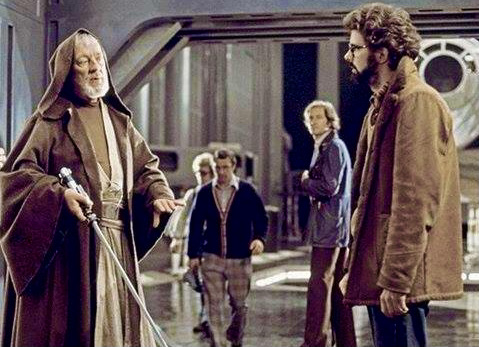
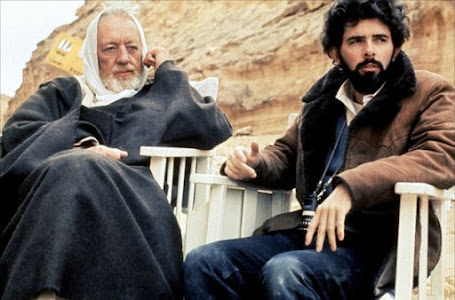
Recapping Sir Alec Guinness’s Rocky Relationship With STAR WARS


O
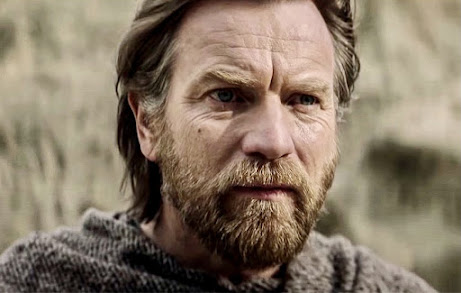
n Friday, May 27, one of the most anticipated installments in one of the biggest franchises of all time dropped: Obi-Wan Kenobi, the new Disney+ mini-series. The six-part program features Ewan McGregor reprising his role as the titular Jedi Master, who he first portrayed in the STAR WARS prequel trilogy (1999-2005). McGregor’s Kenobi, was one of the most popular characters in the three widely disdained prequels, largely because his performance paid loving tribute to the actor that originated the role in the original STAR WARS trilogy.

That would be Sir Alec Guinness, who embodied Kenobi, Ben to his friends, in STAR WARS (1977, later re-titled A NEW HOPE), THE EMPIRE STRIKES BACK (1980), and RETURN OF THE JEDI (1980). So as McGregor again summons the wise, gentle spirit of Guinness for his new journey as Kenobi, let’s look back at an amusing factor that many fans are well aware of, but that many others may be blissfully unaware of – that is, Guinness’s heavy distaste for that “Galaxy far, far away.”

Hatred is a strong word, and Guinness never outright said he hated George Lucas’ iconic creation; just that it wasn’t really his cup of tea, and that its overwhelming popularity was a bit concerning. Since science fiction wasn’t his preferred genre (“Crumbs, not for me”), Guinness took the role for the money, and, with royalties from the 1977 film, and its sequels, he pocketed around $50 million, so we can definitely say that he didn’t hate the money.

Guinness had qualms at the beginning of the shoot of STAR WARS in Tunishia early 1976, noting in a letter to a friend that “new rubbish dialogue reaches me every other day on wadges of pink paper - and none of it makes my character clear or even bearable.” 

Funnily enough, he concluded his note to Anne Kaufman with some chat about his fellow cast members: “I must off to studio and work with a dwarf (very sweet – and he has to wash in a bidet) and your fellow countrymen Mark Hamill and Tennyson (that can’t be right) Ford – Ellison (? – No!*) – well, a rangy, languid young man who is probably intelligent and amusing. But Oh, God, God, they make me feel ninety – and treat me as if I was 106. Love, Alec *Harrison Ford – ever heard of him?”


In another letter, later in the shoot, Guinness wrote, “Apart from the money, I regret having embarked on the film. I like them well enough, but it's not an acting job, the dialogue - which is lamentable - keeps being changed and only slightly improved, and I find myself old and out of touch with the young.”

But when the film was released in the summer of ‘77, he was quite complimentary, writing in his diary: “It’s a pretty staggering film as spectacle and technically brilliant.”

At the height of the film’s success, Guinness appeared on the BBC talk show, Parkinson (hosted by Sir Michael Parkinson), where he praised STAR WAR’s “marvelous, healthy innocence. Great pace, wonderful to look at. Full of guts, nothing unpleasant – I mean, people go ‘bang bang’ and people fall over and are dead, but no horrors, no sleazy sex - in fact, actually, no sex at all, when it comes to that. And a sort of wonderful freshness about it, kind of like a wonderful fresh air. When I came out of the cinema at Tottenham Court Road, I thought to myself, ‘Oh Lord, London’s awfully gritty and dirty and full of rubbish, isn’t it’. Because it had all been so invigorating.”


But still, the script’s words were a sticking point as he told his diary, “some of the dialogue is excruciating and much of it is lost in noise.”

20 years later, Guinness was still going on about the dire dialogue in an interview in Talk magazine (1999): “What I didn't tell Lucas was that I just couldn't go on speaking those bloody awful, banal lines. I'd had enough of the mumbo jumbo.”

Throughout the years before his death in 2000, the grand actor went back and forth from thankfully acknowledging the fortune he received from the franchise (“Blessed be STAR WARS” he even said at one point), and lamenting that his involvement in the movie that earned him a Best Supporting Actor nomination was something that made him squirm.


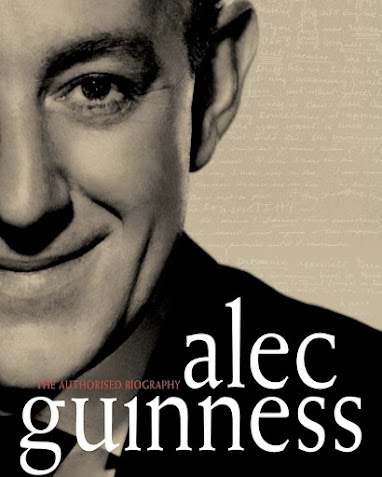
Possibly Guinness’s best summation came in Alec Guinness: The Authorised Biography: “A refurbished STAR WARS is on somewhere or everywhere, I have no intention of revisiting any galaxy. I shrivel inside each time it is mentioned. Twenty years ago, when the film was first shown, it had a freshness, also a sense of moral good and fun. Then I began to be uneasy at the influence it might be having.”

Perhaps the most amusing episode in the saga of Guinness’s rocky relationship with STAR WARS comes in the form of an oft told tale about a young boy, who, when asking for an autograph from the original Kenobi, told him that he had seen the 1977 movie 100 times (actually 102 times). Guinness response was that he only give him the autograph, if the boy promised that he’d never see the film again.

This is how Guinness described the scene in his last memoir, A Positively Final Apperance (2000): “The bad penny first dropped in San Francisco when a sweet-faced boy of twelve told me proudly that he had seen Star Wars over a hundred times. His elegant mother nodded with approval. Looking into the boy’s eyes I thought I detected little star-shells of madness beginning to form and I guessed that one day they would explode.

“I would love you to do something for me,” I said. “Anything! Anything!” the boy said rapturously. “You won’t like what I’m going to ask you to do,” I said. “Anything, sir, anything!” “Well,” I said, “do you think you could promise never to see Star Wars again?”

He burst into tears. His mother drew himself up to an immense height. “What a dreadful thing to say to a child!” she barked, and dragged the poor kid away. Maybe she was right but I just hope the lad, now in his thirties, is not living in a fantasy world of secondhand, childish banalities.”

Despite this anecdote being in Guinness’s book, I thought it was an exaggeration or amalgam of the man’s encounters with fans, but it’s been confirmed by the boy himself – Daniel Henning, an actor/audiobook narrator, who had, at 12 years old, met Guinness at an event in 1979. In 2019, Henning put out the audiobook, Alec Guinness Hated Star Wars or How I Became a Famous Star Wars Fan: A True Star Wars.


Just last month, Henning gave his first ever interview about his exchange on the podcast, Rebel Force Radio. Henning told hosts, Jason Swank and Jimmy Mac, that it occurred at the San Francisco International Film Festival, which held an Alec Guinness tribute at the Palace of Fine Arts that year.

Henning says it went down like this: “I said, ‘Sir Alec, hello - I have seen STAR WARS 102 times,’ and I paused because I thought, when other people heard that they were kind of shocked and I thought that the audience might have some reaction too, which they did, there were gasps, there was laughter, there was a little bit of applause, and then Sir Alec literally did this in his chair (slumps back and acts dead)…and then he leans up to the microphone, and says, ‘it wasn’t even my best picture.’

Henning goes on, “And it would mean very much to me, if I could have your autograph.’ And I expected him to say, ‘Come down to the stage,’ and just sign it there. That was my fantasy of what was going to happen, that was how I was going to meet Alec Guinness, right? But instead, he said, he pointed his finger at me, and said ‘I’ll see you after the show.’”

After some joking around that I’ll edit for time, Henning explains, “We went backstage, my Mom and I, they immediately let us in, and everyone knew, like all the people backstage were like ‘there he is, there he is, there’s that boy.’ People were hanging around wanting to see whatever this is going to be, I guess. I didn’t quite realize that in the moment, but then when it happened, I was like ‘oh, they were all listening.’ We’re standing there and they bring Sir Alec over to me, and he was, huge smile on his face, and he was lovely, and charming, and the very first thing he said to me was, ‘I feel like I should give you some of my money back.’

Following even more kidding around banter, Henning arrives at the pivotal moment: “He says, ‘I’ll give you the autograph, but I want to ask you to do something for me.’ And I said, ‘anything.’ He said, ‘you’re not gonna like what I am going to ask you to do,’ and I said, ‘anything, anything!’ And he said, ‘Do you think you could manage never to see STAR WARS again?’ That is certainly not what I was expecting him to say. Again, I thought it was just going to be the moment of him signing the autograph, I didn’t realize we were going to get into his psychological issues with STAR WARS.”

The 12-year old Henning agreed that he would never again see the original movie again, and that Guinness even put it in writing (“you’ve promised me not to see STAR WARS again”) with his autograph on the program for the festival. Listen to the entire interview.

It’s interesting that Henning points out that Guinness’s first responses to the boy’s tally of viewings were about it not being his best work, and then the money thing. An art versus commerce predicament for the actor so succinctly displayed.

Whatever his issues with the supreme space opera, Guinness brought gravitas and a aged wisdom to the then budding franchise, despite only being 58 years old when he began his run as Kenobi. Having watched the first two episodes of Disney+’s Obi-Wan Kenobi series, I can attest that McGregor is successfully channeling Guinness, but at the same time putting forth his own rugged take on the character.


While the great Jedi Master Kenobi has grown in stature as a core character in the ginormous saga with the now extended portrayal by McGregor in the prequels, and the new series, I have a bad feeling that Guinness would still be shaking his head at the absurd longevity of the cult surrounding STAR WARS, and would be lamenting how the dialogue is still so lame.

More later...

Friday, November 22, 2019

FROZEN 2 Isn’t As Fun As The First, But The Kids Won't Care

Now playing everywhere that movies play:

FROZEN 2 (Dirs. Chris Buck & Jennifer Lee)
  

Since the first FROZEN was a massive hit - the top grossing film of 2013, the 15th biggest movie of all time, and the second most successful animated film ever - it was inevitable that there would be a sequel. Here it is, and while it’s undeniable that it will be a soaring smash too, I doubt it’ll come close to the boffo box office of the original.

For starters, the story isn’t as good. The computer-animated epic reunites the royal sisters Queen Elsa, and Princess Anna (voiced by Idina Menzel, and Kristen Bell); Anna’s boyfriend Kristoff (voiced by Mindhunter’s Jonathan Groff), his companion reindeer Sven (not voiced by anyone), and, most importantly to the movie’s comedy, the wacky Olaf the snowman (voiced by Josh Gad), who journey to a mythical enchanted forest in order to unravel the mystery behind Elsa’s icy powers, and to save the kingdom of Arendelle from dam-busting doom.

Along the way, they encounter the new characters of Lieutenant Destin Mattias (Sterling K. Brown), nomadic tribe leader Yelana (Martha Plimpton), tribe member Ryder (Jason Ritter), and Ryder’s sister Honeymaren (Rachel Matthews), who has powers of her own. While not new characters, Elsa and Anna’s parents are given new voices by Alfred Molina and Evan Rachel Wood.

The motions that the leads go through include a scary storm, ginormous stone monsters, flood-threatening tidal waves, and emotionally magical visions, none of which equal the impact of the first film’s fantastical sense of wonder. A subplot involving Kristoff’s farcical attempts to find the right time to propose to Anna also fails as it offers nothing new to a well worn sitcomish premise.

Then there’s the soundtrack which features seven new songs, none of which are very memorable, or have the potential to be big hits like the previous adventure’s top ten hit, “Let it Go.” Also, it isn’t very likely that any of the tunes will be award winners like the Oscar and Grammy grabbing “Let it Go,” let alone be nominated.

The only element that I found superior to the first FROZEN is that Gad’s Olaf has more funny moments.

But none of that means that FROZEN 2 isn’t a fair amount of fun. The pace is pleasing and never dull; the animation is vividly immaculate, and the cast provides their share of energetic entertainment. It also has the fact that it's deliciously darker this time around.


I can’t say that I found the first one to be Disney’s best animated achievement – there are many much more solid contenders for that classic crown – but it was rightly beloved as it’s omph and infectious spirit were right on the money – literally as it made billions.

This sequel just can’t compete, as hard as it tries, and is bound to be seen as a second fiddle follow-up; an assistant appendage that isn’t likely to be remembered as fondly.

However, for the time being, one thing’s for sure – the kids won’t care about its quality. They’ll still eat it up.

More later...

Wednesday, November 21, 2018

Neither CREED II Nor RALPH BREAKS THE INTERNET Suffer From Sequelitis

The top two box office champs currently playing everywhere:

CREED II (Dir. Steven Caple Jr., 2018)


T
his, obviously, is the follow-up to 2015’s CREED, the seventh film in the long-running ROCKY franchise, which makes this ROCKY VIII. But it’s also a direct sequel to ROCKY IV, as it features the son of that film’s villain, Ivan Drago (Dolph Lundgren), challenging Adonis “Donnie” Creed (Michael B. Jordan) for the title of heavy weight champion of the world. Donnie’s father, Apollo Creed, was killed in the ring by Drago, and his son, Viktor (Florian Munteanu) is one scary, big ass dude with a permanent scowl so Donnie’s trainer, Rocky (Sylvester Stallone, of course) fears the worst and opts out.

Anyone who’s ever seen a ROCKY movie knows the formula of how in their first fight the antagonist will triumph (Viktor doesn’t win because of an illegal head shot, but his unstoppable round of punches to Donnie’s face and ribs hospitalizes him), then the film builds to a climatic rematch with a montage or two along the way. Well despite the over familiarity, the formula still works.

Jordan, who earlier this year stole BLACK PANTHER, puts in a just as confidently powerful performance as in the previous film, and shares some touching moments with the also returning Tessa Thompson as his singer girlfriend. As for the rest of the cast, Phylicia Rashad also reprises her role as Donnie’s stepmother, there’s a surprise cameo by another ROCKY IV face, and the dad from This is Us, Milo Ventimiglia, shows up as Rocky’s son (I forgot he played the part in ROCKY BALBOA).

Stallone, who co-wrote the screenplay with Juel Taylor, will doubtfully get an Oscar nomination like he did for the first CREED, but he’s played Rocky so often that it’s beyond second nature for him. His reliably sturdy turn makes Rocky’s relationship with Donnie very moving, and enhances the excitement of the fight scenes in the ring, which were beautifully shot by cinematographer Kramer Morgenthau.

CREED II may not reach the heights of its Ryan Coogler*-directed predecessor, which I had called “one hell of a legacyquel,” but it still stands with the best of the series. Just don’t ask me to rank them as I’m so not into that

* Coogler Executive Produced on this round.

RALPH BREAKS THE INTERNET
(Dirs. Phil Johnston & Rich Moore, 2018) 


While Wreck-it Ralph’s first adventure was what I called a “worthwhile retro romp,” his second go round takes him out of the world of ‘80s video games and sends him and his BFF Vanellope into cyberspace. John C. Reilly and Sarah Silverman are back as Ralph and Vanellope, who live behind the walls of Litwak’s Family Fun Center and hang out in various games’ landscapes when the arcade is closed.

When Vanellope complains about being bored with her game, Sugar Rush, Ralph decides to surprise her by making a new track. Things go awry when a girl unable to control the game’s vehicle breaks the wheel off of the console, and the game has to be shut down because a replacement part would be too expensive.

Learning that one is available on Ebay (or Eboy as Ralph calls it), Ralph and Vanellope speed through optical cables into the internet which is depicted as a ginormous shiny city that looks like a mixture of Wakanda and Tomorrowland. This where users in the real world are represented by avatars, and companies like Amazon, Pinterest, and Google (Ralph: “I guess we know where to go if we ever need a pair of goggles”) appear as logo-bearing skyscrapers.

Our lovable duo (seriously Reilly and Silverman are again extremely adorable) encounter such new characters as Alan Tudyk as the quick-to-guess search engine KnowsMore, Taraji P. Henson as Yesss, the algorithm for the fictional site BuzzzTube, Bill Hader as a pop-up ad named J.P. Spamley and most strikingly, Gal Gadot (Wonder Woman!) as Shank, the protagonist for of an online street racing game called Slaughter Race that Vanellope so wants to be a part of. Brief returning turns by Jack McBrayer as Fix-it Felix Jr., Jane Lynch as his wife, Sergeant Tamora Jean Calhoun, and Ed O’Neil as the arcade owner, Mr. Litwak round out the cast.

Jokes come fast and mostly land about viral videos, internet auctions, and in a central sequence, Disney princesses via cameos by Cinderella (Jennifer Hale), Aurora (Kate Higgins), Ariel (Jodi Benson), Belle (Paige O'Hara), Jasmine (Linda Larkin), Pocahontas (Irene Bedard), Mulan (Ming-Na Wen), Tiana (Anika Noni Rose), Rapunzel (Mandy Moore), and Merida (Kelly Macdonald).

With its infectious spirit, imagery that pops, big goofy nature, and zippy stylish energy, RALPH BREAKS THE INTERNET is a lot of fun that has enough invention to keep it from suffering from severe sequelitis. It also has a last third that dares to go a bit dark, but pulls it off grandly. Sure, it’s a Disney family film, but folks of all ages should appreciate that it’s ultimately not just kids stuff.

More later...

Monday, April 18, 2016

Jon Favreau's THE JUNGLE BOOK: Charms & Visual Delights A-Plenty


Now playing at a multiplex near you:

THE JUNGLE BOOK (Dir. Jon Favreau, 2016)


Okay, so I was cynical walking in to this live-action/CGI adaptation of Rudyard Kipling’s 1894 classic “The Jungle Book,” as it’s another big ass Disney re-imagining of an established property, but its charms as well as its visual delights are plentiful. I really should have had more faith in Favreau.

Apparently it did the director a lot of good to get back to his indie roots with his 2014 hit CHEF, as there’s spirit and soul here that was in short supply in Favreau’s previous bid for blockbuster success, 2011’s COWBOYS AND ALIENS (not to mention 2010’s IRON MAN 2).

Favreau, aided by stellar cinematography by Bill Pope (THE MATRIX trilogy), brings a grand sweep to the story of Mowgli, a young orphaned boy raised by wolves in the jungles of India played with wide-eyed gusto by newcomer Neel Sethi.

Mowgli was brought to the wolves as a baby by Bagheera, a black panther voiced by Ben Kingsley. When Mowgli life is threatened (as are the lives of his adoptive parents voiced by Lupita Nyong'o and Giancarlo Esposito) by the sinister Shere Khan (Idris Elba), a Bengal tiger who strongly distrusts humans; he leaves the pack to journey to the nearby man village guided by Bagheera.

From there, Mowgli has a series of adventures involving almost getting squeezed to death by the sultry-voiced python Kaa (Scarlett Johansson), stealing honey from a dangerous cliff location for a sloth bear named Baloo (a wonderfully droll Bill Murray), and being kidnapped by monkeys who take him to the lair of the towering King Louie (a cunning Christopher Walken), a Bornean orangutan who, like Kaa did before him, wants Mowgli to provide him with the secret of man’s “red flower”aka fire.

Despite being shot entirely on a green screen soundstage in LA, THE JUNGLE BOOK’s CGI-ed environs are astoundingly convincing. The photorealism pops in every shot, and coupled with how intricately animated the animals are, there’s barely a moment in which the viewer isn’t immaculately immersed in what’s on screen.

Favreau, who co-wrote the screenplay with Justin Marks, whose only previous feature length writing credit is STREET FIGHTER: THE LEGEND OF CHUN-LI, has a warm feel for this material which helps transcend it from what could’ve been a routine run through familiar set-pieces.

While Sethi and Murray, who have the best chemistry together bonding as boy and bear, get to duet for a brief bit on the Disney standard “The Bare Necessities,” the decision for the film to not be a musical seems to have been made, but if you stay through to the bitter end there are several excerpts of songs sung by Johansson, Walken, et al, during the closing credits.

Otherwise, the score by John Debney, a frequent Favreau collaborator, overworks the drama at times, but mostly keeps its movements admirably in line with the action.

As overwhelmed as the character is with his surroundings and iconic co-stars, Sethi puts in a solid everykid performance as Mowgli. The scenery and spectacle wouldn’t have as much weight to it if there wasn’t a kid to care about in the middle of it all.

Both by box office (it’s #1) and critical acclaim (it’s at 94% on Rotten Tomatoes) Favreau and co. have a huge hit in THE JUNGLE BOOK, with a sequel already in the works. It’s an understandable gut reaction to react with cynicism to all the remakes, re-imaginings, sequels, etc. that clog up the multiplexes, but films like this show that there are inspired creative forces, who while faithful to the original source, can produce new worthwhile versions of beloved properties.

So it’s best to leave your skepticism at the door, and go in as wide-eyed as Mowgli.


More later...

Monday, April 11, 2016

Full Frame 2016: Days 3 & 4


Despite the sunniness, it felt like the last gasp of winter on Saturday and Sunday with very chilly winds flowing through the buildings of downtown Durham. There was even a freeze warning on Saturday night. But why am I talking about the weather when I was warm and cozy inside the Carolina Theatre on both days watching what I could of the Full Frame Documentary Film Festival roster? I'm not sure so let's just get to the docs.

First up, Roger Ross Williams' LIFE, ANIMATED, which focuses on the autistic world of Owen Suskind, the son Pulitzer Prize–winning journalist Ron Suskind.


Owen was diagnosed at age 3 with regressive autism and started speaking only in gibberish but over the years of watching every animated Disney film repeatedly, he began to communicate with his family through the dialogue from those classic cartoons. Williams, who won an Oscar for Best Documentary Short Subject for his film MUSIC BY PRUDENCE, filmed Owen as he graduated school and moved out of his parents’ house to live on his own for the first time. Owen’s father, Ron, mother Cornelia, and brother Walt appear to provide their insights, while animation by Mac Guff brings to life both the families’ memories, and Owen’s own original story “The Land of the Lost Sidekicks” (there's also lots of clips from the over 40 classic Disney films that Owen has memorized).

Based on father Suskind’s 2014 book “Life, Animated: A Story of Sidekicks, Heroes, and Autism,” Williams’ film is a heartwarming, inspiring work that I could tell greatly touched the audience at Fletcher Hall on Saturday afternoon. That was strongly evident when Owen took the stage, with the filmmakers and members of his family, for a Q & A after the screening. Owen delighted everyone with his impressions of Disney characters, and his short to the point answers. Anybody who’s cynical about what effect Disney has on the world should see this film – it’ll make them change their tune for sure.


Following that was Jedd and Todd Wider’s GOD KNOWS WHERE I AM, about the troubling life of a mysterious woman whose body was found in an abandoned New Hampshire farmhouse. Next to her was a diary in which she documented her starvation and loss of sanity. The woman was identified as Linda Bishop, who had been in and out of psychiatric hospitals and served time in jail. Bishop's sister, Joan; and daughter, Caitlin Murtagh, alongside testimony from various therapists and social workers, appear to help tell her story, but its the voice-over readings from Linda's diary by actress Lori Singer (probably best known as the female lead of the 1984 hit FOOTLOOSE) that are most affecting.

GOD KNOWS WHERE I AM is a chilling, dark doc debut from the Wider brothers, who have learned well from producing several of ace documentarian Alex Gibney's project. I know that Linda's sad, haunting story will stay with me for some time.

Another promising doc debut I saw on Saturday was Margaret Byrne's RAISING BERTIE, which follows three young African American men - Reginald “Junior” Askew, David “Bud” Perry, and Davonte “Dada” - over the course of five years as they grow into adulthood in the rural county of Bertie, here in North Carolina. The trio attended The Hive, a school for at-risk students, together before striking out on their own, but when the alternative school closes , they have to return to the system that originally failed them.

Byrne's camera captures some intimate moments with these men as they struggle to find their place in adulthood in this unpretentiously framed narrative. There's a fly-on-the-wall feel to the proceedings as we witness such events as Davonte attending his senior prom, and Reginald visiting his biological father in jail. As RAISING BERTIE concentrates on the coming-of-age arc of its subjects, it raises some vital questions about what options and opportunities exist for young people in rural America. It doesn't have any answers to these questions but, through these men, it stirringly taps into the power of individual perserverance.

Saturday night, I took in Ido Haar's PRESENTING PRINCESS SHAW, which was part of this year's Center Frame series. Having been previously clueless to its content, I was very taken by the tale of how its star, Princess Shaw (real name: Samantha Montgomery), became a viral sensation when a Israeli musician, Kutiman (real name: Ophir Kutiel) used her vocals in a mix with other “found” musical elements to make this striking song:


The doc follows Princess Shaw, who by day works as a nurse in New Orleans, as she finds out (and freaks out) about her internet stardom and travels to Tel Aviv to meet and collaborate further with Kutiman. Originally, Haar's project was supposed to be about the culture of YouTubers in general, but came to center around the infectious, bouyant personality and sympathetic backstory of Princess Shaw. It was a wonderful choice, as the film is quite possibly not just the most joyous doc of this year's fest, but the most joyous doc I've seen at Full Frame ever.


Princess Shaw herself appeared during the end credits to rapturous applause, and went on to give us a live performance of her signature song: 


In the Q & A, our lady of honor revealed that she is soon to be working on a proper album for release later this year, stressed that she's not a star yet as she's still working her nurse job, and repeatedly shared what was apparently her new favorite expression of excitement: “rock sausages!” Many complain of cyber disconnection in our modern times, but strong, passionate, and (again) joyous stories like this show that the digital age can bring people together. Rock sausages indeed.

Full Frame's closing night film was another major crowdpleaser: Heidi Ewing and Rachel Grady's NORMAN LEAR: JUST ANOTHER VERSION OF YOU.


This biodoc of one of the most successful independent TV producers of time (at one point he had five different televsion shows in the top ten in the Nielsen ratings) ought to be mandatory viewing for Millienials so that they can get some understanding of how influential and game changing such sitcoms as All in the Family, The Jeffersons, Good Times, and Maude were in the '70s.

The 93-year old Lear appears in insightful interview segments (which somewhat resemble the ones in BY SIDNEY LUMET but that's a doc given), alongside and overlapping with clips from his classic shows, while family members, friends and collaborators such as George Clooney, John Amos, Louise Lasser, Rob Reiner, and son Ben Lear appear to sing his praises. As a fan of the man who grew up on his shows (I really felt Jon Stewart when he said “you raised me!” to Lear backstage before a guest appearance on The Daily Show), I didn't learn much new, but still highly enjoyed the ride through Lear's rich career. But I had forgotten some of the juicy details about his fighting the Moral Majority in the '80s so the refresher there was very appreciative.

Lear's legacy is so considerable that, unless one didn't have access to footage from his TV library, it would be hard to make a bad doc about the man, but Ewing and Grady (makers of such fine docs as THE BOYS OF BARAKA, JESUS CAMP, and DETROPIA) have assembled an affectionate tribute that made me tear up throughout. Now I want to watch the entire run of All in the Family again.

Okay! So that's Full Frame 2016. Thanks for reading and stay tuned to this space for more Film Babble Blog Fun.

Postscript: LIFE, ANIMATED won The Full Frame Full Frame Audience Award at the Awards Barbecue on Sunday. Click here to see the full list of winners.


More later...

Thursday, March 17, 2016

ZOOTOPIA: A Delightfully On Point Takedown Of Racial Profiling


ZOOTOPIA (Dir. Byron Howard, Rich Moore, and Jared Bush, 2016)


Earlier this week, I caught up with the #1 movie at the box office right now: ZOOTOPIA, the latest animated family feature from the Walt Disney Corporation. I had been initially dismissive of the film, having skipped an advance screening of it for a weird Neil Young double feature, but I heard that many critics were raving about it being a clever topical takedown of racial profiling so I just had to check it out.

ZOOTOPIA takes place in a world with no humans, only animals, who were once savage but have evolved, and formed a civilization in which they walk upright, wear clothes, and work regular jobs. Ginnifer Goodwin voices our plucky protagonist, a rabbit named Judy Hopps, who dreams of being the first bunny police officer. Thanks to the city of Zootopia’s new Mammal Inclusion Initiative, she gets her chance but is assigned to parking ticket duty by the chief of police, who’s an intimidating buffalo voiced by Idris Elba.

Because of a bias against foxes – we see her being bullied as a child by a fox in the opening sequence, and she carries “fox repellant” given to her by her parents – she follows one that looks suspicious to her into an ice cream store, but finds out it’s just a doting dad, named Nick Wilde (voiced by Jason Bateman) trying to buy a popsicle for his kid.

When the elephant run establishment refuses service to Nick and his offspring, Officer Judy steps in and calls out the store’s unsanitary conditions, which include an elephant employee scooping ice cream with his bare trunk – heavens! The situation is resolved with Judy buying an elephant-sized popsicle for the thankful father and son.

However, Judy soon finds out that she was hustled by Nick, who takes the huge popsicle and makes it into hundreds of tiny popsicles to sell to business suited rat population. Judy tries to arrest Nick, but finds that she can’t make any of the charges stick.

Defeated yet still trying to prove her worth, Judy gets into a chase after a crook named Duke Weaselton (Alan Tudyk), inside the segmented city within a ciry, Little Rodentia.

This gets Judy in trouble with the chief, but, via the surprise support of the Assistant Mayor Bellwether (Jenny Slate), it leads to the officer bunny getting put on a major case involving a series of missing animals. Turns out that Nick can help with a lead, and the duo hit the trail, which involves a cameo by Tommy Chong as a hippy yax who’s the “emotional life coach” at a naturalist commune, an arctic shrew crime boss named Mr. Big (Maurice Lamarche doing his best Marlon Brando), and, in one of the movie’s funniest scenes, the city’s DMV being run by sloths – get it? 


The well cast Bateman, at his cheeky best, and the equally Goodwin, giving it her all, play off each other well and do a lot towards making this the likable, yet appropriately apt, exercise that it is.

ZOOTOPIA may have made by committee – there are three directors and seven “story by” credits, but its sharp screenplay (credited to only two names - Jared Bush and Phil Johnston) that serves up a lot of on point social satire. Just about every joke lands, and there’s genuine feeling behind its message, which is basically ‘let’s recognize and put a stop to negative stereotyping and discrimination.’

It’s voice cast is energetically up to task throughout – though I could’ve done more with J.K. Simmons’ Leodore Lionheart, the lion mayor of Zootopia, and less with Shakira’s pop star gazelle (named Gazalle, of course), but I know they’ve got to work that teenybopper pop angle in order to sell some soundtracks (you just know that this one won’t push anywhere near as many units as FROZEN though).

A delightful family film that actually has as much depth as it does heart, ZOOTOPIA is a really good sign for the future of Disney’s Animated Classics division. With hope, other lesser animation studios will take note and start to tackle real, relatable issues more in their movies. I’m looking at you, Dreamworks!


More later...

Saturday, May 23, 2015

TOMORROWLAND: The Summer's First Big Spectacular Dud


Now playing at a multiplex near you:

TOMORROWLAND (Dir. Brad Bird, 2015)


After his phenomenal winning streak consisting of THE IRON GIANT, THE INCREDIBLES, RATATOUILLE, and MISSION IMPOSSIBLE: GHOST PROTOCOL, Brad Bird gives us his most ambitious, and most personal feature yet: an epic adventure that shares its name, vision, and production company with one of Disney’s most popular amusement park rides.

Sadly, it’s also Bird’s most disappointing, and most thematically messy film. One which shares a lot in common with last year’s INTERSTELLAR, Christopher Nolan’s cosmically-minded misfire, in that they both aim for futuristic inspiration with the help of an A-lister, a few cute kids, and wall-to-wall special effects, but come up incredibly short in the movie magic department.

It begins at the 1964 World's Fair in Queens, New York where we learn via an 11-year old inventor wannabe named Frank Walker (Thomas Robinson), the kid in this world who’ll grow up to be George Clooney, that there’s a portal to another dimension accessible though the “It’s A Small World” ride.

Frank was let into the alternate realm which encases an elaborate CGI-ied shiny city full of jet packs, flying cars, and gravity-defying wonders (like floating pools) of all kinds, by a young girl (Raffey Cassidy) named Athena, but he's discovered and kicked out by the Governor of Tomorrow, David Nix (Hugh Laurie).

Flashing forward to the present we meet Florida teen Casey Newton (Britt Robertson), the daughter of a NASA engineer (Tim McGraw), who finds a mysterious pin with the Tomorrowland logo. When she touches the pin it transports her to the same parallel dimension we saw previously, but, trouble is, when she moves forward she walks into the walls of the real world.

To figure out what’s going on with this alternate realm and to save both worlds from, of course, impending destruction, Casey teams up with the grown up and Frank (Clooney) and Athena. Our heroes are chased by black-clad MATRIX-style robot bad guys led by the slick Matthew MacCaull, through a few explosive set pieces that have some instances of violence that are a bit surprising for a PG-rated family film.

My friend Will Fonvielle, of the blog Filmvielle, joked that INTERSTELLAR could’ve been named EXPOSITION: THE MOVIE, but this film could easily win that title as there’s so many talky passages between the fights and the chases bogging the pace down. And that dialogue is so full of earnest yet infinitely tedious clichés, about how mankind has invented its own doom, and how if we have faith we can change things, that even Clooney’s charm can’t elevate or make gel any of this mediocre material.

Bird, who co-wrote the film with Damon Lindelof (Lost, STAR TREK INTO DARKNESS, WORLD WAR Z), cinematographer Claudio Miranda (LIFE OF PI), and scores of visual design artists craft an immaculately vivid landscape, but it’s not anything we haven’t seen before. The imagery that they keep trying to wow us with is the kind of stuff that whizzes by in the background in like say, the city in GUARDIANS OF THE GALAXY, but here as the main attraction it loses my interest pretty quickly.

That’s not to say there’s no fun to be had here. Several sequences have supreme watchability (I stole that from a Bud Light ad: “supreme drinkability”), like one involving a hidden rocket inside the Eiffel Tower. But the film speeds through its best ideas such as that there was a secret society founded by visionaries Gustave Eiffel, Tesla, Thomas Edison, and H.G. Welles at the 1889 World’s Fair, while it lingers on its worst ones - i.e. the inconsistencies of how this alternate retro-future dimension and our world intersect.

There’s also the factor that there folks like Keegan-Michael Key and Kathryn Hahn, as the proprietors of a sci-fi toys and comics store called “Blast from the Past,” (full of Easter Eggs like IRON GIANT memorabilia), in a big shoot-out/fight scene that doesn’t play at all to those comic actors’ strengths. Same could be said for Laurie in the extremely anticlimatic finale, though he at least gets the obligatory speech in before the end.

After the heights of AVENGERS: AGE OF ULTRON and MAD MAX: FURY ROAD, Bird has the first big spectacular dud of the summer on his hands. As much as I admire the ambition, and all the attempts at mind-bending spectacle, this film's ultimate message of hope rings hollow.

Upon seeing that it all comes down to the exclusionary notion of a select group of visionaries being chosen by the superiors from an unknown dimension to save the world, I couldn't help but wonder how all those folks popping up in the vast fields outside the art deco streamlined utopian city won't just be walking into walls over and over.

More later...

Friday, May 30, 2014

MALIFICENT: The Film Babble Blog Review


Now playing at a muliplex near you:

MALIFICENT (Dir. Robert Stromberg, 2014)


“I hate children!” Angelina Jolie yells in the guise of the iconic villainess Maleficent, perhaps the most iconic villainess ever in the world of Disney.

This declaration is amusingly believable, despite the fact that Jolie and hubby Brad Pitt have a brood of both biological and adopted children in real life, but almost nothing else is in this live-action prequel of sorts to the 1959 animated milestone SLEEPING BEAUTY.

The idea here is that Maleficent had her reasons for her wicked wrongdoings, such as cursing a newborn baby to fall into an eternal sleep on her 16th birthday.

You see, as a young faerie living in the magical realm known as The Moors, she was once in love with the baby’s father, Stefan, when they were young and played by Isobelle Molloy and Michael Higgins respectively. After they grow into up into the form of Jolie and Sharlto Copley, Stefan betrays Malificent by drugging her and stealing her wings – cutting them off with iron, which is like Kryptonite to the faeries – in order to become king of the human realm.

So the curse upon Stefan’s daughter Aurora (played as child by both Jolie’s own offspring Vivienne Jolie-Pitt and Eleanor Worthington Cox; then as a teen by Elle Fanning) is purely an act of revenge because you know what they say about Hell having no fury like a woman scorned.

Sorting out this mythical mess will involve Malificent’s right-hand man Sam Riley as a shapeshifter, who can become anything from a crow to a ginormous fire-breathing dragon; the chatty comic relief of three floating pixies (Imelda Staunton, Juno Temple, and Lesley Manville), and a wannabe epic battle with Stefan’s faceless army of armored soldiers.

The premise of giving a classic character an elaborate back story explaining how their role in a classic tale came to be brings to mind last years’s OZ THE GREAT AND POWERFUL, so it’s no surprise that MALIFICENT is directed by that film’s production designer, Robert Stromberg making his directorial debut.

Stromberg, whose work on James Cameron’s AVATAR and Tim Burton’s ALICE IN WONDERLAND won him Oscars, has a sweeping visual style and flair for creating otherworldy terrains, but all of his previous conceptual designs appear to blend together into this one. The result is a lavishly generic CGI-ed landscape that could be in any number of fantasy films over the last decade.

This all too familiar artificial atmosphere renders Jolie as just another special effect. With her face saturated in white make-up on top of scary cheekbone prosthetics, Jolie looks like a pristine porcelain doll, or worse like a dolled up mannequin posed and re-posed for stop-motion sequences. At least she doesn’t strike a pose with her hand on hip, while her bare right leg juts out of her dress like on the Oscars a few years back. But then maybe that would make up a little for the film’s lack of genuine humor.

Jolie does display moments of impassioned emotion – like when she’s screaming to the Heavens after having her wings clipped - but overall her icy, intense commitment to embodying the Mistress of Evil doesn’t help get across the heart and soul that screenwriter Linda Woolverton (THE LION KING, ALICE IN WONDERLAND) is going for.

It may be possible that MALEFICENT didn’t appeal to me because neither the original fairy tale, whether it was Charles Perrault’s or the Brother Grimm’s version, nor the Disney movie adaptation have never appealed to me. So, of course, the prospect of the story being told from another perspective would have little allure.

SLEEPING BEAUTY fans may rejoice in Jolie’s performance, and find the revisionism refreshing, but this non-fan found it to be a dark, drab, and tediously draggy re-imagining that has no imagination of its own.


More later...

Friday, November 02, 2012

A Worthwhile Retro Romp In WRECK-IT RALPH


WRECK-IT RALPH (Dir. Rich Moore, 2012)
          
It’s not the first time that the great John C. Reilly has been animated - Jake Kasdan’s WALK HARD featured Reilly’s Dewey Cox character dabbling in psychedelics with the Beatles bringing on a YELLOW SUBMARINE-style hallucinatory sequence (“I like being a trippy cartoon!”), and Reilly was the sole comic relief as a scared stitch-punk in Shane Acker’s dreary 2009 sci-fi CGI-concoction 9 - but in WRECK-IT RALPH, it’s the first time he’s been properly animated with such purpose.

Reilly lends his voice to the title character, an oafish villain in a Donkey Kong-ish video game called “Fix-It Felix Jr.,” who decides during his game’s thirtieth anniversary that he doesn’t want to be the bad guy anymore. 30 Rock’s Jack McBrayer, also appropriately animated, voices the games’ hero, who is constantly celebrated by the tenants of the apartment building for fixing what Ralph, uh, wrecks.

The game is located in the fictional Litwak's Arcade, alongside other parody/homages to classic ‘80s video games, such as the violent war game “Hero’s Duty,” and the seemingly set in Candyland go-cart game “Sugar Rush.” There are also many amusing cameos from real game characters, including Frogger, Q*Bert, Sonic the Hedgehog, and Clyde, the orange ghost from Pac-Man.

Told that he’d have to win a medal to be accepted by the residents of his game, Ralph leaves through the wires of “Fix-It Felix Jr.” to the arcade’s master power strip called Central Game Station, where all the various video game characters interact with one another after the establishment closes, in a TOY STORY style (not to mention the similarities to the world where cartoon characters live among us in WHO FRAMED ROGER RABBIT?).

There’s also a bit of PURPLE ROSE OF CAIRO happening like when its noticed that Ralph is missing from his game and the arcade manager (voiced by Ed O'Neill) puts up an out of order sign. Since this means that the videogame is broken and will be unplugged, Felix goes after Ralph.

In one of the funniest scenes, Ralph tries to get a medal in “Hero’s Duty,” ruled by the stern Sergeant Tamora Jean Calhoun (Jane Lynch), and succeeds despite how chaotically over the top the game is. Ralph exclaims: “When did video games become so violent and scary?!!?”

In the next game Ralph hits, “Sugar Rush,” his medal is stolen by Vanellope von Schweetz, voiced by comedienne Sarah Silverman, who's plagued with a programming code glitch which makes her as ostracized in her video game world as Ralph was in his.

Silverman's Vanellope has a persona tailored to her patented cute snarkiness, and her penchant for crude bathroom humor - her riffing on the name of the game “Hero’s Duty” (sounds like ‘doody,’ right?) gets some good mileage (“Why did the hero flush the toilet?' ‘Cuz it was his DUTY!”), and she and Reilly exude likable chemistry bouncing off each other in their exchanges, with both comical and emotional impact.

In several smaller parts that stand out, Mindy Kalling has a few choice moments as a racing rival of Silverman's, as does Alan Tudyk as King Candy (the film's real bad guy), and is that Skrillex putting in a cameo as the DJ at Fix-It Felix's 30th anniversary party? Why yes, it is.

The sprightly, inventive, and neatly nostalgic WRECK-IT RALPH is one of the few recent animated kid’s films that uses pop culture referencing to its advantage, with genuine affection towards its inspirations. When Reilly's Ralph realizes, and says touchingly, that ‘retro’ doesn’t necessarily mean outdated and unnecessary, it can mean that something’s “old but cool,” it’s obvious that director Moore (who helmed many classic Simpsons episodes), and screenwriters Phil Johnston (CEDAR RAPIDS), and Jennifer Lee honestly feel the same way.

Whether they grew up in the age of 8-bit, or have been weaned on the high resolution graphics that dominate the game world now, folks of all ages should take to the worthwhile romp that is WRECK-IT RALPH. 

It looks like Disney, whose 52nd feature-length animated film this is, has taken more than a few cues from Pixar (including having a charming animated short play before the movie - John Kahrs’ “Paperman”), and made, via a mixture of hand drawn and CGI, a much sharper and hipper film than their last few features (I barely remember TANGLED or THE PRINCESS AND THE FROG).

It’s good news indeed that the Magic Kingdom’s movie makers can still mazimize on a promising premise, get so many laughs and thrills out of it, all the while poignantly pulling the heartstrings. It goes a long way to make up for the kind of crap that too often passes for family entertainment these days.

*Cough* “Hotel Transylvania” *Cough*.

More later...