Showing posts with label The Clash. Show all posts

Friday, May 20, 2022

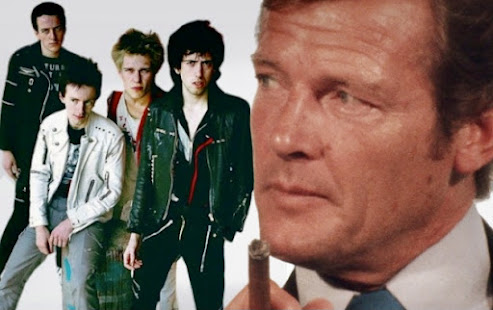
That Time The Clash Did A Diss Track On Roger Moore


While many of the songs in the all-too brief repertoire of the punk icons, The Clash, are rock classics, there are a handful of lesser known tunes by the British band that are really worth seeking out. One such is a non-album track that only appears on the 1991 box set, The Clash on Broadway, entitled “One Emotion.” It’s an outtake from their second album, Give ‘Em Enough Rope (1978), and it’s a pleasingly punchy number that was amusingly inspired by the acting styling (that’s right, one styling) of Roger Moore.


Moore famously portrayed the legendary secret service agent James Bond in seven films from 1973-1985, but there is some dispute by the song’s writers, Joe Strummer and Mick Jones, about whether it was Bond or Moore’s earlier role as Simon Templar in the TV series, The Saint(1962-69), that sparked the song into existence.

In excerpts from the booklet for the Clash on Broadway box, Strummer recalls, “The phrase ‘One Emotion’ came when we were watching Roger Moore. I think it might have been reruns of The Saint, it struck us how one dimensional he was. Then we wrote a more serious song around it, trying to jib our way out of a hole.”

But Jones offers alternate facts: “We used to nip in the cinema just to catch a film in our spare time. I think it was Roger Moore in a really bad James Bond film.”

At the time of the Clash’s recording of “One Emotion” in 1978, the most likely Bond movie to be playing in British cinemas was 1977’s THE SPY WHO LOVED ME, which wasn’t a really bad Bond film in my, and many critics and fans’ minds (it’s even Moore’s personal favorite of the 007 films he made), but still may have been seen as establishment dreck by Strummer, Jones, and their bandmates, Paul Simonon, and Nicky “Topper” Headon. 

But reruns of The Saint were possibly prevalent during that period as well, so it’s plausible that it was a combination of these influences that gave the song its title and hook. A promotional disc for the Clash on Broadway collection featured a soundbite of Strummer talking about the song, but this time he said it was from the gang watching a James Bond movie on television, and that it was Jones that exclaimed, “This guy’s only got one emotion!”

The song is worth YouTubing as, aside from the Moore takedown, it’s an infectious performance that captures the early Clash sound in all its edgy punk pop purity. 

Check it out:


One of the first concerts I ever attended was the Clash at Carmichael Auditorium on the UNC campus in my hometown of Chapel Hill, N.C. on April 6, 1984 (tickets were $11.50!). Now this was the band on their last legs as Jones, and Headon had left, and Strummer and Simonon were joined by hired hands Pete Howard, Nick Sheppard, and Vince White, but it was still The Clash, and therefore a rousing, thrilling experience for my 13-year old existence.

I vividly recall was that there was a wall of television sets on the stage behind the band that were all showing news clips of war footage, and other violent events to punctuate the power of the Clash’s performance. A bit of film that repeatedly appeared interspliced into the mix of vicious visuals was a moment from the 1965 James Bond smash, GOLDFINGER, in which Sean Connery is engaged in a fight with the villain’s henchman, Odd Job in the vault at Fort Knox.

I think that makes it pretty damn obvious which Bond the Clash really preferred.


More later...

Friday, October 03, 2008

Talkin' 'Bout A Generation Gap With 2 New Release DVDs

A couple of new DVDs to review - one that has barely legal kids singing punk rock and the other features really old folks way past retirement singing, yes, punk rock. Let’s start with the old folks and then move backwards:

YOUNG@HEART (Dir. Stephen Walker, 2007)

I was hesitant about this indie documentary about a vocal group comprised of 22 senior citizens singing pop, rock, and punk songs.

I mean, though this is a chorus that has been at it with different members for the last 20 years the prospect of hip-ifying old folks brings to mind Pepsi commercials with rapping GrandMas or lame cheap comedies that have elders speaking in hip-hop jargon made me think this was a possible gimmicky cringe-fest. 

Well, moments into YOUNG@HEART those short-sighted fears disappeared as choral director Bob Cillman introduced his singers to a song they’ve never heard by a band they’ve likely never heard of: “Schizophrenia” by Sonic Youth.

They don’t seem to take to it (sideline sound bite interviews show that most of these folks prefer classical music and show-tunes) but Cillman presses on. They are more receptive to Jame's Brown’s “I Got You (I Feel Good)” though the rhythm and getting the lines right throws members Dora Morrow and Stan Goldman as they prepare for a concert in their hometown of Northampton, New England. 

The day to day toll of getting old hinders some rehearsals as the beloved Bob Salvini’s health worsens and his duet partner Fred Knittle struggles with his absence. They all struggle with the 71 “cans” in Allen Toussaint's “Yes We Can Can” which frustrates Cillman who threatens to scrap the number but nobody wants to give up.

Not giving up is the-show-must-go-on bottom line here as these resiliant and enthusiastic folks do their best to get their vocals right and find harmony with each other knowing that every extra day to do so is a gift. At times cheesy (I could do without the flashy music video sequences for the Talking Heads’ “Road To Nowhere” and the Bee Gees’ “Staying Alive”) but mostly a funny and heartfelt ride, it's impossible to not be emotional when watching the climatic concert finale of this film. 

Knittle’s soft voiced emotional version of Coldplay's “Fix Me” (pictured on the left) ripples through the hall with the light glimmering off the tears in the eyes of people of all ages. It’s not a spoiler to tell that they nail every “can” in Toussaint’s punchy positive action anthem; it’s really just an enhancement to my endorsement.

And now a DVD (complete with 80’s-style promotional buttons!) that I was very happy to win from a contest on one of my favorite film/music blogs ThePlaylist: LADIES AND GENTLEMEN, THE FABULOUS STAINS (Dir. Lou Adler, 1982) What?!!? You’ve never heard of this film? Well, you’re not alone - very few have seen it as it has never before had a proper home video release and has only has the occasional revival screening. 

With this new DVD release that will likely change because I think they'll be plenty of people who will want to see a 15 year old Diane Lane as the singer, songwriter, and manager of the Stains - a punk trio rounded out by a 13 year old Laura Dern and the still unknown Marin Kanter.

Virtually unrecognizable from his recent roles in THE DEPARTED and the last INDIANA JONES flick is Ray Winstone with a wardrobe cribbed from Joe Strummer as the leader of the Looters, a British punk band that tours with the Stains. Real life punkers Steve Jones and Paul Cook of the Sex Pistols along with Paul Simonon of the Clash make up Winstone’s band who go head to head with an aging hard pyschedelic rock band named The Metal Corpses fronted by Fee Waybill of the Tubes.


After learning some sleazy lessons about life on the road and a drastic change in their appearance (mostly see-through blouses and white stripes in their hair) The Stains gain a following not from their talent (a few performances prove that they have none) but from some TV appearances. 

“Because they were on TV” one of their minions explains to a smirking overly ambitious newslady (Cynthia Sykes). “I'm perfect but nobody in this shit-hole gets me because I don’t put out!” Lane yells and it becomes a mantra of sorts to the copycat crowd that comes calling. “I don’t put out” doesn't necessarily mean what you’d think - she does engage in sex but it’s on her own terms or something like that. Not sure if the movie makes a compelling case for that but what does it matter?

Director Lou Adler, whose only feature film before this (and after) was CHEECH AND CHONG’S UP IN SMOKE which says a lot, was no visual stylist and the film is certainly badly edited.

Reportedely its original screenplay was so mangled that writer Nancy Dowd took the pseudonym Rob Morton as credit but as it stands it’s still such a scrappy, yet very guilty, pleasure. The DVD features a very funny commentary by Lane and Dern who seem so amused, and many times embarrassed, to be watching it again. Dern remarks: “We were just babies”. Lane: “I thought I was so experienced!”

With its sloppy unbalance between a gritty social statement and ABC afterschool special aesthetics, LADIES AND GENTLEMEN, THE FABOULOUS STAINS is simply great schlocky fun. Thematically this exists in the weird realm between such a lofty loved work as Elia Kazan’s A FACE IN THE CROWD and the 80’s tacky yet still very much loved THE LEGEND OF BILLIE JEAN. For a could-be cult classic that’s not a bad place to be.

More later...

Thursday, July 10, 2008

Clash Frontman Joe Strummer Gets The Julien Temple Treatment With Great Rock Doc Results

“I need some feeling of some sort - hey, we’re all alive at the same time, at once, you know!” - Joe Strummer yelling at the US Festival crowd 5/28/83 


I sadly missed this film on its extremely brief theatrical run in my area but happily just viewed the newly released DVD so here’s my review:


JOE STRUMMER: THE FUTURE IS UNWRITTEN (Dir. Julien Temple, 2007)
Tracing Joe Strummer’s life from a “mouthy little git” to “punk rock warlord” (Strummer’s words) Julien Temple’s lively and loving documentary is full of insights and powerful ideology that render it immediately essential.

As the frontman for the seminal British punk rock band The Clash, Strummer was rawly outspoken, always passionate, and brutally honest so he’s the best one to tell his story and by way of BBC radio recordings of him as guest DJ and audio from many interviews over the course of his career - he does.

These archival Strummer soundbites are helped along by a bountiful bevy of talking head comments from such stars including Johnny Depp, Steve Buscemi, Bono, and John Cusack as well as those with a more personal connection - former bandmates, girlfriends, and family members who I wish were better identified.

That’s one of the only beefs I have with this project - we know who Matt Dillon or Bono are when they appear at a campfire shot to offer their takes on Strummer but without a name and caption many folks like girlfriend Palmolive (from the lesser known but still vital bands The Slits and The Raincoats) fly by with their context not properly placed *


Also would be nice to have concert dates and events better titled. Small quibbles though, the rest is rockumentary gold or at least rock doc crack. *


Luckily the DVD has an over an hour and a half of bonus extended interviews which does identify each participant and is also essential. A couple of the highlights: Angela Janklow tells of a hilarious chance meeting of Strummer and Monica Lewinsky & Martin Scorsese relays how Clash music fueled his inspiration making RAGING BULL and later GANGS OF NEW YORK. Born as John Mellor, the son of a British diplomat and a Scottish nurse, his family moved quite a bit during his childhood; living in Eygpt, Germany, and Mexico before John ended up at a boarding school in London. 


It was there that he was turned on to The Rolling Stones, learned to play the ukulele, and starting going by the name of “Woody” ostensibly because of an affection for Woody Guthrie. He went to art school with cartoonist aspirations (many of his drawings are sprightly animated and interspersed throughout) but music was his real calling and he was soon playing guitar in a band called the Vultures which didn’t last long. 


At the same time he toiled in such vacant career opportunities as carpet salesman and grave-digger. Because of his style of guitar playing he changed his name to Joe Strummer and angrily derided anybody who called him by another moniker. As it certainly was suspected the center piece here is Strummer’s years with, as the hyped phrase goes, the “only band that matters.”


Having disbanded another band - the popular pub rockers The 101ers, Strummer met guitarist Mick Jones and manager Bernie Rhoades. With bassist Paul Simonon, drummer Terry Chimes, and another guitarist Keith Levene they formed The Clash. 


They were immediately embraced by the blossoming British punk scene and signed to CBS within a year of their live debut (in 1976) with Chimes replaced by Topper Headon and Levene being axed. Great grainy footage abounds - most notably The Clash playing to a giant crowd of pogo-ing punksters at an Anti-Nazi League benefit. 


Their political themes, fueled by Strummer's leftist views, were not lost on their fans as Bono from the mega-band U2 pretentiously but accurately explains: “I never knew who the Sandinistas were or where Nicaraqua was, the lyrics of Joe Strummer were like an atlas; they opened up the world to me and other people who came from blank suburbia.”


“I couldn't believe we turned into the kind of people we were trying to destroy” Strummer laments as we see The Clash reap the rewards of success/excess.


Contrasting professional arena concert footage from the early 80's with the grimy black and white basement video of their early days of the same song illustrates beautifully his case: “we were part of the audience, part of the movement. 


Once it became thousands of miles removed from that I began to freak out.” Mick Jones final appearance was at the US Festival in 1983 (which again, is not properly identified) at which point Strummer, most likely way after the fact, describes the band as a “depleted force.”


The Clash carried on however with some replacement blokes but the glory was gone so yep, here comes death. The death of the band that is, Strummer had many years of soundtrack work, acting roles (he appeared with Buscemi in my favorite Jim Jarmusch film MYSTERY TRAIN, solo recordings, and powerful performances with his band the Mescaleros. 


As a former global punk superstar he struggled a bit: “You meet a 17 year old guy and he's never heard of The Clash; that's the moment my feet touch the ground again.” Strummer died of a congenital heart defect on December 22nd, 2002. 


Just weeks before he played with Mick Jones for the first time since 1983. It was an impromptu appearance with Jones getting on stage to join Strummer and the Mescaleros on the Clash classics “Bankrobber”, “White Riot”, and “London's Burning.”


The footage from that gig, albeit brief, adds enormously to the emotional last third of the documentary. 


Temple’s clever construction of the different strains of pop culture, even utilizing clips of ANIMAL FARM and the classic British flick IF.... to symbolize oppressive British society, is incredibly compelling from the before mentioned concert footage to even an appearance on South Park (1998). 


As both a enjoyable touching tribute for the long-time fan and a teaching-tool for the uninitiated, Julien Temple’s JOE STRUMMER: THE FUTURE IS UNWRITTEN is one of the best of its kind and a new addition to the definitive rocumentary checklist.

More later...