Showing posts with label Don Cheadle. Show all posts

Tuesday, April 27, 2021

When Bill Murray’s Brother Played The Bill Murray Part In A Forgotten ‘80s Comedy

John Murray in the 1985 comedy MOVING VIOLATIONS
International superstar, and the most beloved SNL veteran ever, Bill Murray has five brothers, some of whom you may know of. Firstly, there’s Brian Doyle Murray, who also had a stint on SNL, and appeared with his brother in several movies including CADDYSHACK, SCROOGED, and GROUNDHOG DAY. Then there’s Joel Murray, who has appeared on many TV shows including Mad Men, Shameless, and Dharma & Greg, and in many films including ONE CRAZY SUMMER, GOD BLESS AMERICA, and THE ARTIST.

Thirdly, there’s the late Ed Murray, who while not an actor is cited as the inspiration for CADDYSHACK, and appeared in a 2009 documentary about the classic film. Fourth, there’s Andy Murray, a chef who co-founded and runs Murray Brothers Caddyshack sports bar and grill, which has locations in St. Augustine and Rosemount.


But while his siblings have ridden on Bill’s coattails to varying degrees, only one brother has imitated the comic actor’s presence so blatantly. That would be his fifth brother, John Murray, who in 1985 starred in a long forgotten comedy entitled MOVING VIOLATIONS, in which he aped nearly all of his older brothers’ moves.

The film was directed by Neal Israel, who has the given the world such crappy comedies as AMERICATHON, BACHELOR PARTY, and COMBAT ACADEMY. Israel co-wrote it with Pat Proft, also a beacon of quality, who co-wrote POLICE ACADEMY, HIGH SCHOOL HIGH, MR. MAGOO, and WRONGFULLY ACCUSED (his lone directorial effort), but at least did contribute to some decent comic work such as the NAKED GUN series.

The premise of MOVING VIOLATIONS is pretty typical for an ‘80s us-versus-them scenario in which a group of misfits go up against the evil establishment, or more accurately one particular individual, in this case a cold, corrupt cop played by James Keach (acting legend Stacy’s brother – hmm, a theme?). 


Keach presides over a Los Angeles traffic school classroom of goofballs, whove all had their licenses revoked, led by John Murray’s (will just call him John from now on) wisecracking character, whose every single utterance, facial expression, and display of physical energy summons the spirit of his brother, Bill.

I can imagine Director Israel saying “That last take was great, John, but can you really Bill it up on the next one?”

Many scenes feel like slight re-writes of scenes from MEATBALLS, STRIPES, and GHOSTBUSTERS, which came out the previous year, most likely when MOVING VIOLATIONS was in production. John’s co-opting of his brothers’ showbiz speak, his smarmy charm, and penchant for mock inspirational speeches is shameless, but what’s funny (even if the film largely isn’t) is that often his shtick works. John does look and sound a lot like Bill, and when he says such lines like “You guys are nutty!” one can almost buy the conceit. Almost.


MOVING VIOLATIONS, which also featured Jennifer Tilly, Sally Kellerman, Fred Willard, Wendi Jo Sperber, and a cameo by Clara Peller (at the height of “Where’s the Beef” mania!), unsurprisingly flopped, and after a brief run on cable (that’s where I first saw it) disappeared and was never mentioned again until this blog post. Okay, that’s not true - I’m sure Bill brings it up to needle his brother at family gatherings.

John never headlined a movie again. He has a fair amount of credits on his IMDb page, but they are mostly small parts with no character names – for example, he appears in ELF as “Man in Elevator” (he doesn't even have his own Wikipedia page!) 

His first role after MOVING VIOLATIONS was in SCROOGED, which, in a primo case of typecasting, he played his brother Bill’s brother (John also had a miniscule part in CADDYSHACK, so it wasn’t the first time his brother threw him a bone).


Putting aside all this brotherly love, the icing on the cake that is MOVING VIOLATIONS is that it features the big screen debut of Don Cheadle, credited as “Juicy Burgers Worker.”

Or maybe that was his brother.

BTW: MOVING VIOLATIONS isnt available streaming (that I could find anyway), but the whole movie is on YouTube for free. Youre welcome.

More later...

Sunday, April 24, 2016

Don Cheadle’s Problematic Yet Worthwhile Miles Davis Movie


Now playing at an indie art house near me:

MILES AHEAD (Dir. Don Cheadle, 2015)


This unconventional biopic of jazz legend Miles Davis is undeniably Don Cheadle’s dream project. In his directorial debut, Cheadle stars, co-wrote, co-produced, and even trained on the trumpet to play his subject’s solos so there’s definitely passion in place to make a powerful portrait.

And despite not much of a facial resemblance, Cheadle makes a great Miles Davis. He’s got the voice, affectations, and swagger down as just about anybody who’s spent some time YouTubing Davis clips can attest.

But to get MILES AHEAD (at one point titled KILL THE TRUMPET PLAYER) made, Cheadle had to make a major concession: he had to hire a white co-star in order for investors to finance the film.

Now if you have to have a white co-star, Ewan McGregor is a fine choice. However, I kept thinking that his character wasn’t necessary. McGregor plays Dave Braden *, a reporter for Rolling Stone, who shows up at the door of Davis’ New York brownstone trying to get an interview with Davis. The year is 1979, and Davis has been in heavy seclusion, having not performed in public or put out any music for five years.

McGregor’s Braden, who’s hoping to get to the bottom of what’s been called Davis’s “silent period” and pen a big comeback piece that will prompt the famous recluse to come out of hiding, discovers that there is a tape from a secret recording session that Davis’s label, Columbia Records, has stolen, and the unlikely duo of journalist/jazz legend team up to steal it back.

The tape is the film’s obvious McGuffin, with the coked-up Davis and the antsy Braden winding through a day involving confrontations with record execs, a shoot-out, and a car chase to retrieve the elusive recording. Caught up in the tape caper is Michael Stuhlbarg as a sleazy producer, and LaKeith Lee Stanfield as his client, a young up and coming trumpeter.

All of these characters and events are fictitious, but Cheadle has the film intermittently flash back to Davis’ early career in gorgeous smoky black and white shots that capture the artist in his late ‘50s/early ‘60s “Kind of Blue” period. These scenes center around Davis’ relationship with his first wife, Frances Taylor (Emayatzy Corinealdi), whose face face on the album cover for his 1961 album “Someday My Prince Will Come” haunts the later day musician.

The movie is wall-to-wall Miles music, including such key tracks as “So What,” “Nefertiti,” “Frelon Brun,” “Solea,” "Go Ahead John, Pt. 2," and “Black Satin,” all sounding wonderful, and all nicely tied together with new music, a score by composer Robert Glasper, which Cheadle even contributed to too.

“If you’re gonna tell a story, come with some attitude, man,” Cheadle’s Davis tells McGregor’s Brill and Cheadle does indeed do that here, but the fractured narrative zig zags around its protagonist so much that we feel disconnected from him. I felt as baffled as McGregor looks throughout at Davis’ behavior and self-imposed darkness. For somebody who prefers to call his style “social music” instead of jazz, Davis comes across as somebody who’d rather not socialize. One of my major takeaways is that I’d rather listen to this guy play than hang out with him, especially considering his gun waving hostility.

I admire that Cheadle, and co-writer Steven Baigelman (GET ON UP), didn’t want to take a traditional cradle-to-grave Wikipedia page approach to Davis’ life, and decided instead to make an impressionistic portrait, but when one of the most stirring scenes is drawn from the historic record, the 1959 beating and arrest of Davis outside the jazz club Birdland by two members of the NYPD, it made me wonder how they might’ve crushed it had they gone the more conventional route.

The scenario with McGregor’s desperate scribe latching onto Cheadle’s scrambled characterization of the troubled trumpeter, and the convolutions surrounding the much sought after tape wore on me in short time. They felt more like tropes that would make up a bad episode of the HBO show Vinyl (detractors would say that would be any of them) than elements worthy of fleshing out on the big screen.

The conclusion of the film appears to be a comeback concert scene with Cheadle’s Davis, wearing a vest branded “#SocialMusic,” jamming with Herbie Hancock. The implication is that it is modern day and Davis, who in the non movie world died in ’91, is still alive – in influence at the very least. The title: “Miles Davis May 26, 1926 -” backs that up.

So I have some issues with Cheadle’s efforts here, but still found enough of his film to be vital, electric, and effective stuff that pays hardcore homage.

Its flights of fancy can ultimately be forgiven on that respect.

* The character that McGregor plays is listed as Dave Brill on IMDb, but “David Braden” on the film's Wikipedia page. Googling it I found that the name Braden or Brill come up in almost equal amounts on many sites entries on the film. So what's the deal? Why two different last names for the guy? Anybody know?

More later...

Friday, May 03, 2013

IRON MAN 3: The Film Babble Blog Review


Opening today at just about every multiplex in North America: 

IRON MAN 3 (Dir. Shane Black, 2013) 


Shane Black, best known for writing such action hits as LETHAL WEAPON and THE LONG KISS GOODNIGHT, delivers a vast improvement over Jon Favreau’s IRON MAN 2 in this big-ass third installment of the series that features Robert Downey Jr.’s sharpest, and funniest, performance as the genius billionaire playboy philanthropist Tony Stark yet.

There are possibly more laughs (most of them from Downey Jr.-delivered one-liners) than there are thrills throughout, but the centerpiece sequence of Stark’s ultra-modern Malibu cliff-side house being destroyed by missile-firing attack helicopters puts the humor on hold for an armrest-gripping eye-popping experience of major proportions.

But onto the plot: Downey Jr.’s Stark, sleepless for months and still shaken from events in last summer’s Marvel smash THE AVENGERS, via opening narration takes us back to a New Year’s Eve in 1999 in Switzerland when he had a fling with a beautiful botanist (Rebecca Hall), and drunkenly disregarded a shaggy Guy Pearce as a scientist who wanted to work with him.

Pearce, of course, comes back to bite Downey Jr. in the ass in the present day as a slicked back charmer of a villain who wants to own the war on terror via a super-soldier virus that Hall's character developed.

Jon Favreau, not letting not directing get in the way of reprising his role as Stark’s bodyguard turned head of security, senses Pearce is a threat, mainly because he’s flirting with Gynneth Paltrow, who returns as Downey Jr.’s girlfriend/Stark Industries CEO Pepper Potts.

While trailing one of Pearce’s thugs (James Badge Dale), Favreau gets injured in a bombing, one of many brought about by the mysterious Mandarin (Ben Kingsley), the leader of the international terrorist organization The Ten Rings, who has the power to interrupt major network broadcasts to make his menacing threats to all of America.

Downey Jr. then makes a threat of his own right into a reporter’s camera phone for the Mandarin to bring the fight to him, and even leaves his home address. This results in the before mentioned incredible destruction of Stark’s homestead, in which the CGI crew members (of which there are thousands – check the credits) really outdid themselves on.


The rest deals with Downey Jr. rebuilding his Iron Man suit (and some of his soul) with the help of a kid (Ty Simpkins) he meets while doing some sleuthing in Tennessee, tracking down the bad guys in Florida for some shoot-outs (I love one moment when a hired thug yells: “Honestly, I hate working for these guys. They’re so weird!” So Downey Jr. lets him go), and another stunner of a scene in which Downey Jr. and Don Cheadle (also back for more as Colonel James Rhoades/the Iron Patriot) race to save the lives of the President (William Sadler) and 14 other passengers from a crashing Air Force One.

Cheadle, who does strong work and at times is as funny as Downey Jr., is largely absent from the film until the third act, which mainly involves a nighttime battle on an oil rig. 

The second half of IRON MAN 3 can be a bit overstuffed with spectacle at times and a few twists don't have the intended impact, but there are some warm moments involving Downey Jr.’s amusing bantering with Simpkins (was so glad he didn’t let the kid tag along for the remainder of the movie though), and affecting bits where we get a window into the darkness behind the snark of Tony Stark.

The way the villains' scenario with Pearce and Kingsley both showing their true colors worked more for Pearce, who got more and more intense, than Kingsley who got a bit too goofy, but to say anything more would be Spoiler City.

As in THE AVENGERS, the Marvel movie formula is in full swing here with all the expected yet welcome elements - Stan Lee cameo, stinger after the end credits, shout-outs to previous adventures, etc - but what makes IRON MAN 3 really pop is Black’s deft handling of the characters and the action set-pieces through his and co-writer Drew Pearce's quick-witted screenplay. Wasn’t really a fan of his previous film, Black’s glibly meta directorial debut KISS KISS BANG BANG, but his amped-up approach feels dead on in this film.

I’ve seen some cinephiles complain online about the glut of superhero movies, but if every now and then, we can get ones as smart, funny, and thrilling as IRON MAN 3, I won’t be complaining.

Oh yeah, the 3D didn’t make much difference – some shots were slightly enhanced early on but I largely forgot about it most of the film. However, you do get some specially made IRON MAN 3D glasses (I saw several different types at the screening I attended) so that might sway you.

More later...

Friday, November 02, 2012

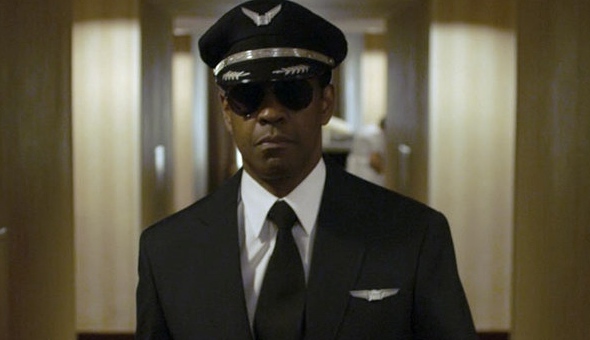
FLIGHT: The Film Babble Blog Review


FLIGHT (Dir. Robert Zemeckis, 2012)

With its disaster movie tension and tone, Robert Zemeckis’ first live action film since 2000’s CAST AWAY (and first R-rated movie since 1980’s USED CARS) comes on at first like it could be a reboot of the ‘70s AIRPORT series. Albeit a more edgy version, as we witness pilot Denzel Washington snort a few lines of cocaine before take-off, and drink vodka while in flight.


Despite the drinking and the drugging, when the airplane’s machinery malfunctions Washington is still able to successfully make an emergency landing, after the stunning maneuver of flying the jet upside down to halt the dive. Washington’s skills saves 96 of the 102 lives (or “souls” as he says it), and he’s initially hailed as a hero, but his hospital toxicology report could get him lifetime imprisonment for manslaughter.

As he’s recuperating, Washington tries to quit drinking and throws out all his liquor and beer. This can’t help but be comical as the supply of booze at his family’s farmhouse in the countryside of Georgia, where he’s hiding from the media, is so huge that he keeps finding more to dispose of.

Washington’s sobriety doesn’t last long; he drops off the wagon right after a morning meeting with Bruce Greenwood as a airline union rep, and Don Cheadle as a Michael Clayton-esque fixer-lawyer who is a little concerned about a certain blood-alcohol-level report. Although Cheadle is confident that he can suppress it, Washington relapses big-time.

Again, the scenes with Washington dealing with his alcoholism can’t help but be comical as we see him guzzle from a big bottle of liquor in the parking lot of a liquor store, and driving around Atlanta with a can of Budweiser in his hand. It seems like Washington spends most of the movie trying to out-drink Nicholas Cage in LEAVING LAS VEGAS.

Washington falls in with Kelly Reilly, who he met at the hospital, as a recovering heroin addict/hooker, but it’s obvious that she’s on a better path to getting her life back together than he is by getting a new job and going to AA meetings. Reilly tries to get Washington to attend a meeting with her, but he walks out half-way through. Our disgraced hero’s behavior gets even worse when he pays a drunken visit to his ex-wife (Garcelle Beauvais) after Reilly leaves him.

While Zemeckis, actually a longtime pilot himself, is a former Steven Spielberg protégé his use of music here has a Martin Scorsese-style specificity. This is most on display in the cameo by the always hilarious John Goodman, who should cameo in every movie, as Washington’s drug dealer who struts through hallways to the Rolling Stones’ “Sympathy For The Devil.” Washington gets Joe Cocker’s “Feelin’ Alright” as his strutting song when all he’s coked-up yet still smooth, and Reilly gets the Cowboy Junkies’ cover of the Velvet Underground’s “Sweet Jane” to serenade her when she shoots up in an early scene. 

I dug how gutsy FLIGHT was for most of its lengthy running time (2 hours and 18 min), and was highly amused by Washington’s cocky manner of talking around people (“Don’t tell me how to lie about drinking, I’ve been lying about drinking my whole life!”), but the film hugely falters in its concluding scenes that contrive to give this appealingly un-redemptive character redemption.

Sorry if this is a Spoiler!, but in the climatic hearing, in which Washington gets questioned by Melissa Leo as an understanding federal inquisitor, I was rooting for the guy to get away with it all, like folks often do in this cruel world. Is that what screenwriter John Gatin (REAL STEEL - that’s right) wanted folks to feel? Like, yeah we know Denzel has substance abuse issues, but, da-ham! Look how good he looks even after a rough night, and he did save the majority of passengers on that doomed flight, so why not let him off the hook?

In the end, the well made FLIGHT enjoys partying with Washington so much, that its punishment of him doesn’t really fly.

More later...

Sunday, August 05, 2007

On-The-Air Amusement And Angst

After seeing the new movie TALK TO ME (reviewed below) I got to thinking about radio personalities in the movies. Sometimes they are disc jockeys, sometimes they have specialty call-in shows, sometimes they are rabble rousers - sometimes all three. Let's take a look at some of the most memorable motor mouths : Barry Champlain (Eric Bogosian) in TALK RADIO (Dir. Oliver Stone, 1988) Champlain is the epitome of all three of the above. His station announcer introduces him as "the man you love to love" and he gets more death threats than phone-ins. Taking place almost completely around a radio console as Barry insults, cajoles, and just plain provokes callers TALK RADIO can best be considered a comic tragedy. It expands on the stage play (recently revived on Broadway) by giving us Barry's back-story showing his rise to be one of the top talk radio personalities in Dallas on the verge of national syndication. His fame though is running face to face with the mounting militia-based hatred of much of his audience. Barry's final break-down resulting in a mesmerizing monologue lays bare a pathetic self destructive unsalvageable soul but the announcer is right - over the years I've come to love to love the man whose signature sign-off line is "Sticks and stones can break your bones but words cause permanent damage." Adrian Cronauer (Robin Williams) in GOOD MORNING, VIETNAM (Dir. Barry Levinson, 1987) Based on the real life experiences of a Armed Forces Radio Saigon disc jockey this role features Williams way before he became so annoyingly over-exposed and before his film formula became so, well, annoying. Dealing with uptight army officials (the late greats Bruno Kirby and J.T. Walsh) and ignoring army playlists and protocol Cronauer learns and grows mostly when he's not on the air but some maturity is shown on the mike before we reach the treacly but still affecting conclusion. David "Dave" Garver (Clint Eastwood) in PLAY MISTY FOR ME (Dir. Eastwood, 1971) Eastwood's directorial debut with him as a soft spoken (I know, of course) disc jockey is really more of a thriller (the mold of which would be later used for FATAL ATTRACTION - 1987) than a radio-related story. Garver's most loyal fan (Jessica Walter) repeatedly makes the request of the title which is all good that is until she becomes a stalking murderous mad woman. Maybe it's because she fell overboard for Garver's smooth soothing tone. Maybe like Dylan, Eastwood should consider doing a XM satellite radio show - that is if he's not afraid of attracting new stalkers. Leon Phelps (Tim Meadows) in THE LADIES MAN (Dir. Reginald Hudlin, 2000) Yeah! Another awful movie made from a running SNL sketch character at least has some radio-tested charm by way of Phelps's smarmy self intro : "I am an expert in the ways of love. I have made love to many fine ladies from the lowliest bus station skank to the classiest most sophisticated, educated, debutant, high society... bus station skank." Phelps is a Chicagoan host of a late night sex advice show who is always accompanied by a glass of Courvoisier and an unjustified arrogant romantic philosophy. He unwisely journeys out of the studio to hunt down an ex-lover. I think that was the plot, I mean really - who cares? Jack Lucas (Jeff Bridges) in THE FISHER KING (Dir. Terry Gilliam, 1991) The role of the "shock jock" gets played here in a role that comes from the same cloth as TALK RADIO's Barry Champlain. The twist here is - what if the guy has a conscience? One of Lucas's random radio comments inadvertently causes a mad man to open fire in a bar and one of the patrons - history professor Parry (Robin Williams again) watches as his wife gets killed. Tossed out of the radio fame game Lucas meets a homeless deranged Parry years later. Lucas decides to help Parry which will in turn be his redemption. Lucas even has a radio catch-phrase that fits in with the movie's premise, the Steve Martinesque "hey, forgive me!" Howard Stern (Howard Stern) in PRIVATE PARTS (Dir. Betty Thomas, 1997) Playing himself in his own biopic (based on his bestselling book) is not surprising considering the size of the ego of the self-proclaimed "king of all media" but come on, who else would or could do it? The best scenes here are the re-creations of Stern's infamous broadcasts and not the rom com trappings surrounding them. Much has changed for the man who popularized the term "shock jock" in the ten years since PRIVATE PARTS was released. Mainly the divorce from the woman that this film was a Valentine to and the gigantic $500 million Sirius Satellite deal that got him off regular radio make the meager goals of this movie seem quaint today. Funny how cute rather than cutting Stern seems when looking at this portrayal today - especially his naive reaction to Don Imus's (played by Luke Reilly - of course Imus wouldn't appear in this film) dismissal of him when they are first introduced. Shirlee Kenyon (Dolly Parton) in STRAIGHT TALK (Dir. Barnet Kellman, 1992) Yep, it has been a sausage party in the booth so far so we gotta to acknowledge Dolly! Sure, it's a silly disposable comedy but it's Dolly! She brings her smirking spunk to play a woman who through a wacky mishap is mistaken for a certified psychologist and becomes a successful radio talk show host. It feels unfair to bash on this innocuous inanity especially when it has Dolly wrapping her Southern lips around such lines as "get down off the cross honey, somebody needs the wood!" Okay! So now on to the current release about a real-life radio semi-legend : TALK TO ME (Dir. Kasi Lemmons, 2007) Ex-con turned outspoken AM Disc Jockey Ralph Waldo Petey Greene is not a household name these days and this movie is probably going to do little to change that. In the age of Stern and Imus the labeling of a broadcaster as a "controversial radio personality" doesn't carry the cache it used to. Greene's (Don Cheadle with a raspy clipped voice) story taking place during the turbulent late 60's in Washington D.C. does have gusto and a strong sentiment but the formulaic biopic approach mars the third act. MLK's death, riots, and demonstrations are given about the same amount of depth as the historical background in DREAM GIRLS. To its credit Cheadle does his thing though in a decisively funkier manner than before, Chiwetel Ejiofor slickly plays the right notes as his producer, Martin Sheen takes a few satisfying solos as the uptight white station manager who is perpetually about to pull the plug on Greene, and Cedric The Entertainer is well, there. Greene's legacy will get a few more fans from this treatment as it is not without heart, it's just that its soul is that of a TV movie. More later...