Monday, February 28, 2022

Based On A True Story, But Not Really


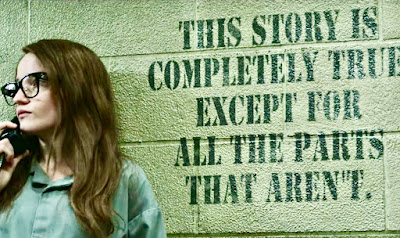
The opening of each episode of the new Netflix show, Inventing Anna, includes a disclaimer: “This whole story is completely true. Except for the parts we made up.” This is repeated throughout the 9-episode run of the show, embedded in the scenery (in newspaper headlines, Times Square mega screens, elevator doors, street signs, etc.) with slight variations like “Totally made up,” and “Total Bullshit.”

We’ve all seen the “Based on a True Story” disclaimer so many times that we might not notice it anymore. Maybe because we knew going in that it was inspired by events that happened, or because we know that with all the dramatized embellishments it probably isn’t very accurate anyway.


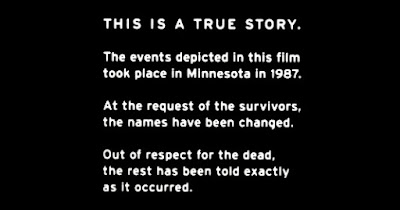
In 1996, Joel and Ethan Coen’s FARGO opened with this:


It was revealed later that the Coens made up material possibly from real accounts of kidnappings, murder, and a woodchipper. Joel told an MTV interviewer that, “If an audience believes that something’s based on a real event, it gives you permission to do things they might otherwise not accept.”

FARGO star William H. Macy told Vox’s Todd VanDerWerff, “I said to Ethan [Coen], You can’t say its a true story if it wasnt.” He said, ‘Why not? It’s just a crawl on the screen.’ I said, Uh...”

FX’s Fargo, the series adaptation, continues using this motif in each episode.


Another example of another dissociation to the “Inspired by true events” disclaimer is the opening of David O. Russell’s 2013 crime comedy AMERICAN HUSTLE:


Many other movies and shows have used these style caveats, so maybe I’ll add to this in time. Maybe you can think up some too.

More later...

Sunday, February 27, 2022

Jerry Garcia’s Only Film Role Was As A Robot In An Andy Kaufman Movie


A long forgotten 1981 Andy Kaufman sci-fi comedy, HEARTBEEPS, has been long forgotten for good reasons. 
Directed by Allan Arkush, who was coming off the success of the 1979 Ramones flick ROCK ‘N’ ROLL HIGH SCHOOL, the film wastes the talents of Kaufman and Bernadette Peters as robots who fall in love in what was then, the near future of 1995. Even with its ripe-for-possibilities premise, it’s a slow, energy-less drag that well earned its 0% rating on Rotten Tomatoes.

It is notable as being weird AF comic/performance artist Kaufman’s last film before his death in 1984, and that he apologized for the movie’s incredibly poor quality on Late Night on David Letterman in early 1982, and offered to give back the money to anyone who saw the film. Letterman’s quick response, “you’d better have change for a twenty,” was singled out by critic Peter Sobczynski as being “perhaps the only genuine laugh to be connected with the strange, sad beast known as HEARTBEEPS.”


However, the cast was somewhat decent. Kaufman and Peters were joined by Mary Woronov, Paul Bartel (both were also in ROCK ‘N’ ROLL HIGH SCHOOL), Randy Quaid, Christopher Guest, Melanie Mayron, B-movie legend Dick Miller, and Jerry Garcia. 


Wait, what? That
s right, the late Jerry Garcia of the Grateful Dead appears in the film – not in human form, but as the voice of a robot named Phil. Phil is a cute lil droid that was built by Kaufman’s character, ValCom 17485, and Peters as AquaCom-89045, to be their traveling companion, I guess. 

Now, Garcia’s speaking voice isn’t really in HEARTBEEPS, as he provides the baby robot Phil’s R2-D2 sounds via his guitar effects. Garcia, who passed away in the year the movie was set, 1995, became involved in the production from his friendship with Director Arkush. They hung out together watching movies at the time, and I would suspect that the idea of the Dead front-man taking part in the film in the guise of a robot was influenced by a little bit of substance intake.


There isn’t much info about Garcia contribution to HEARTBEEPS online (how much info do you need?), but the film hasn’t completely gone away. It’s available for rent streaming on Amazon, and YouTube, as well as in DVD or Blu Ray editions, with Phil prominently featured on the cover with Kaufman and Peters. But I wouldn’t recommend it in any of those forms unless you’re Kaufman, Peters, or Garcia completists. 


Strangely Garcia wasn’t responsible for any music in HEARTBEEPS as it had a score by the bigwig film composer John Williams, who worked on the movie between his iconic soundtracks for RAIDERS OF THE LOST ARK and E.T. It also got an Academy Award nomination for Best Makeup by Stan Winston. 


But it’s Garcia’s scene-stealing blurts run away with the movie. Well, actually I haven’t seen it in a long time, so I can’t confirm that really, but that’s the way I’d like to remember it.


Well, that’s all I got about Garcia’s odd involvement with a movie that’s barely a blip on the radar on the pop culture radar.


Now, you can go about your day.

More later…

Thursday, February 24, 2022

Sci-Fi City Fun With Logan, Buck, & Mork


There are countless times that the same sets, the same costumes, the same soundtrack music, and even the same footage appears in more than one movie. There are also times where it’s not exactly the same material, but it’s so close that it might as well be. Michael Anderson’s 1976 futuristic adventure, LOGAN’S RUN, set the template for many sci-fi cities with what they called “The City of Domes.”


There were examples of architectural speculation in film before - Fritz Lang’s classic METROPOLIS (1927) for one - but Robert De Vestal’s Set Decoration (this was before it was called “Design”) for LOGAN’S RUN influenced such sci-fi flicks as Daniel Haller’s BUCK ROGERS AND THE 25TH CENTURY (1979), and the TV series (1979-1981) that followed. 


That’s New Chicago. There’s just something about those curved buildings, huh? 

LOGAN’S RUN was set in the 23rd Century, while BUCK ROGERS was, of course, set in the 25th. I know they’re not set in the same universe, but the similarity of set decorations is uncanny. Also, BUCK obviously had a bigger budget.


I remember as a kid watching the hit sitcom that made Robin Williams a star, Mork & Mindy, and thinking that the city on Mork’s home planet looked familiar. 


That’s because it was footage of The City of Domes from LOGAN’S RUN. Looking like it’s been run through an orange filter to make it look at least a little different from its original source (or maybe that was the quality of the film they had), these exterior shots lasted only a few seconds so it flew by most people, but I’m so proud that my 10-year old pop-culture nerd eyes caught it!

By the way, Mork’s home city was named Frizbat - in case you need that for some trivia game some day.

From the mid-‘70s to the early ‘80s, futuristic sci-fi cities were largely shiny, clean silver backgrounds. Ridley Scott’s 1982 dystopian future-set BLADE RUNNER greatly influenced the direction of many set designs since, but those stylish, advanced cities still exist in movies and TV shows. Like this one from the 2015 Brad Bird/George Clooney flop TOMORROWLAND:


Addition: After posting this, I found another use of the LOGAN'S RUN city design in AIRPLANE II: THE SEQUEL (1982), which is set slightly in the future (the opening crawl says “In the near future...”). Ken Fickleman’s follow-up was a retread of the original AIRPLANE! with the only difference being that it concerns a space shuttle situation instead of a jetliner disaster scenario. That means they could stuff in a bunch of sci-fi spoofery like jabs at 2001, Star Trek (William Shatner was even in it), STAR WARS, and E.T. In one scene a futuristic cityscape can be seen out of a window at the Transcendental Air desk in the airport:
 

Yes, the set decoration from LOGAN'S RUN strikes again!

There are so many examples of similar sci-fi cities to choose from, so feel free to speak up in the comments section below. It’s been so long since I’ve had a comment that wasn’t an ad, so I’d really appreciate it. Anything to shut those crickets up.


More later...